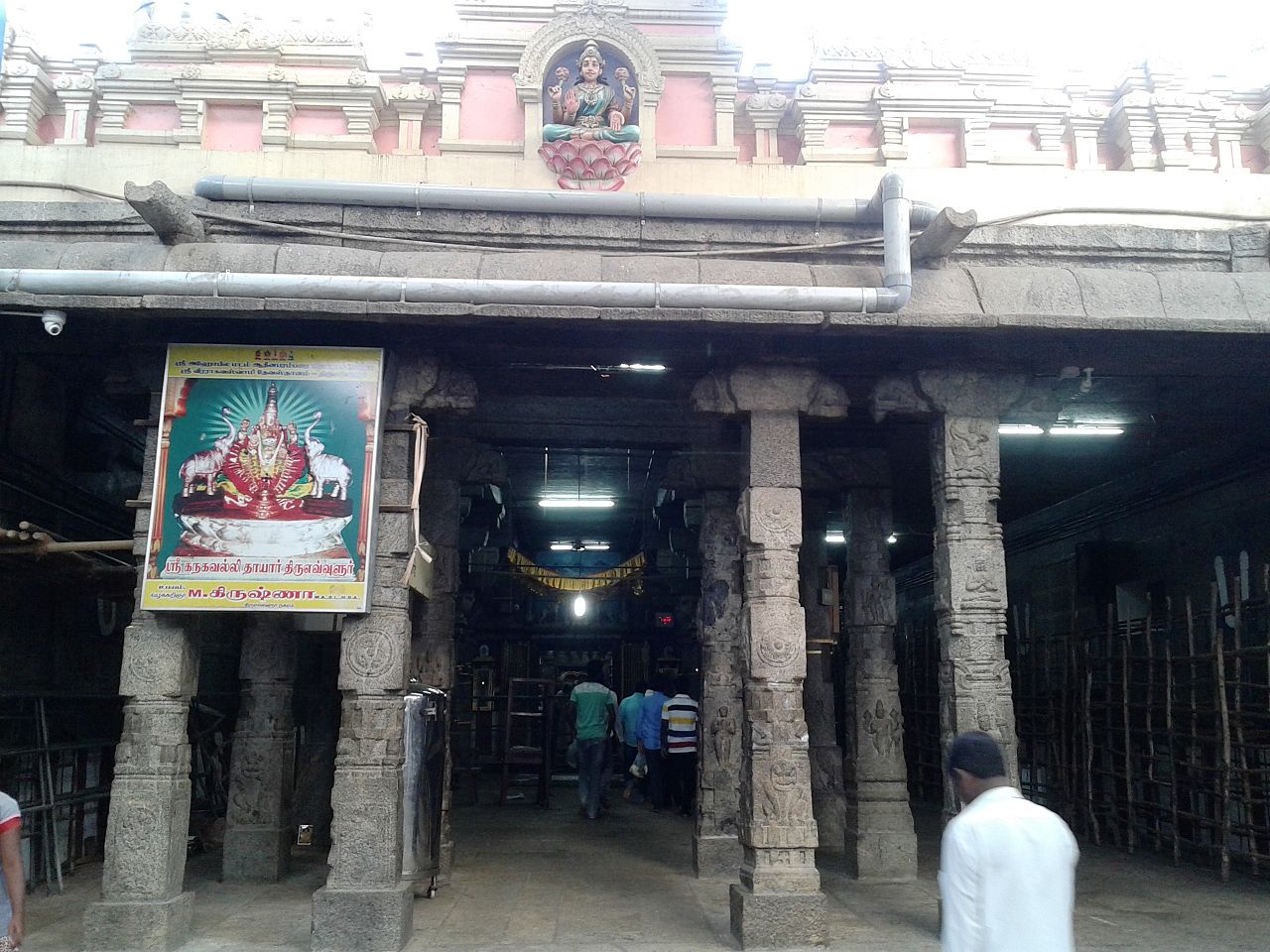
About an hour north-west of Chennai, past the flat paddy country and the sudden bustle of a district-headquarters town, the streets of Thiruvallur funnel towards a towering gopuram. This is the Veeraraghava Swamy Temple, one of the 108 Divya Desams — the sacred shrines of Vishnu sung by the Tamil Alvar poet-saints. But pilgrims come here for something more intimate than a place on a holy list. They come, in a tradition centuries old, to be made well. The Lord who reclines in the sanctum is worshipped as Vaidya Veeraraghava, the divine physician, and the town has long carried the tender old name Tiru Evvul — the place of “everyone”, where anyone may find refuge.
- Where: Thiruvallur town, roughly 45 km north-west of Chennai, in Tiruvallur district, Tamil Nadu.
- What: A Divya Desam dedicated to Vishnu as Vaidya Veeraraghava, the reclining “divine physician”.
- Don’t miss: The Hrit Theertham temple tank opposite the shrine, and the vast Chittirai Brahmotsavam if your visit falls in April–May.
- Getting there: Frequent suburban trains and buses run from Chennai; the temple is a short walk from Thiruvallur station.
The sage, the disguised traveller, and a Lord who stayed
The temple’s beloved origin story, drawn from Puranic tradition, begins with a hermit named Salihotra. He is said to have lived a life of severe simplicity in the forest that once covered this land, grinding a little rice each day, offering half to any guest and eating the rest. One day, so the legend goes, a weary old traveller appeared at his door begging for food. Salihotra gave him everything he had and, with nothing left, offered his own humble hut for the night. Moved by this selflessness, the traveller revealed himself as Vishnu — and, the tradition holds, chose not to leave. He reclined right there, in Salihotra’s hermitage, and remains reclining to this day. It is a story that turns a grand cosmic deity into something startlingly close: a guest who came for a meal and decided to stay forever.
In the sanctum, Vishnu lies upon the coils of the serpent Adisesha in a posture unlike the more familiar sleeping Ranganatha. His head is raised, alert, turned towards the little figure of the sage. Tradition describes one hand resting near Salihotra — held, devotees like to say, close to the sage’s ear, as though the Lord were leaning in to whisper reassurance that all would be well. Whether one reads that as sculpture or as tender belief, it sets the emotional key of the whole temple: this is a deity who listens up close.

The divine physician
It is that healing role that draws the crowds. By long tradition, Vaidya Veeraraghava is believed to cure illness of body and mind, and the practice devotees follow is remarkably direct. Many bring small thin plaques of metal, each embossed with the image of a particular part of the body — an eye, a leg, a pair of lungs — and offer them at the shrine with a prayer that the Lord will mend the ailing organ. It is an act of faith rather than medicine, of course, but for centuries it has given anxious pilgrims a way to place a specific worry into divine hands. The very name of the town, Tiru Evvul, and the emphasis on refuge reinforce the idea that no one arrives here too broken to be received.
The Hrit Theertham and the great Brahmotsavam
Facing the temple lies its sacred tank, the Hrit Theertham — also remembered by the evocative name Hrith-Thapa-Nasini, said to mean “the destroyer of the heart’s distress and the body’s heat”. Devotees regard its water as holy and, by tradition, healing, and a bathe here is woven into the pilgrimage. Broad steps drop to the water, and at festival time the tank becomes a stage in its own right, when the processional bronze of the deity is floated across it during the Theppam, or float festival. The temple keeps a full ritual calendar — Vaikunta Ekadasi in December–January among the most thronged — but its grandest event is the Chittirai Brahmotsavam around April–May, a multi-day festival when the utsava murti is carried through the streets on a succession of vahanas and the whole town turns out behind the drums and the great temple car.
The Thiruvallur country
Thiruvallur rewards travellers who linger, because the district around it is unusually rich in old and powerful shrines. A short drive back towards Chennai brings you to Thiruverkadu and the Karumariamman Temple, one of Tamil Nadu’s great centres of Shakti worship. Karumariamman is revered as a fierce yet compassionate mother-goddess; temple lore tells that she appeared as a ball of fire to bless sages meditating in the ancient forest of Verkadu, and her eternally burning Padi Vilakku, or stair lamp, draws a ceaseless stream of the faithful.
Elsewhere in the district, at Tiruvalangadu, stands the Vadaranyeswarar Temple, famed as the Ratna Sabha, the Hall of Gems, one of the five sacred dance-halls of Shiva. Its most celebrated legend is a dance contest: the goddess Kali, tradition says, challenged Shiva for dominion over the forest, and the two matched step for step through countless movements — until Shiva performed the Urdhva Tandava, lifting one leg high towards his ear, a posture no dancer could decently repeat. Kali conceded, and the temple has honoured that raised-leg cosmic dance ever since. Between a Lord who cures the sick, a mother born of fire and a god who dances to win a forest, the Thiruvallur country packs an extraordinary amount of story into a small map.
Visiting
Thiruvallur is one of the easiest Divya Desams to reach from Chennai — suburban trains run to Thiruvallur station through the day, and the temple is a short walk away. Go early to beat both the heat and the queues, dress modestly as at any working shrine, and allow time to walk the tank as well as the sanctum. It pairs naturally with Thiruverkadu and Tiruvalangadu for a full day of temple-hopping. For where it sits among the other 107 sacred shrines, and for building it into a wider loop out of the city, see our companion guides: /india/tamil-nadu/guides/divya-desams-of-tamil-nadu and /india/tamil-nadu/guides/day-trips-from-chennai .
Frequently asked questions
Why is the Veeraraghava temple called a place of healing?
By long tradition the reclining Vishnu here is worshipped as Vaidya Veeraraghava, the divine physician, believed to cure illness. Devotees commonly offer small metal plaques embossed with the affected part of the body as a prayer for its healing. This is a matter of faith and custom rather than medical treatment.
Is the temple really a Divya Desam?
Yes. It is one of the 108 Divya Desams — the shrines of Vishnu praised by the Tamil Alvar saints — and is counted among the Tondai Nadu group. The town also carries the old name Tiru Evvul.
What is the story of sage Salihotra?
According to Puranic tradition, Vishnu came disguised as a hungry old traveller to the hermit Salihotra, who gave away all his food and offered his own hut. Pleased by this selflessness, the Lord revealed himself and chose to remain reclining at the spot, where he is worshipped today.
What is the Hrit Theertham?
It is the temple’s sacred tank, facing the shrine, also known as Hrith-Thapa-Nasini. Its water is regarded as holy and healing, and the deity is floated across it during the temple’s float festival.
When is the biggest festival?
The grandest is the Chittirai Brahmotsavam around April–May, a multi-day procession festival. Vaikunta Ekadasi in December–January is also heavily attended.
What else is worth seeing nearby?
The fierce mother-goddess Karumariamman at Thiruverkadu, and the Vadaranyeswarar temple at Tiruvalangadu, famed for the legend of Shiva’s raised-leg Urdhva Tandava dance contest with Kali. Both make an easy add-on to a Thiruvallur day trip.