
Before dawn, in the foothills west of Coimbatore, pilgrims tighten their cloth bundles, leave their sandals behind and turn to face a wall of green hills swallowed in mist. Ahead lies one of South India’s most demanding sacred treks: a barefoot climb over seven ridges of the Western Ghats to a self-formed shrine of Shiva that devotees hold on a par with Mount Kailash itself. The Velliangiri Mountains — Thenkailayam, the “Kailash of the South” — do not give up their summit easily, and that is precisely the point.
- Where: Velliangiri foothills, roughly 40 km west of Coimbatore, Tamil Nadu
- What: a strenuous barefoot pilgrim trek over seven hills to the Velliangiri Andavar (Swayambhu Shiva) shrine
- Trek: around 6–7 km of steep climbing one way — a full, hard day out and back
- Season: open only part of the year (roughly Maha Shivratri to the onset of the monsoon); shut in the rains
- Access: this is reserve forest — register and check current forest-department rules before you set out
The seven-hill barefoot climb
The mountains are known in Tamil as the Sapthagiri, the seven hills, and the trek earns every one of them. From the trailhead the path rises through boulder fields, tree roots and slick rock, gaining well over a kilometre in height across ridges that range from around 500 metres to more than 1,800 metres at the top. Pilgrims traditionally climb barefoot, and most reckon on a long, punishing day — a pre-dawn start, a grinding ascent of roughly 6–7 km with a false “summit” at nearly every hill, and a knee-jarring descent before dark. There is little shade on the exposed stretches and water is scarce, so this is not a casual day walk; a reasonable level of fitness, sturdy soles and an early start are genuinely non-negotiable. The reward, near the top of the seventh hill, is the Velliangiri Andavar temple, where Shiva is worshipped as Swayambhu — self-manifested — amid drifting cloud and cold mountain wind.
The Kailash of the South, by tradition
The identity of Velliangiri as a southern Kailash is a matter of living belief rather than geography. By tradition, this is a place where Shiva is present exactly as he is at Mount Kailash, the legendary Himalayan abode; older Tamil temple lore, including the Perur Purana, tells of sages worshipping him here and of his grace being shown on these very slopes. The sage Agastya, the great figure of the southern spiritual tradition, is also woven into the mountain’s story. Whether one takes the tales literally or as metaphor, the effect on the ground is the same: pilgrims climb in silence and reverence, treating the whole ascent as an act of devotion, and speak of the shrine near the summit as one of the most charged places they have stood.
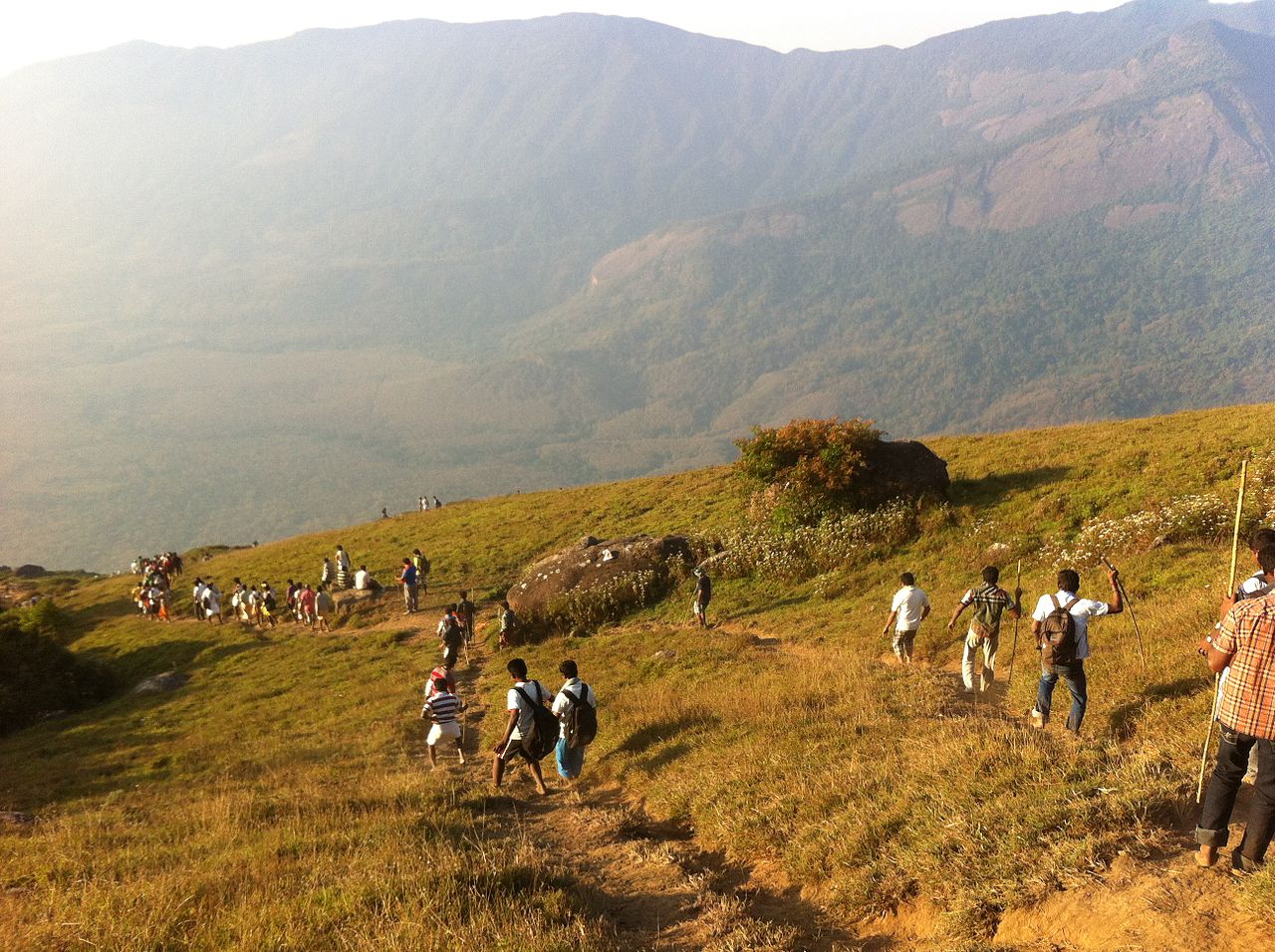
Forest, falls and the foothills
Velliangiri sits within the Nilgiri Biosphere Reserve, and the trail threads through wildlife-rich country in the Anamalai foothills — dry deciduous woodland lower down giving way to evergreen and misty shola forest on the upper hills, home to elephants, gaur, deer and a rich birdlife. That same watershed feeds the region’s water: streams off these hills drain into the Siruvani reservoir, which supplies drinking water to Coimbatore, and the nearby Siruvani waterfalls and dam draw day-trippers to bathe below the cascades. Siruvani water is famous across the region for its sweet taste — often claimed to be among the finest anywhere — and a chilled bottle of it is a small pilgrimage of its own. At the very foot of the mountains lies the Isha Yoga Center, whose towering Adiyogi statue and consecrated Dhyanalinga shrine make the base of the trek a destination in itself, even for those who never climb a step.
When to go, and going lightly
Timing matters more here than almost anywhere else. The full seven-hill trek is open for only part of the year — broadly from around Maha Shivratri in February or March until the monsoon closes in by June or July — and the hills are shut during the rains, when the rock turns lethal and the forest is off-limits. Because this is protected reserve forest, access is regulated: check the current forest-department position and any registration requirements before you travel, rather than assuming the path is open. Go early, carry your own water and something to eat, tell someone your plans, and be honest with yourself about the climb. Plenty of visitors do only the first hill or simply spend time at the foothills, and there is no shame in that; the mountain is unforgiving of overconfidence.
Visiting
The foothills are about an hour’s drive west of Coimbatore, an easy and well-connected city that makes the natural base — buses and taxis run out towards the Isha Yoga Center and the trailhead. Many visitors pair a foothills day (Adiyogi, the Dhyanalinga and a trip to the Siruvani falls) with an early start for the trek on a separate day, when they are rested and the weather is settled. Sort out your food, water and timing the night before, and treat both the forest and the shrine with the respect the pilgrims do. Plan the rest of your trip with the /india/tamil-nadu/guides/coimbatore-city-guide and, if the hills have hooked you, the /india/tamil-nadu/guides/tamil-nadu-hill-stations .
Frequently asked questions
How hard is the Velliangiri trek?
Very hard. It is a steep barefoot climb of roughly 6–7 km one way over seven hills, with a big height gain, little shade and scarce water. Expect a long, demanding day and a reasonable level of fitness; it is not a casual walk.
Why is it called the Kailash of the South?
By tradition, Velliangiri (Thenkailayam) is held to be a place where Shiva is present as he is at Mount Kailash in the Himalayas, and he is worshipped near the summit as Swayambhu, the self-manifested one. It is a matter of belief rather than geography.
Is the trek open all year?
No. The full seven-hill trek is open only for part of the year — roughly from Maha Shivratri (February/March) until the monsoon arrives around June or July — and is closed during the rains. Always check current forest-department rules before going.
Do I need permission to climb?
The hills lie within reserve forest, so access is regulated. Check the latest forest-department position and any registration requirements before you travel rather than assuming the path is open.
What is there to see at the foothills?
The Isha Yoga Center sits at the base, with its huge Adiyogi statue and the consecrated Dhyanalinga shrine. The Siruvani waterfalls and dam are nearby, and Siruvani water is famed across the region for its taste.
How do I get there?
The foothills are about 40 km (roughly an hour) west of Coimbatore, which is the practical base. Buses and taxis run out towards the Isha Yoga Center and the trailhead.