What to expect
Highlights
- The single well-preserved Hoysala tower (shikhara).
- The carved friezes, ceilings and lathe-turned pillars.
- A peaceful, rarely visited Hoysala temple.
The Amrutesvara Temple at Amruthapura, in Tarikere taluk, is a Hoysala temple of 1196 CE built during the reign of Veera Ballala II, dedicated to Amrutesvara, a form of Shiva.

Check entry arrangements. Ask temple staff about visitor entry, dress requirements and access to the inner shrine before you travel, especially if you are visiting as a non-Hindu.
Dress respectfully and follow the institution’s admission and photography rules.
On the classic Hoysala star-shaped plan, it has a well-preserved tower, a long hall with lathe-turned pillars and finely carved friezes and ceilings — a quiet, uncrowded relative of the famous Belur and Halebidu temples.
A Hoysala temple of 1196 CE that almost nobody stops at, in a village of a few hundred people nine kilometres off the Bengaluru–Honnavar road. Around its parapet run about a hundred and forty carved panels of the Ramayana, the Mahabharata and the life of Krishna, and the ceilings inside were the first work of the greatest sculptor the dynasty produced.
Amruthapura is not on the way to anything. It sits in Tarikere taluk in the north of Chikkamagaluru district, on flat farmed country between the Bhadra reservoir and the road to Shivamogga, and the village is small enough that the temple is plainly the largest thing in it. There is no ticket office, no queue and, most days, nobody else there. That is the first thing to understand about it: this is a great Hoysala building with the visitor numbers of a parish church.
The building itself is what the specialists call an ekakuta — a single shrine with a single tower — and it is the plainest of the Hoysala plans. Sanctum, vestibule, closed hall of nine bays, open hall of twenty-nine. The open hall is the part people remember. It stands on a raised platform with a low parapet wall around it, seat-backed so that you can sit in the shade and look out, and the roof above is carried on rows of black stone pillars turned on a lathe to a polish that still throws light after eight centuries. Nobody has satisfactorily explained how they were turned.
Then there is the parapet. The outer face of that low wall around the open hall carries the narrative sculpture, and this is where Amruthapura departs from its famous cousins. At Belur and Halebidu the story panels are small and the carving is miniature; here they are comparatively large, so you can actually read them standing up. The south wall carries the Ramayana — seventy panels by the count Gerard Foekema used and Wikipedia follows, about seventy-five by others — and it runs anti-clockwise, which is not how Hoysala friezes are supposed to run. The north wall behaves itself: twenty-five panels on the life of Krishna and forty-five from the Mahabharata, all clockwise. Above them, along the same parapet, are more than a hundred miniature temple towers carved in relief, large and small alternating.
The tower over the sanctum is seven storeys of indented squares, ringed row on row with kirtimukhas — the grinning demon faces that Hoysala masons used the way a bookbinder uses tooling — and on the smaller tower over the vestibule, the sukanasi, sits the dynastic emblem: Sala, the legendary founder, driving a weapon into a beast. Every Hoysala temple carries it. Few carry it this legibly.
Near the porch stands a tall slab of stone covered in Old Kannada. It is the foundation inscription, and it records that on a day in 1196 Amritesvara-dandanayaka — a general in the army of the Hoysala king Veera Ballala II — set up the god Amritesvara with royal sanction. What lifts it out of the ordinary run of foundation records is who wrote it: the verses were composed by Janna, the Jain poet of Ballala II's court who carried the title Kavichakravarti, emperor among poets, and whose Yashodhara Charite is still read as one of the monuments of Kannada literature. It is unusual to be able to stand in front of a stone and know that a major poet wrote what is on it.
And the ceilings. The domed ceilings of the main hall are signed work, and among the sculptors who put their names to this temple is Ruvari Mallitamma, the most celebrated of all Hoysala artists, whose recorded career ran something like seventy-three years and whose signature turns up on temples across the old kingdom. Amruthapura is where he began. The domes over the open hall are his apprentice work, which is a strange and rather moving thing to look up at.
The temple did not stop when the dynasty did. It is a working Shaiva temple, not a monument with a turnstile, and a lamp inside it has reportedly been kept burning for two centuries, taking close to a litre of oil a day. The Archaeological Survey of India protects the fabric; the village keeps the ritual. Both facts matter when you visit — you take your shoes off well before the steps, and you fit yourself around whatever is happening rather than the other way round.
The legend on this building is the founding legend of the dynasty that built it, and you can see it from the courtyard. On the sukanasi — the smaller tower over the vestibule, which sticks out from the main tower like a nose — is the Hoysala emblem: a young man striking down a beast.
Kannada folklore tells it like this. A youth named Sala, or Poysala, was with his Jain guru Sudatta in the forest at Sosevur when a beast came at them. The guru called out "hoy, Sala!" — strike, Sala — and he struck, and from that shout the dynasty took its name, hoy being "strike" in Old Kannada. Sosevur is Angadi village, in this same district of Chikkamagaluru, and it was the Hoysalas' first capital. The legend is local to the ground the family came from.
Whether the beast is a tiger or a lion depends on who is telling it, and the difference is not decorative. The tiger was the emblem of the Chola dynasty, and the Hoysala king Vishnuvardhana beat the Cholas at Talakadu in 1116. Historians including Suryanath Kamath have suggested the legend may have arisen — or at least become popular — after that victory, precisely because a Hoysala killing a tiger reads as a Hoysala killing a Chola. The earliest surviving telling is in Vishnuvardhana's Belur inscription of about 1117, a hundred and sixty years after the family first appears in the record.
That is the honest position: it is folklore, and historians treat it as folklore, because the story does not fit the inscriptions cleanly. The Hoysalas' own records call their founders Maleparolganda, "lord of the hills", which points at the Malenadu highlands rather than at a boy and a tiger. But it is the story the dynasty chose to put on the front of every temple it built, this one included, for two hundred years — which makes it true in the only sense that matters when you are standing in front of it.
The temple's own name has a plainer origin than the village legends suggest. Amritesvara is "lord of amrita", the nectar of immortality, and the god was set up by a man called Amritesvara-dandanayaka. The general named the deity after himself, or himself after the deity, and the village of Amruthapura took its name from the temple. Travel pages that trace the linga to the Gandaki river in Nepal are repeating a tradition that belongs to saligrama stones, which are Vishnu's, and we have not found a source for it worth printing.
1196 CE — the temple is founded. The Old Kannada inscription near the porch records that Amritesvara-dandanayaka, a commander in the army of the Hoysala king Veera Ballala II, set up the god Amritesvara with royal sanction. The verses on the slab were composed by the court poet Janna, honoured as Kavichakravarti. The date sits at the top of Ballala II's reign: he had beaten the Yadava king Bhillama V at Soratur and Lakkundi in about 1191, crowned himself emperor over most of modern Karnataka by 1192, and a record of 1196 itself claims him victorious over the ruling families of Banavasi, Hangal, Halashi, Nolambavadi, Bagalkot and Yelburgi.
The same reign built the Kedareshwara temple at Halebidu, the Veera Narayana temple at Belavadi and the twin Chennakeshava and Nageshvara temples at Mosale. Amruthapura belongs to that group and is generally the least visited of them.
c. 1196 onward — Ruvari Mallitamma begins his career here, working on the domed ceilings of the main hall. He became the best-known sculptor of the Hoysala period, with an artistic career reported at some seventy-three years and signed work on temples across the kingdom. Several other sculptors also signed their work on this building.
1206 CE — an inscription records officials making a grant free of all imposts for the maintenance of the temple.
1210 CE — an inscription records the establishment at Amruthapura of a Brahmapuri of twenty-four Brahmin families, endowed with land, to run the temple and the settlement around it. The village as it exists is in that sense a creation of the temple rather than the other way round.
After 1212 Ballala II lost the territories north of the Tungabhadra to the Yadava king Singhana II, and the Hoysala state declined through the fourteenth century. The temple survived, in a village too small and too far off the road to be worth sacking.
The building is today a protected monument under the Archaeological Survey of India, Bengaluru Circle, and at the same time a living temple with daily worship. A lamp inside it is reported to have been kept burning for about two hundred years, consuming close to a litre of oil a day.
⚠ Two figures in circulation are contested and we print both. The Ramayana frieze on the south wall is given as seventy panels by Gerard Foekema, whose 1996 Complete Guide to Hoysala Temples is the standard reference and which Wikipedia follows, and as about seventy-five by other published accounts. The road distance to Chikkamagaluru is published as 67 km on the strength of Wikipedia and repeated everywhere; routed on real roads on 25 August 2026 it is 71.9 km. Neither pair is worth being dogmatic about, and both are here so nobody is caught out.
Because you will very probably have it to yourself. Belur is 101 km away and Halebidu 85 km, and both are properly busy; this is the same dynasty, the same century and the same hands, with nobody in the courtyard. If you have ever wanted to look at Hoysala carving without a crowd behind you, this is the building.
Because you can actually read the story panels. The narrative sculpture here is comparatively large rather than miniature, which means the Ramayana on the south wall and the Krishna and Mahabharata scenes on the north are legible standing up, at walking pace, without a guide pointing at things with a torch.
For the two names on it. Janna wrote the inscription and Mallitamma cut the ceilings — the outstanding Kannada poet of the court and the outstanding sculptor of the dynasty, both traceable to this one small building, one at the start of his career and one at the height of his.
For the parapet and the pillars. The seat-backed parapet wall lets you sit down in the shade and look out at the fields, which is not something the great pilgrimage temples allow, and the lathe-turned black pillars in the hall still hold a polish nobody has been able to explain.
And because it is easy. Nine kilometres from Tarikere town, fifteen minutes off the highway, thirty to forty-five minutes to see properly, free to enter. Add it to a drive between Shivamogga and Chikkamagaluru or to a day coming down from Kemmanagundi and it costs you almost nothing.
Road km to Chikkamagaluru; ghat roads and traffic vary — allow extra.
October to February; morning light for the carvings.
Live forecast loads in your browser.
Sun and moon are calculated for this location and shown in IST. Photography windows are the hour around sunrise and sunset; the sunset bearing is degrees clockwise from true north. Moon phase is accurate to about half a day.
Verified hotels, homestays, restaurants, experiences, sights, shops and rentals around Amrutesvara Temple, Amruthapura — commission-free, with direct contact. Filter by what you need.
The restaurant attached to the government hill resort, and effectively the only regular kitchen at the top of Kemmanagundi — everything else on the hill is a tea stall. Jungle Lodges has run it along with the guest houses since March 2021, and meals are built into the resort packages. If you are not staying, ring ahead or ask at the reception rather than assuming you can walk in, and if you are heading out to Hebbe Falls or Z Point for the day, carry water and something to eat, because there is nothing at either end.
Book with the place itself. India’s cyber-crime coordination centre warned in April 2025 that convincing copies of hotel and pilgrimage booking sites are being pushed through sponsored search and social ads, taking payment for rooms the property never hears about. Every listing here links to the business’s own contact details and its own Google or Bing profile — we take no commission and sit in nobody’s payment path. If a booking page reached you through an ad, check the address bar against the property’s own site before you pay. Fraud can be reported on cybercrime.gov.in or on 1930.
Find food, accommodation and activities across Kemmanagundi. Browse the guides for places to eat, stay and explore along your route.
One more place around Kemmanagundi worth a day of its own.
35.7 km · 42 min drive
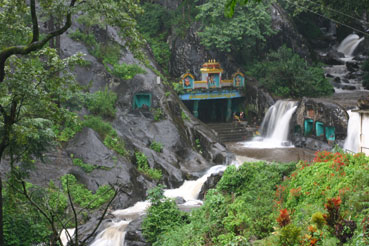
A 45-metre cascade beside the living Kalhatti Veerabhadreshwara Temple on the road below Kemmanagundi. Karnataka Tourism places it 10 km from the hill station; wet rock becomes hazardous during strong flow.
Roampedia is commission-free — own or know a stay, eatery, guide or shop near Amrutesvara Temple, Amruthapura? List it and it appears here once verified.
Add a nearby businessEntry: Free. There is no ticket, no counter and nobody at the gate to sell you one. This is an Archaeological Survey of India protected monument that is also a working village temple, and neither role comes with an admission charge — unlike Belur, Halebidu and Somanathapura, which are ticketed ASI sites. If a puja is being performed you may be offered prasada and there may be a hundi; anything you put in it is a matter for you. Nobody should be asking you for money to go in, and if somebody does, they are freelancing.
Dress code: Ordinary south Indian temple manners, and nothing stricter — this is not Sringeri, where traditional attire is mandatory and enforced at the door. Cover shoulders and knees, and dress as you would to walk into a village shrine where people are praying. Footwear comes off well before the steps and stays off across the platform, so slip-ons are worth having; the stone gets hot from about eleven in the morning between March and May and there is no shade on the open platform, which is one more argument for going early. Leather is best left in the car. If you arrive during a puja, stand back and wait rather than walking through it.
Festivals: Mahashivaratri, in February or March, is the day this temple fills — it is a Shiva temple and that is its festival. Beyond it the calendar is the ordinary one of a village shrine: Shravana Mondays through the monsoon, Kartika lamps, and the local car festival if the village holds one that year. We print no dates, because every one of them moves with the lunar calendar and a wrong date sends somebody on a wasted drive. If you want the building rather than the ritual, any ordinary weekday morning between October and February is better than a festival; if you want the village alive, Mahashivaratri is the day, and you should expect the quiet that is this place's main attraction to be entirely absent.
Photography: Photograph the outside freely; ask before you photograph inside. The parapet friezes, the seven-storey tower, the kirtimukha rows, the Sala emblem on the sukanasi and the lathe-turned pillars in the open hall are all fair game and all of them are dramatically better in the first two hours of light — the relief is shallow and needs a low sun to read. Inside the sanctum is a different matter: this is a living temple, worship happens, and the courteous thing is to ask whoever is there rather than to assume that ASI protection makes it a museum. Wikimedia Commons holds a large free-licensed set of this temple, including the domed ceilings and the 1196 inscription, which is a fair indication that photography is generally tolerated here — but it is tolerance, not a right. No drones over a protected monument.
Parking: Free, unattended, and there is no marked car park — you leave the vehicle on the road by the compound gate, which works because on most days yours will be the only one. The compound itself is a maintained ASI enclosure with a mown lawn and a flagged path up to the hall, not an open village yard, so nothing is driven inside. Nobody is watching the car: take your valuables with you, as at any unattended stop. Tarikere town, 9 km back, is where the fuel, the ATMs and the tyre shops are, and it is worth filling up there rather than assuming a village of this size has a pump. If you are driving on to Kemmanagundi afterwards, do that in Tarikere too — it is 37.7 km of climbing road and there is nothing useful on it.
There is nothing to get around — the temple is one compound and you walk it. The question is really how you move between Tarikere and Amruthapura, and the answer is an auto-rickshaw or your own vehicle. Autos wait at the Tarikere bus stand and by the railway station; settle the fare before you start, and settle the waiting time as well, because the temple has no taxi rank and no passing trade to flag down. We quote no rupee figure: Karnataka's auto tariff is not ours to publish and a stale fare is worse than none. For a day taking in Amruthapura, the Bhadra reservoir and Kemmanagundi, a car with a driver hired in Tarikere, Bhadravathi or Shivamogga is the sane arrangement. Draw cash in Tarikere before you come out; the village has no ATM.
Online taxis: Do not plan around an app cab. Tarikere is a town of about 36,000 in the north of Chikkamagaluru district and neither Uber nor Ola has a working presence in it; a booking may connect in Shivamogga, Bhadravathi or Bengaluru for the journey in, but there is nothing to hail out of Amruthapura and no drivers idling for a return trip, so an app that worked at one end will strand you at the other. Three arrangements actually work: an auto from the Tarikere stand hired for the round trip with waiting time agreed, a car and driver taken for the day from Shivamogga or Chikkamagaluru, or your own vehicle. The train to Tarikere plus an auto is the best public-transport answer to this temple and it is a good one.
If you are travelling by bus or ferry, check the return service with the operator before setting out. Leave time to reach the stop or jetty after your visit.
Ask at the bus stand for the time of the last service back, not the next one. If you miss it, an auto or app cab is the fallback — agree the fare before you get in.
If you need step-free access, contact the site before travelling. Ask about a level entrance, steps along the route, the nearest drop-off point, seating and accessible toilets.
Emergency numbers are verified against official government and state tourism sources. 112 works anywhere in India.
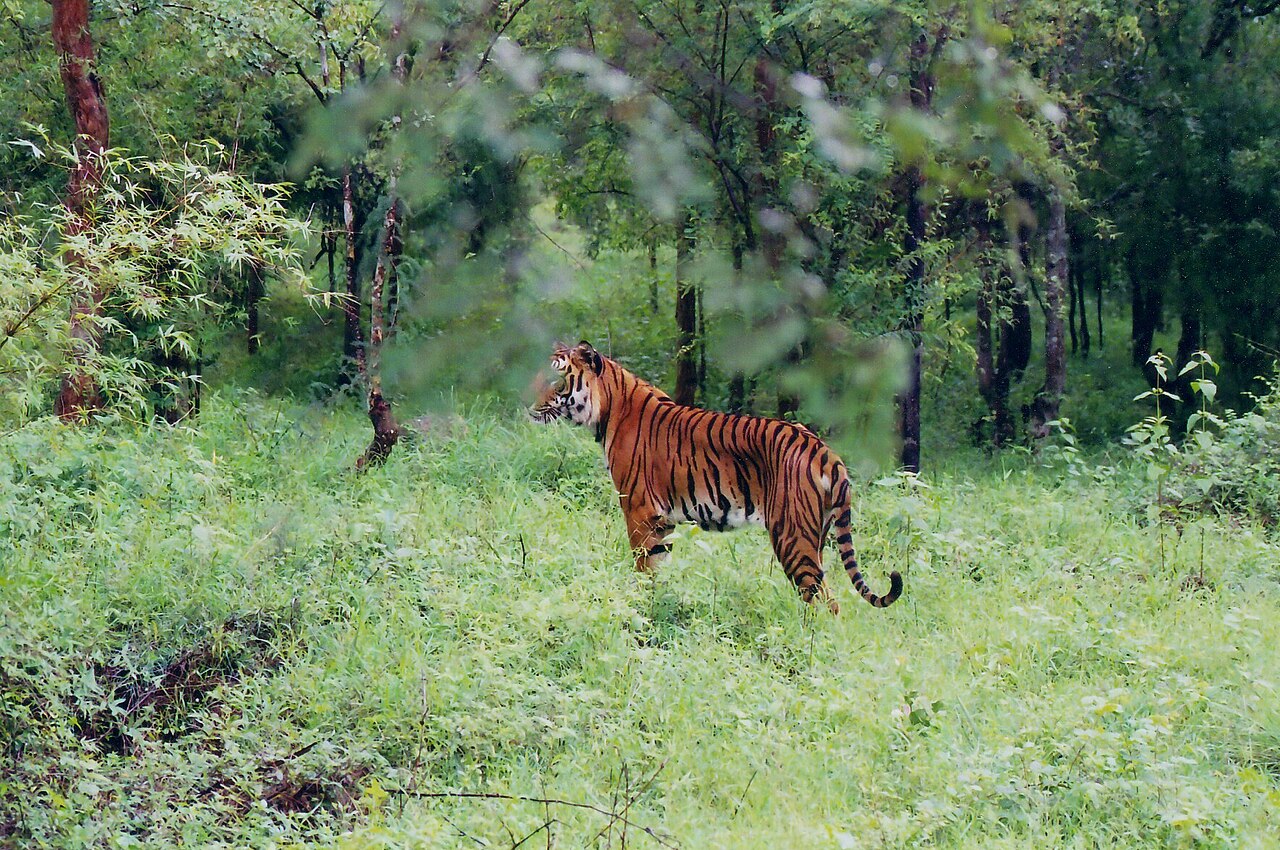
A tiger reserve on the Bhadra river around Muthodi, its dry and moist deciduous forest sheltering tigers, elephants, gaur, sambar and rich birdlife; jeep safaris run from the Muthodi range.
31.5 km · ~52 min by cab · straight lineA 45-metre cascade beside the living Kalhatti Veerabhadreshwara Temple on the road below Kemmanagundi. Karnataka Tourism places it 10 km from the hill station; wet rock becomes hazardous during strong flow.
35.7 km · 42 min drive
One of the largest lakes in Karnataka, a centuries-old tank below the Baba Budan hills near Sakharayapatna, ringed by farmland and hills — a quiet birding and sunset spot.
53.4 km · 49 min drive
A sacred mountain range north of Chikkamagaluru named after the Sufi saint Baba Budan, credited with first bringing coffee to India; its cave shrine (the Dattatreya Peetha) is revered by Hindus and Muslims alike, and the ridge has grassy trails and viewpoints.
67.7 km · 89 min drive
A thin, sacred cascade on the Baba Budangiri slopes where pilgrims stand in the spray, believed to have healing powers; reached by a short walk down steps from the road near the Dattatreya shrine.
68.1 km · 89 min drive
A calm irrigation lake ringed by coffee hills a few kilometres from Chikkamagaluru town, a popular spot for sunset views over the water with the Baba Budan range behind.
77.8 km · 67 min drive
At about 1,930 m the highest peak in Karnataka, a grassy summit of the Baba Budan range near Chikkamagaluru topped by a small Shiva shrine (Mullappa Swamy); a motorable road climbs to a saddle, from where a short stepped path leads to the top and sweeping Western Ghats views.
90.4 km · 87 min driveWalking and driving times are real routed distances, except the few marked “straight line”, which are direct-line estimates and will read short.Routing: © openrouteservice.org by HeiGIT | Map data © OpenStreetMap contributors
At Amruthapura village in Tarikere taluk, Chikkamagaluru district. Routed on real roads on 25 August 2026 it is 9.0 km from Tarikere town, 9.1 km from Tarikere Junction railway station, 25.2 km from Birur Junction, 47.6 km from Shivamogga, 71.9 km from Chikkamagaluru town and 37.7 km from Kemmanagundi. Wikipedia's published figures — 67 km from Chikmagalur, 50 km from Shimoga and 110 km from Hassan — are close enough to ours to be a good sign; where they differ it is route choice.
It was founded in 1196 CE by Amritesvara-dandanayaka, a commander in the army of the Hoysala king Veera Ballala II, with royal sanction. The foundation inscription near the porch records it, and the verses on that slab were composed by Janna, Ballala II's court poet, who held the title Kavichakravarti — emperor among poets.
Entry is free. It is an Archaeological Survey of India protected monument that is also a living temple, so there is no ticket and no counter. Daylight hours in practice, with the usual south Indian pattern of a midday break in worship; do not plan around a printed opening time, because there is not a reliable one. Morning is both the likeliest time to find it open and the best light for the carving.
It is a much simpler building — one shrine and one tower, where Halebidu has two — and it is not as densely carved as either. What it has instead is scale in the narrative panels, which are larger and easier to read than the miniature friezes at the famous sites, and near-total quiet. Think of it as the temple to see after Belur and Halebidu rather than instead of them.
Four things. The direction of the Ramayana frieze on the south wall, which runs anti-clockwise against Hoysala convention. The domed ceilings of the main hall, which are the first known work of Ruvari Mallitamma. The Hoysala emblem of Sala and the beast on the sukanasi, the smaller tower over the vestibule. And the more than one hundred miniature temple towers carved in relief along the parapet, alternating large and small.
Both, and that is not a technicality. The ASI protects the fabric and the village runs the worship — a lamp inside is reported to have been kept alight for about two hundred years. Remove footwear well before the steps, dress as you would for any south Indian temple, ask before photographing inside the sanctum, and give way to anyone who has come to pray rather than to look.
Thirty to forty-five minutes covers it properly, and an hour if you mean to work along the whole parapet panel by panel. It is a stop, not a destination: it fits naturally into a drive between Shivamogga and Chikkamagaluru, into a day coming down from Kemmanagundi, or onto the end of a Bhadra reservoir trip at Lakkavalli, 27.7 km away.
Tarikere town, 9 km away, is the nearest place with rooms and food, and the hill station at Kemmanagundi, 37.7 km up the ghat, is the nearest place worth staying a night for its own sake. We list what we can verify and no more: the businesses in Tarikere town itself have no websites and appear only on booking platforms whose content we are not licensed to republish, so we would rather show you nothing than repeat something we cannot stand behind. Carry water and something to eat — there is nothing at the temple.
October to February; morning light for the carvings.
Entry: Free. There is no ticket, no counter and nobody at the gate to sell you one. This is an Archaeological Survey of India protected monument that is also a working village temple, and neither role comes with an admission charge — unlike Belur, Halebidu and Somanathapura, which are ticketed ASI sites. If a puja is being performed you may be offered prasada and there may be a hundi; anything you put in it is a matter for you. Nobody should be asking you for money to go in, and if somebody does, they are freelancing. Timings: Daylight hours, and we deliberately print no clock times. Travel pages state 8:00 AM to 6:00 PM and we have not been able to source that from the ASI or from the temple itself; what small living temples in this part of Karnataka actually keep is a morning opening, a long midday closure while the priest is elsewhere, and an evening reopening, with the outer courtyard and the parapet sculpture reachable through most of the day. In practice: come in the morning. It is the likeliest hour to find the sanctum open, it is the best light on the carving, and it leaves you the rest of the day. If the sanctum matters to you rather than the architecture, ask in Tarikere before you drive out.
At Amruthapura in Tarikere taluk — 9.0 km from Tarikere town and its railway station, 37.7 km from Kemmanagundi and 71.9 km from Chikkamagaluru; reach it by road or taxi. There is no ticket; it is a living temple with few facilities, so remove footwear well before the steps and carry water.
30 to 45 minutes.
Nearby you can pair Bhadra Wildlife Sanctuary (31.5 km), Kalhattigiri Falls (35.7 km), Ayyanakere (53.4 km), Baba Budangiri (67.7 km).
Footwear comes off well before the steps and the open platform gets genuinely hot between March and May — one more argument for a morning visit. The platform and the parapet are uneven stone with no handrail. Take care on the steps and keep hold of children. Do not touch or lean on the carved panels; the parapet is within reach all the way round. It is a working shrine rather than a monument — ask before photographing inside, and give way to anyone who has come to pray. There are no facilities at all at the temple: no shop, no water, no toilet, no ATM and no fuel. Tarikere, 9 km away, has all of it. The road down from Kemmanagundi is a ghat road; allow fifty minutes for the 37.7 km rather than reading it off the distance.
Written about Amrutesvara Temple, Amruthapura itself — its history, its legends and the arguments about them.


These guides explore Kemmanagundi and the surrounding area. Choose a visit that fits your interests, allowing separately for travel between stops.


Route-level itineraries and practical guides for the rest of Karnataka.
Photographs: Dineshkannambadi, CC BY-SA 3.0, via Wikimedia Commons (CC BY-SA 3.0), Chidambara (CC BY-SA 3.0), Primejyothi (CC BY-SA 3.0), Pramod jois (CC BY-SA 3.0), Shynahegde (CC BY-SA 3.0), Bkmanoj (CC BY-SA 4.0), Dineshkannambadi (CC BY-SA 3.0). Wikimedia Commons.


