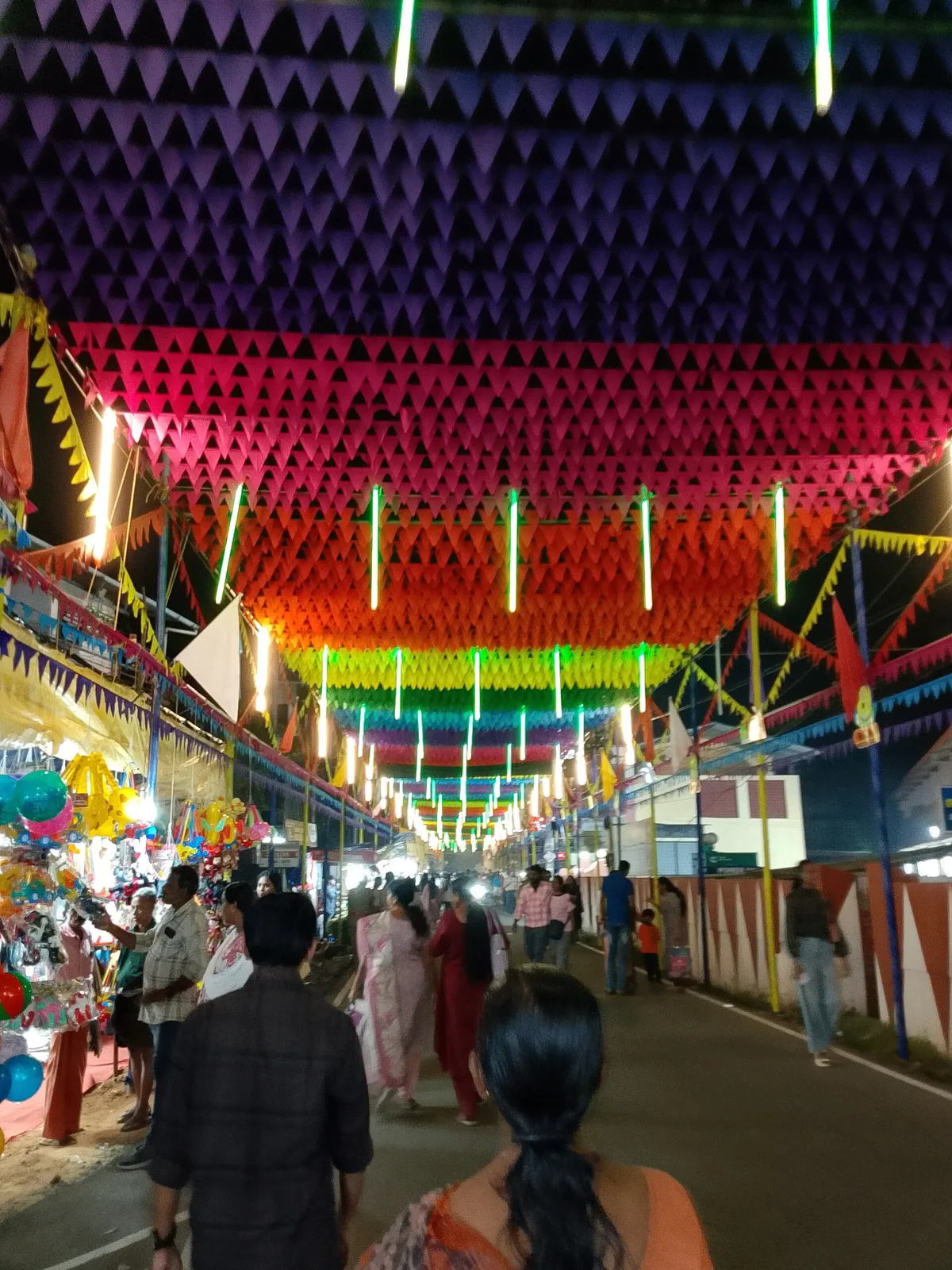
For most of the year, the street around the Mullakkal temple is just a busy road of shops. Scooters squeeze past delivery vans, shopkeepers call out to people walking by, and almost nobody looks up. Then, towards the end of the year, something changes. One morning a roof of coloured cloth and strings of lights stretches across the road, and the whole street starts to feel like the inside of a temple. That change is the start of Mullakkal Chirappu.
To understand why the festival feels this way, you have to know where the temple stands. The Mullakkal Rajarajeswari temple is not on a quiet hill or at the end of a long path. It is right in the busiest part of Alappuzha, with shops pressed close on both sides. That busy centre grew up as a trading port, a story told in how Raja Kesavadas built Alappuzha. So when the goddess’s festival arrives, it does not take place away from the market. It takes over the market itself.
The celebration builds slowly. Kerala Tourism says the temple’s festival lasts 41 days, in November and December. For the first weeks, the town carries on more or less as usual. The final 11 days are different. They are called Chirappu, and that is when the street fills with people. Elephant processions move between the shopfronts, cultural programmes fill the evenings, and fireworks light up the sky after dark. Each day the crowds grow, until the last two days, which are the most important of all.
That closeness is what makes Chirappu unlike Kerala’s more famous festivals. Thrissur Pooram fills a huge open ground, and the Nehru Trophy boat race happens far out on the water, where people watch from the banks. At Chirappu there is no stand and no distance. You are standing in the crowd among the stalls, and the procession passes almost close enough to touch. The festival happens at the width of an ordinary street.
Because the festival fills such a narrow space, a little planning makes the visit much easier. First, check the dates for the year you travel, because Kerala Tourism’s festival record shows the festival can run on into January. If you want to see Chirappu at its biggest, choose the last two days, and expect the biggest crowds then too. Traffic is moved away from the centre, so leave your vehicle further out, walk in, and ask your hotel how the roads are working that week. Once you reach the temple, remember that it is a working place of worship, and ask at the gate about entry, dress, footwear and photography.
When the eleven days end, the lights come down and the shops take back their street. The road looks ordinary again, but you will not see it that way any more. And the walk does not have to stop at Mullakkal. A few streets away, another part of the trading town’s story is waiting at the Jain temple on Gujarati Street, on the street that still carries the name of the Gujarati traders. Walk from one to the other and you start to see the Alappuzha that most houseboat visitors miss.
Frequently asked questions
What is Mullakkal Chirappu?
It is the final 11 days of the 41-day festival at the Mullakkal Rajarajeswari temple in central Alappuzha, with elephant processions, fireworks and cultural programmes.
When is Mullakkal Chirappu?
Kerala Tourism places the festival in November and December, and it can run into January. Confirm the dates for the year before you travel.
Which days are the biggest?
The last two days of Chirappu.
Where is the Mullakkal temple?
In the commercial centre of Alappuzha town.