Cherthala is the taluk town at the north end of Alappuzha district, on NH-66 halfway between Alappuzha and Kochi, on the strip of coconut country between the Arabian Sea and the Vembanad backwater. Most people pass through it. It repays an hour or two, and a half day if you take the coast.
The temple in the middle of the town
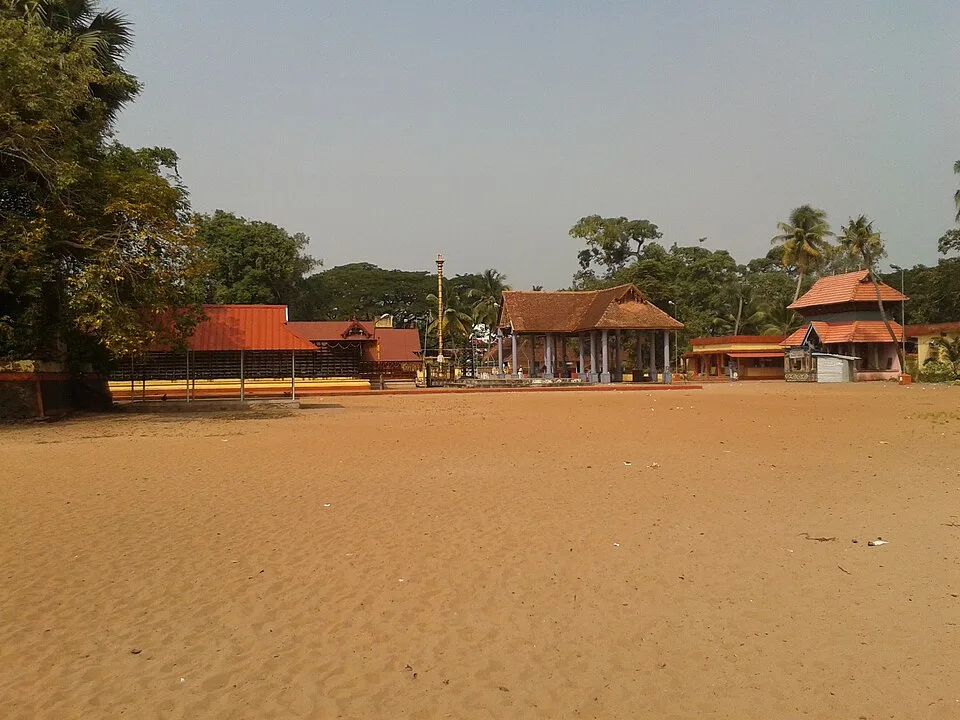
Cherthala Karthyayani Temple sits in the centre of town and is one of the 108 Durgalayas. Three things about it are unusual enough to look for. The goddess sits about four feet below ground level. Hundreds of cockerels, released as offerings, live in the compound and wander it freely. And the town’s own name is traditionally traced to the legend of the goddess being found and raised out of the mud — chera, the slush, plus thala.
Coir here is an industry, not an exhibit
What Cherthala makes is rope. Drive the lanes toward the coast and you will see husks retting in the shallows and yarn drying along walls — but none of it is set up for visitors, nobody is going to demonstrate anything, and there is no ticket. If you want the curated version, with machinery, explanation and a bookshop, that is the International Coir Museum at Alappuzha, 20-odd km south. Come to Cherthala for the working version and treat it as somebody’s workplace.
- It is not a beach town. The coast is a working shore, not a resort strip.
- It is not a backwater cruise base — for that, go on to Alappuzha or Kumarakom.
- St Andrew’s Basilica at Arthunkal is a Cherthala-taluk landmark and a major pilgrimage church, but it is about 10 km west of the town, not in it.
When to come
November to February is the dry, comfortable window on this coast. If you can time it, the Cherthala Pooram and its padayanis are the town at its loudest and most itself; the dates move with the Malayalam calendar, so confirm them in the year you travel rather than trusting a fixed date online.
Getting there and moving on
Cherthala has its own railway station on the Ernakulam–Alappuzha line and a KSRTC bus station, and it is directly on NH-66, so it is one of the easiest towns in the district to reach. It also makes a sane, cheap base if Alappuzha is full during the season: Kochi is about an hour north and Alappuzha about half an hour south.
Frequently asked questions
Is Cherthala worth stopping at?
For an hour or two, yes — the Karthyayani temple in the town centre is genuinely unusual, and the coir lanes toward the coast show a working industry rather than a demonstration. A half day if you add Arthunkal.
What is Cherthala known for?
Coir manufacturing, the Sree Karthyayani Devi temple at its centre and the Cherthala Pooram, and its position on NH-66 between Alappuzha and Kochi.
Where does the name Cherthala come from?
Tradition traces it to the legend of the goddess of the Karthyayani temple being found in the slush and raised out of it — chera, the mud, giving the town its name.
Can you see coir being made in Cherthala?
You can see it happening — husks retting, yarn drying — but nothing is arranged for visitors. For an explained, curated version, visit the International Coir Museum at Alappuzha instead.