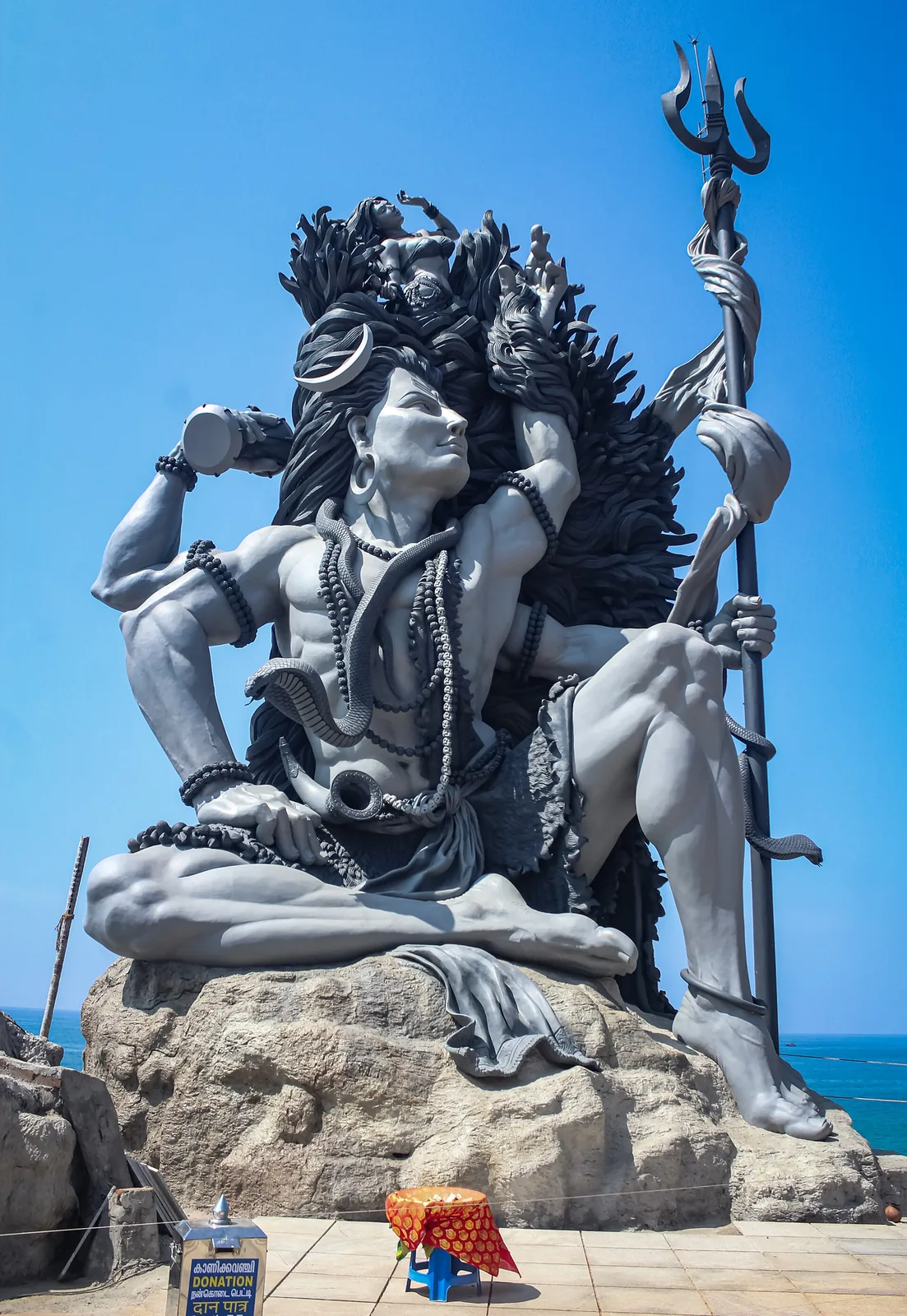
Most visitors to Aazhimala photograph the statue, notice something odd in the hair, and move on. There is a small figure up there — a woman, arms raised, caught in the mass of matted locks above Shiva’s head. She is not decoration and she is not incidental. She is the reason the sculpture is shaped the way it is, and the legend she belongs to is one of the best-loved in Shaivism.
A king with an ancestral problem
The story begins with Bhagiratha, a sage-king whose ancestors had been reduced to ashes and could not be released from that state by any ordinary rite. What they needed was the water of the Ganga, which was not yet on earth — she was a heavenly river, and bringing her down was the object of a long and severe austerity on Bhagiratha’s part. The prayer was granted. That turned out to be the beginning of the problem rather than the end of it.
The catch
A river descending from heaven does not arrive gently. The Ganga’s fall carried force enough to shatter the earth outright, and the redemption Bhagiratha had asked for would have destroyed the world it was meant to bless. Shiva’s intervention is the hinge of the story: he steps beneath the torrent and takes the whole weight of it on his head, where it is caught, slowed and dispersed through the coils of his matted hair, and released across the land at a rate the earth can survive. Hence the epithet — Gangadhara, the bearer of the Ganga — and hence the figure in the hair, who is the river goddess herself, held.
Why the statue looks like that
Read the sculpture with the legend in hand and every choice in it becomes legible. The locks are not stylised hair; they are the mechanism, which is why they are the largest and most worked part of the whole figure. The half-closed eyes and the composure of the face are not generic serenity but the specific point of the story: this is a god absorbing a heaven-sent flood and not registering the strain. The crescent moon, the snake, the trishul and the small drum are Shiva’s standing attributes rather than parts of this episode, but the Ganga in the hair is the episode itself, frozen at the instant of the catch.
And why here
The siting is the part that lifts it. Aazhimala means, more or less, the hill by the deep — aazhi for the ocean, mala for the rock — and the figure sits at the edge of the land with nothing beyond him but water. So a god defined by having mastered one sacred water is placed permanently facing another, and the sculpture’s stillness is given something to be still against: the sea below is never still, the spray comes up the rock on windy days, and the contrast does the interpretive work that a plaque would otherwise have to do. Whether or not the placement was reasoned through in those terms, it is the most articulate thing about the site.
How to look at it
Give yourself three positions. From a distance, along the coast road, the figure reads as a silhouette and you see the profile of the hair against the sky. From the platform you get the body and the proportions. From directly beneath — which is where most people do not think to stand — you get the face and the Ganga, and it is the only angle from which the small figure resolves properly. Then go into the Dhyana Mandapam underneath, which is dim and quiet and about 3,500 square feet, and sit for a minute with the whole thing overhead. Practical detail is on the Aazhimala Shiva Temple page; the sculptor’s side of it is in Six Years on a Sea Cliff.
Frequently asked questions
Who is the small figure in Shiva’s hair?
The goddess Ganga. The sculpture shows Shiva as Gangadhara, the bearer of the Ganga, catching the river in his matted locks at the moment of her descent from heaven.
What is the Gangadhara legend?
The sage-king Bhagiratha won the Ganga’s descent to earth to redeem his ancestors’ ashes, but her fall carried force enough to destroy the world. Shiva stepped beneath the torrent, caught it in his hair, and released the river gently across the land.
What do the other elements mean?
The crescent moon, the snake, the trishul and the small drum are Shiva’s standing attributes rather than parts of this particular episode. The Ganga in the hair is the episode itself.
What does Aazhimala mean?
Roughly, the hill or rock by the deep — aazhi meaning the ocean or the deep, mala a hill or rock. The name describes the headland the temple stands on.