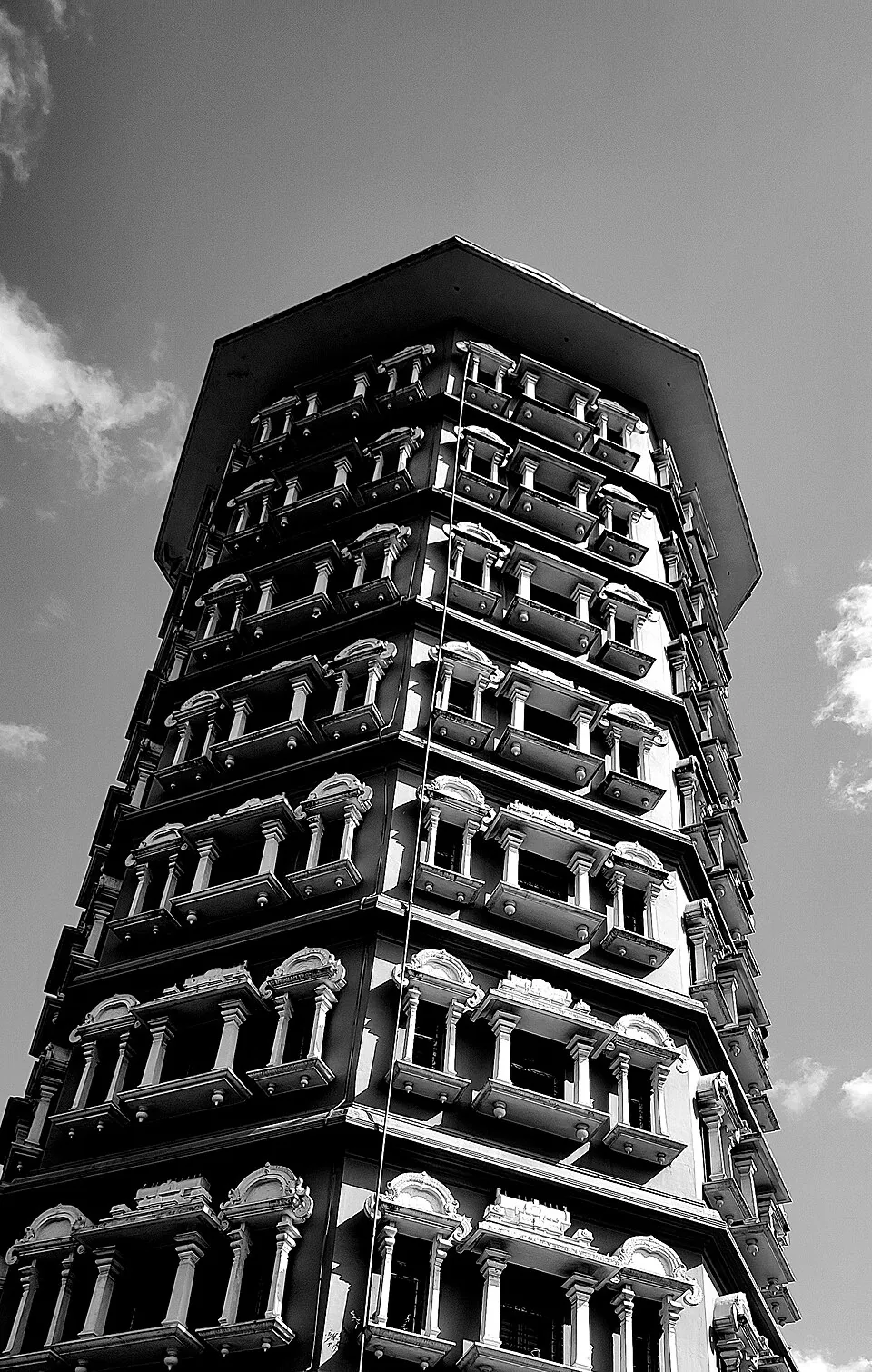
Visitors to Kalady almost always assume the Keerthi Sthambha Mandapam and the birthplace temple complex are one site with two entrances. They are a few minutes’ walk apart, they commemorate the same man, and nothing at either explains the arrangement.
They belong to two different monastic institutions, and those institutions do not agree about when Adi Shankara lived — by more than a thousand years.
Who owns what
The eight-storey tower on the road by the Periyar was built by the Kanchi Kamakoti Peetham, begun under the guidance of Jagadguru Sri Chandrasekharendra Saraswathi Swamigal — the Paramacharya — consecrated by Jayendra Saraswathi Swamigal in 1978, and dedicated to the nation by Neelam Sanjeeva Reddy, President of India, on 12 May 1978.
The Adi Shankara Janma Bhoomi Kshetram, the temple complex on the birthplace itself, is run by the Sringeri Sharada Peetham.
Both institutions trace themselves to Shankara. Both maintain their own account of his life. Neither is a splinter of the other, and both are entirely legitimate on their own terms.
The four mathas
Tradition holds that Shankara established four monastic seats at the cardinal points of India, each assigned one of the four Vedas: Sringeri in Karnataka with the Yajur Veda, Dwaraka in Gujarat with the Sama Veda, Puri in Odisha with the Rig Veda, and Jyotirmath near Badrinath with the Atharva Veda. These are the amnaya mathas, and the arrangement is a map as much as an institution — a philosophical system pinned to the four corners of a subcontinent.
The Kanchi Kamakoti Peetham stands outside that set of four and holds its own foundation tradition, dated in its own account to 482 BCE. That, rather than any dispute over Kalady, is the root of the parallel arrangement you are walking through.
A thousand-year gap
The dating is where the difference becomes concrete, and both positions are held seriously by people who have studied the question.
Mainstream scholarship places Shankara in the eighth century CE. The dates usually quoted are 788–820 CE, with a good deal of recent work preferring something closer to 700–750 CE. The basis is the succession record at Sringeri, which is the only matha to have maintained a relatively unbroken list of its acharyas — from the third acharya onwards the sequence can be dated with reasonable confidence, and it is read backwards from there.
The Kanchi Kamakoti Peetham holds that Shankara was born in 509 BCE and died in 477 BCE, a dating built on guru parampara — the recorded teacher-to-student succession — together with traditional calendrical calculation reckoned from the start of the Kali Yuga.
That is a gap of roughly thirteen centuries between two institutions that both descend from the same teacher, both maintain sites at his birthplace, and both operate a few minutes apart on the same road.
What this does and does not mean
It is not a scandal and it is not our place to adjudicate it. It is what happens when a tradition preserves its history through lineage and memory rather than through archives, and when two lineages preserve it differently. Both methods are internally coherent; they simply do not produce the same number.
It is also worth being clear about what nobody disputes. Shankara was born somewhere in Kerala, wrote commentaries on the Upanishads, the Bhagavad Gita and the Brahma Sutras that reorganised Hindu philosophical thought, travelled the subcontinent debating, founded monastic institutions that survive, and by tradition died at thirty-two. Kalady’s identification as the birthplace rests on tradition maintained by these same institutions rather than on independent evidence — which is worth knowing, and is not a reason to stay away.
How to visit both
Do the whole of Kalady in one loop and treat the split as part of the interest. The tower, with its Paduka Mandapam and its spiral stair of painted episodes, takes twenty to thirty minutes. The Janma Bhoomi Kshetram, the samadhi of Shankara’s mother Aryamba, and the ghat on the Periyar where the crocodile story is set fill another hour.
Go early — the temple complex keeps the usual long Kerala midday closure — and remember that Kalady is about ten minutes from Cochin International Airport, which makes it the most rewarding layover in the state.
Frequently asked questions
Who runs the Keerthi Sthambham and who runs the birthplace temple?
The tower belongs to the Kanchi Kamakoti Peetham; the Adi Shankara Janma Bhoomi Kshetram, the birthplace temple complex, belongs to the Sringeri Sharada Peetham. They are separate institutions on separate sites a few minutes apart, and nothing at Kalady explains the arrangement to visitors.
What are the four mathas Shankara founded?
By tradition, Sringeri in Karnataka, Dwaraka in Gujarat, Puri in Odisha and Jyotirmath near Badrinath — one at each cardinal point, each associated with one of the four Vedas: Yajur at Sringeri, Sama at Dwaraka, Rig at Puri and Atharva at Jyotirmath. The Kanchi Kamakoti Peetham stands outside that set of four and holds its own foundation tradition, dated in its account to 482 BCE.
When did Adi Shankara live?
It depends who you ask, and both answers are held seriously. Mainstream scholarship puts him in the eighth century CE — 788–820 CE is the familiar range, with recent work often preferring 700–750 CE — based on the succession record at Sringeri, the only matha with a relatively unbroken list of acharyas. The Kanchi Kamakoti Peetham holds that he was born in 509 BCE and died in 477 BCE, from guru parampara and traditional calendrical calculation. The gap is about thirteen centuries.
Is Kalady definitely his birthplace?
It is the tradition, maintained by the monastic institutions, and it is not independently evidenced. The firm biographical record for Shankara is thin — his century is argued over, so a village is not going to be easier. What is not disputed is the body of work, the travels and the institutions he founded.
When was the tower built?
Begun under Jagadguru Sri Chandrasekharendra Saraswathi Swamigal of the Kanchi Kamakoti Peetham, consecrated by Jayendra Saraswathi Swamigal in 1978, and dedicated to the nation by President Neelam Sanjeeva Reddy on 12 May 1978.
How should I plan a visit to Kalady?
As one loop, early in the day. Twenty to thirty minutes for the tower, another hour for the birthplace complex, Aryamba’s samadhi and the river ghat. The temple complex keeps the usual long Kerala midday closure. Kalady is about ten minutes from Cochin International Airport, which makes it an unusually good use of a layover.