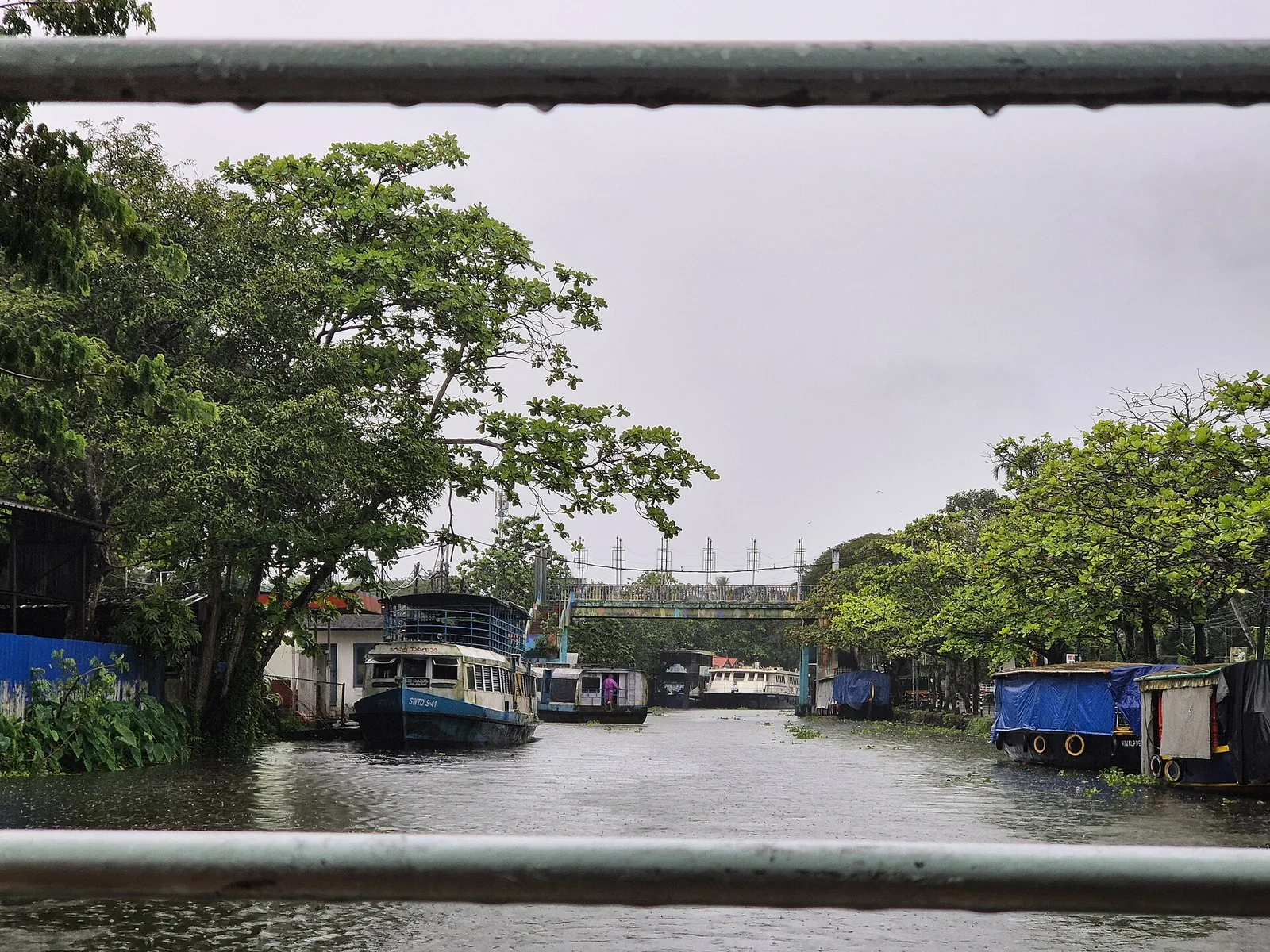
Most towns are an accident that hardened. Alappuzha is not. It was opened as a port in 1762 on the instruction of Raja Kesavadas, Dewan of Travancore, and it was laid out on a plan — roads cut, canals dug, warehouses built, and merchants from Surat, Bombay and Kutch offered terms to persuade them to come. The district administration still calls him the maker of modern Alleppey.
Two canals, two reasons
The plan’s central move was a pair of long parallel canals with shorter link canals between them. They look like siblings. They are not.
The Vadai Canal was cut first, and it was meant as a moat — a defensive line around a new and extremely valuable port. The Commercial Canal was cut for trade, to carry goods between the harbour and the godowns built along its banks.
That distinction has outlived everyone involved in it. Walk both today and the Commercial Canal is the one with the warehouse frontages, because warehouses are what it was dug to serve. A moat wants clear ground beside it; a trade canal wants buildings pressed up against it with doors onto the water. Two and a half centuries later the buildings still remember which was which.
This is the thing worth carrying around the town. Alappuzha’s canals are usually described as scenery, and photographed as scenery, and the word most often attached to them is picturesque. They are better than picturesque. They are purposeful, and the purpose is legible on the ground if you know that the two main ones disagree about what they are for.
The century of turning away
For much of the twentieth century the town stopped using its canals and started using them as drains. They silted. Banks were encroached on. A waterway that had been the reason the town existed became the thing at the back of the buildings rather than the front — which is a familiar story in canal cities everywhere, and it is why so many of them smell.
Both canals are formally part of National Waterway 3, and the current restoration is the largest attempt to reverse that decline. Kerala’s infrastructure investment fund is financing work across nine major canals and two sub-canals — roughly 23 kilometres in total, at a cost in the region of ₹42.85 crore — taking in the Vadai and Commercial canals together with East Junction, West Junction, Murinjapuzha, Uppotti, Kottaram Thodu, Ambalappuzha and the A.S. Canal.
The argument underneath the engineering
Running alongside the construction is a project called Canalpy, developed with IIT Bombay, and it is the part of this story that is genuinely unusual.
Canal restoration in Indian cities has very often meant clearing the banks — which in practice means moving the poorest residents of a city away from the water so that the water can be made nice. Canalpy is built on a zero-eviction principle instead: the households living along the canals are treated as part of the solution rather than as the obstacle to it.
Whether that holds under pressure is not something a travel page can tell you. But it is a real argument about what a restored canal is for — whether it is infrastructure for the people already living on it, or a view for people who arrive later — and Alappuzha is where it is being had.
Which is oddly fitting for a town whose two canals have been disagreeing about their own purpose since 1762.
Frequently asked questions
Why does Alappuzha have canals?
Because it was planned that way. Raja Kesavadas, Dewan of Travancore, opened the port in 1762 and laid the town out on two parallel canals with link canals between them, alongside roads and warehouses, to serve the export of coir matting and yarn.
What is the difference between the Vadai and Commercial canals?
The Vadai Canal was dug first and was intended as a defensive moat. The Commercial Canal was cut for trade, moving goods between the port and the godowns along its banks — which is why the warehouse frontages are on that one.
Are the canals being restored?
Yes. A KIIFB-funded programme covers nine major canals and two sub-canals, about 23 km, at a cost in the region of ₹42.85 crore, including the Vadai and Commercial canals. A separate project, Canalpy, developed with IIT Bombay, works to a zero-eviction principle.