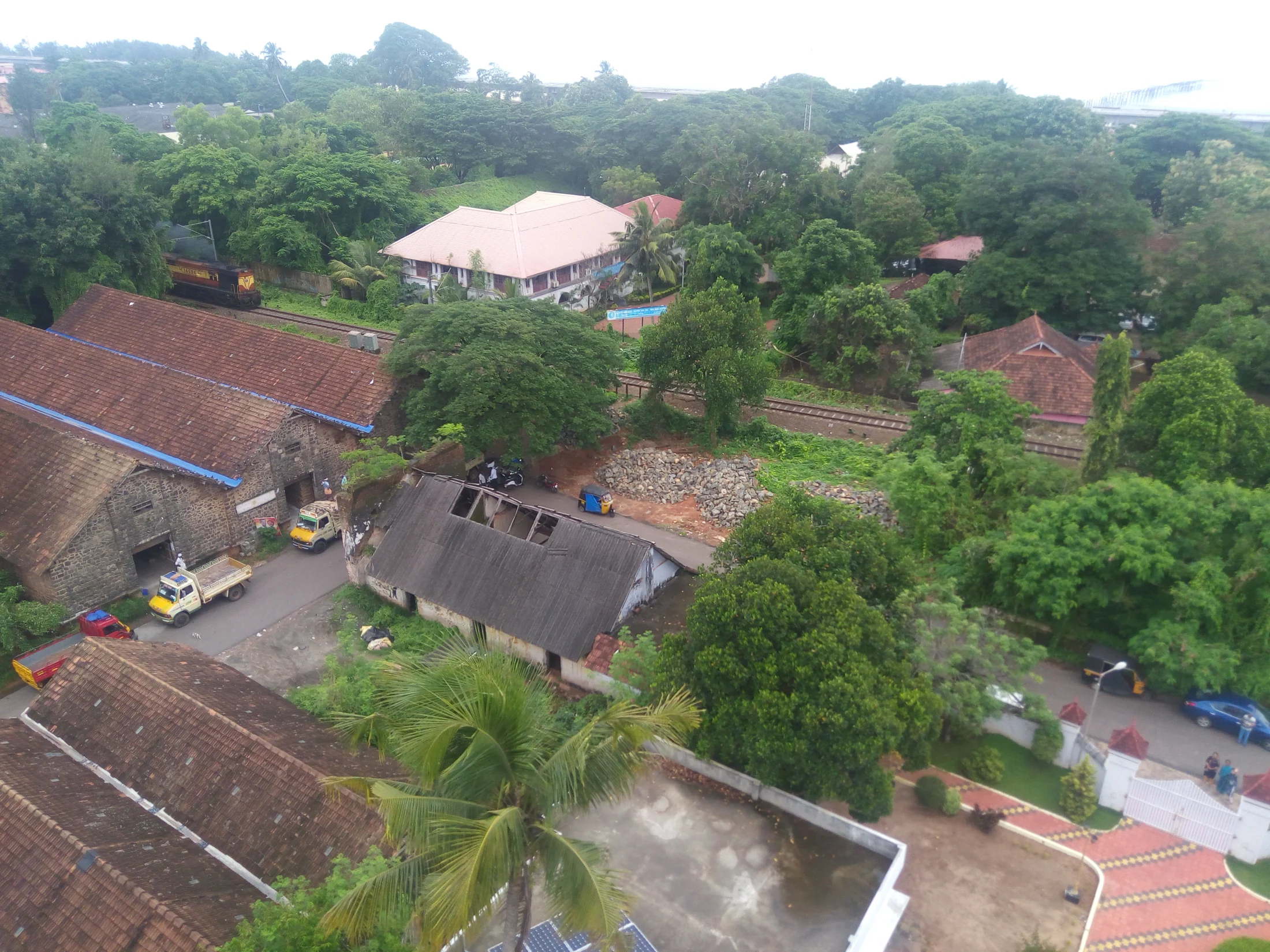
The sea naturally attracts attention at the top of Alappuzha Lighthouse, but the inland view deserves an equal pause. In this 2017 photograph, a train runs through a landscape of low roofs, trees and open ground. The tower provides a position from which transport, homes and the coast can be seen as parts of one town.
A dated view is a useful comparison
The photograph is identified as a view from the lighthouse and dated 2017. It should be read as that moment in the town’s history, not a promise that every roof, open space or road will look the same today. A high viewpoint is especially good at revealing change because so many features appear together in the frame.
Begin with the railway. Its line gives the eye a clear direction through the buildings and greenery. The train supplies scale: the surrounding roofs are no longer anonymous shapes, and the open spaces can be understood in relation to a familiar vehicle. This makes the inland view legible even to someone visiting Alappuzha for the first time.
Find the ordinary town around the landmark
A lighthouse seen from the beach can seem detached from daily life, standing by itself against the sky. Looking down reverses that impression. The station occupies a place among streets and buildings, with people arriving by road and rail. The landmark is embedded in an urban setting rather than standing at the end of an isolated headland.
DGLL’s station ledger places Alappuzha railway station within two kilometres of the lighthouse and identifies C.C.S.B. Road as the station address. These details fit the visual relationship: the sea-facing attraction is connected to ordinary town infrastructure. They also explain why a lighthouse and beach visit can be arranged around a rail arrival without treating the tower as remote countryside.
Turn towards the water
After examining the inland side, move to an available position facing the sea without blocking other visitors. The contrast is the point. Roofs and tracks give way to the broad shore and horizon. The old pier remnants belong to that sea-facing view, while the railway belongs to the town behind it; both are connected to movement through Alappuzha.
The operator’s heritage account describes the port’s links with inland waterways. That history gives another layer to the view, although not every canal can be identified from every part of the gallery. Avoid forcing a label onto a distant line simply because the town is famous for canals. Observe what is actually visible and use the museum and town walk to supply the rest.
Take the view back to ground level
The elevated perspective works best when followed by a short, deliberate ground-level visit. On the beach, look back towards the landward buildings and the routes by which people arrive. Around the lighthouse, notice the separate compound entrance and its relation to the street. These small observations connect the wide panorama to places a visitor can actually use.
A useful photograph need not contain every landmark. One frame can show the railway and town, another the sea-facing side, and a third the tower from below. Together they explain the lighthouse’s position more clearly than a horizon alone. Keep the gallery passage clear while taking them, then carry the sense of the town’s layout into the next part of the visit.
Sources: DGLL’s station location and access record, the operator’s port-history account and the dated photograph credited below.
Plan the visit: Alappuzha Beach & Lighthouse.