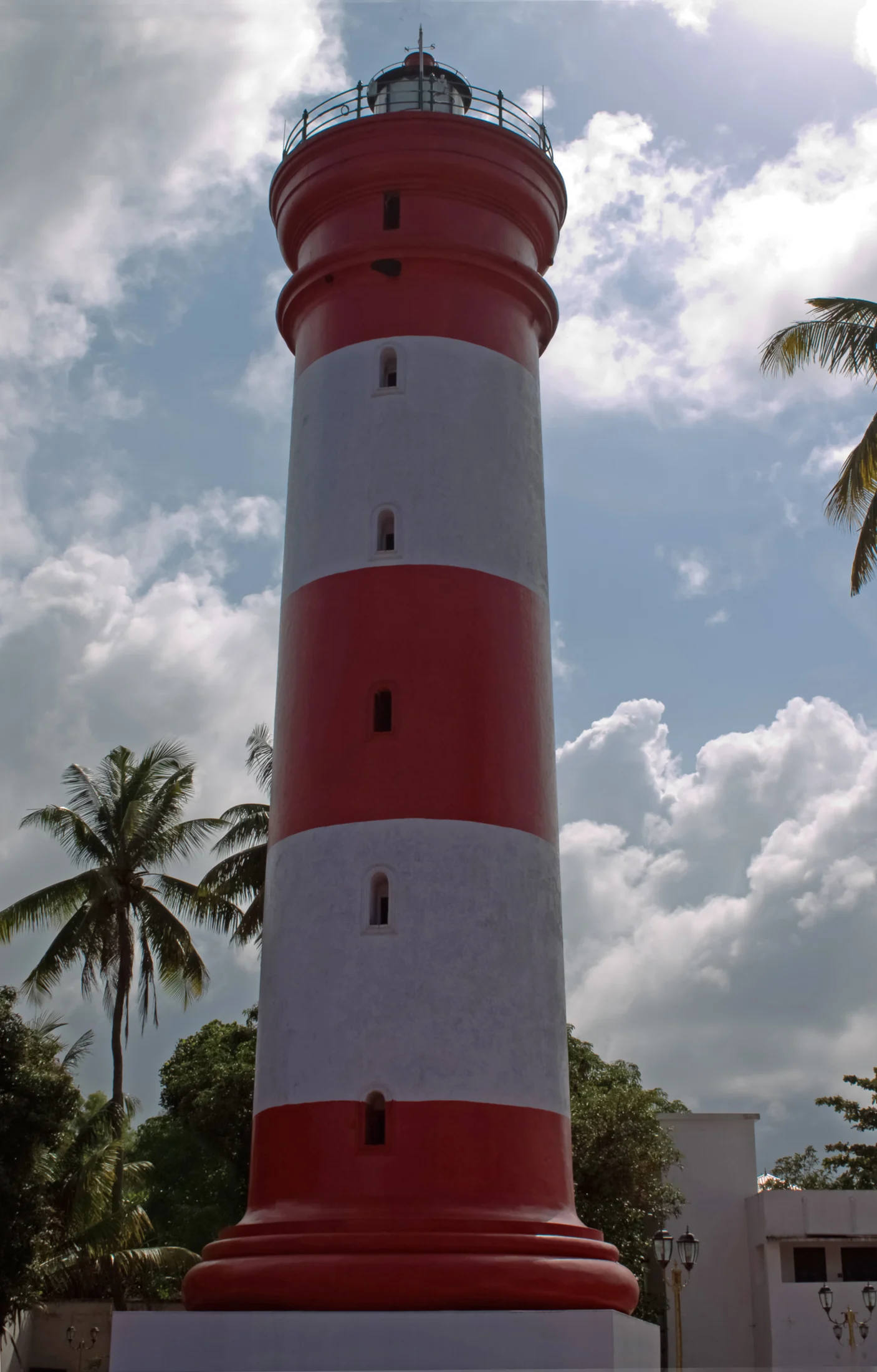
Stand back from Alappuzha Lighthouse before beginning the climb. The tower can be read from the ground: a wide circular base, a tall banded shaft, a projecting gallery and the lantern at the top. Palms and the smaller station buildings help establish its scale. The familiar red and white are only the surface of a structure designed to carry a light above the surrounding coast.
A date that belongs to the tower
The lighthouse operator’s station ledger gives 28 March 1862 as the commissioning date. It is a useful fixed point in a history that also includes an earlier port light and later changes to the equipment. The present masonry tower is the enduring element visitors recognise; the apparatus serving inside it has not remained unchanged since that first day.
The ledger separates a tower height of 28 metres from a light elevation of 33 metres above mean sea level. These figures answer different questions. One describes the building’s height; the other places its light against a sea-level reference. Keeping them distinct helps avoid the confusing range of heights sometimes attached to lighthouse photographs.
A port required a signal
The operator’s heritage account places the new tower within Travancore’s development of Alappuzha as a port. It describes an earlier light carried on a port flag mast during the 1830s, followed by the proposal for a stone tower in 1860. The new station therefore grew out of a maritime need already present at the waterfront.
Hugh Crawford, the port officer named in that account, belongs to the construction story. For a visitor, the most revealing connection is his office itself: the lighthouse was part of the practical equipment of a port. Looking towards the old pier remains after visiting the tower brings that relationship back into the landscape.
Look closely at the exterior
The circular shaft changes character as it rises. The coloured bands emphasise its vertical scale, while the gallery introduces a strong horizontal line just below the lantern. Small openings interrupt the masonry. From a close position, the tower can seem to lean away into the sky; stepping farther back makes its overall form easier to understand and photograph.
Include part of the compound in one image rather than photographing only the upper lantern. The building’s relation to the palms, roofs and ground tells the viewer more about its location. A second, closer view can concentrate on the contrast between the smooth painted wall and the more intricate upper structure. Neither requires entering a restricted operational area.
An old structure with a continuing job
The station remains under the Directorate General of Lighthouses and Lightships. Its preservation is connected to continued navigational use as well as public interest. The museum explains older equipment, while the working tower carries the later apparatus. This combination is what makes the place more than a preserved shell.
On the way down, return to the ground-level view with those distinctions in mind. The commissioning date, building height and purpose of the lantern describe a real structure with a long working life. The stripes are its most immediate visual feature, but the relationship between port, tower and signal gives the visit its historical depth.
Sources: DGLL station ledger and DGLL’s heritage nomination, published by IALA.
Plan the visit: Alappuzha Beach & Lighthouse.