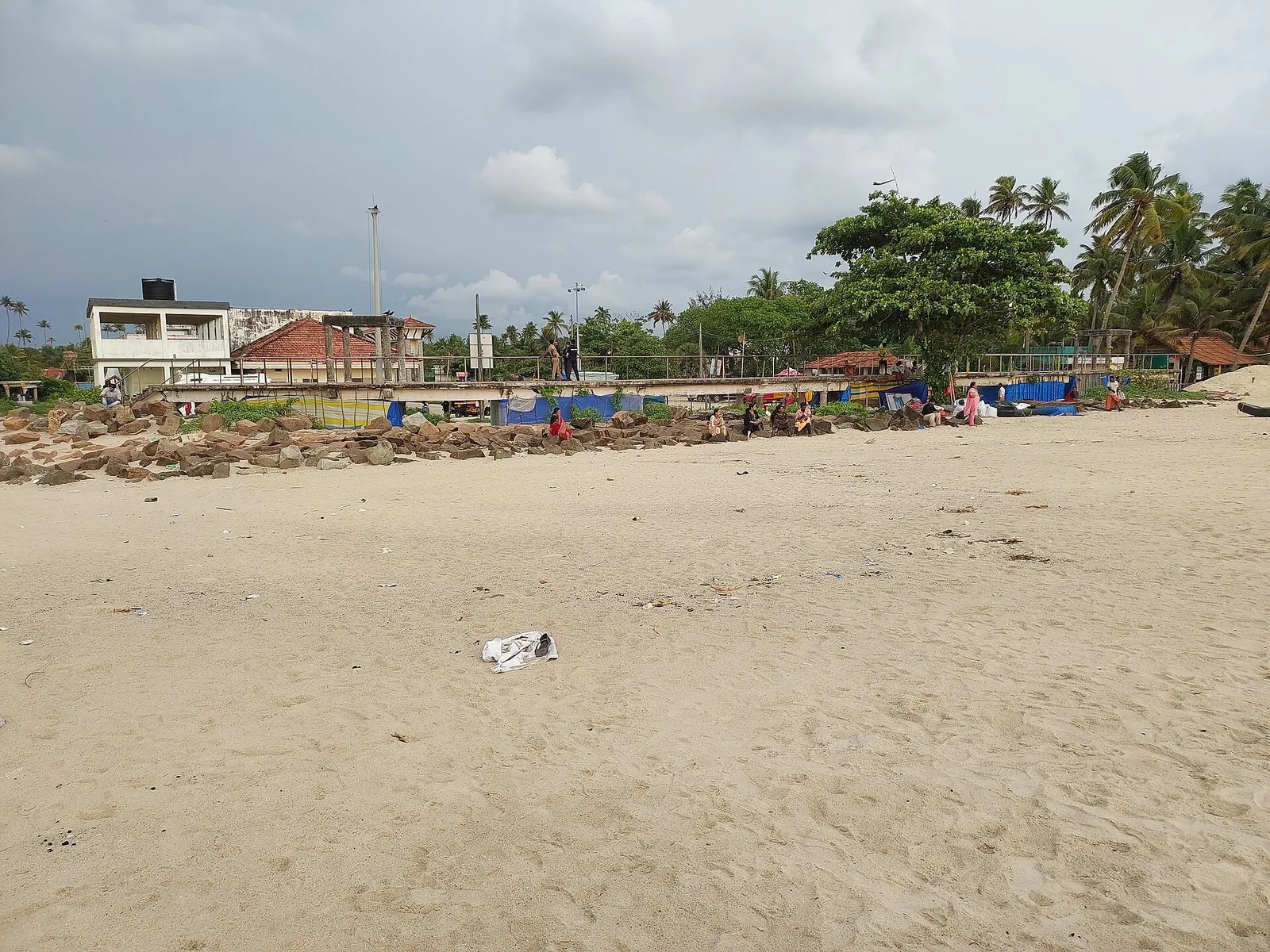
An azhi is a river mouth — the gap where a backwater breaks through the coastal sand and reaches the sea. Andhakaranazhi is the one at the northern end of the Alappuzha coast, and the most interesting thing about it is a comparison.
How the gap works
The Kerala coast runs roughly north to south, and the prevailing longshore drift pushes sand steadily along it. That means any opening in the shoreline is under constant attack from the side.
Behind the opening sits a body of backwater that rises and falls with the rain and with the tide. When the flow from behind is strong — through the monsoon, and on a falling tide — it scours the channel and keeps it clear. When the flow is weak, through the dry months, the drift wins: the opening narrows, shifts along the shore, or closes altogether.
So a sandy river mouth is never in quite the same place twice. The bank of sand you walk across in February may be open water in July. This is completely ordinary behaviour for a bar-built estuary, and it is the reason nothing permanent gets built across a mouth like this casually.
And why that is fine here
Now go 55 kilometres south to Thottappally, where exactly the same physics applies and the outcome is completely different.
There, the same sand bar forms across the same kind of mouth. But behind that mouth lies Kuttanad — below sea level, full of paddy, drained by three rivers that rise together in the monsoon. If that outlet is closed when the water arrives, villages flood. So the state cuts it open every year with machines, to a target width, on a deadline, and in 2018 it managed 200 metres and it was not enough.
Here at Andhakaranazhi there is no Kuttanad behind the bar. The backwater can rise a little, the mouth can wander, the sea can close it and reopen it, and the consequence is a changed shoreline rather than a disaster. So nobody intervenes.
Two river mouths on one coast, doing the same physical job by the same mechanism. One is infrastructure with a budget line and a contractor. The other is left entirely to the sea. The difference is not in the geology. It is in what is standing behind them.
What that leaves you looking at
A footbridge crosses the azhi, and it is the site’s distinguishing structure — a span over a channel whose position and width are not fixed, above water carrying both a tidal current and, in season, a river in spate. There is a boat yard at the mouth, country boats drawn up on the sand, and Christ the King Chapel standing on the beach itself.
The beach is wide, flat and pale, with laterite boulders along parts of it and, honestly, a fair amount of litter. It is about 30 km from Alappuzha and 10 km north of Arthunkal, on the coastal road that runs up through Chellanam towards Kochi — which is why it fills on Sunday evenings with people who have driven down from the city.
⚠ One caution, and we give it as a general point about estuary mouths rather than as a sourced claim about this beach: the water beside an azhi does not behave like the water of an open shore. Bar-built mouths carry strong and variable tidal currents. Swimming near a river mouth anywhere on this coast is a poor idea, and calm-looking water is not evidence of safety.
Frequently asked questions
What is an azhi?
A river mouth or tidal inlet — the gap where a backwater or river breaks through the coastal sand bar to reach the sea. Andhakaranazhi is the azhi at the northern end of the Alappuzha coast.
Why does the river mouth move?
Because longshore drift pushes sand along the coast and tends to close the gap, while the flow from behind — strongest in the monsoon and on a falling tide — scours it open. The balance between the two shifts with the season, so the opening narrows, migrates along the shore, or closes.
How is it different from Thottappally?
Only in what lies behind it. Both are river mouths on the same coast with the same physics. At Thottappally, below-sea-level Kuttanad is behind the bar, so the state cuts the mouth open by machine every year before the monsoon. At Andhakaranazhi nothing comparable is at risk, so the sea is left to open and close it.
Is it safe to swim?
Treat the area near the mouth with real caution — estuary mouths carry strong and variable tidal currents. We state that as a general caution about azhis rather than as a sourced claim about this beach, so take local advice on the day.