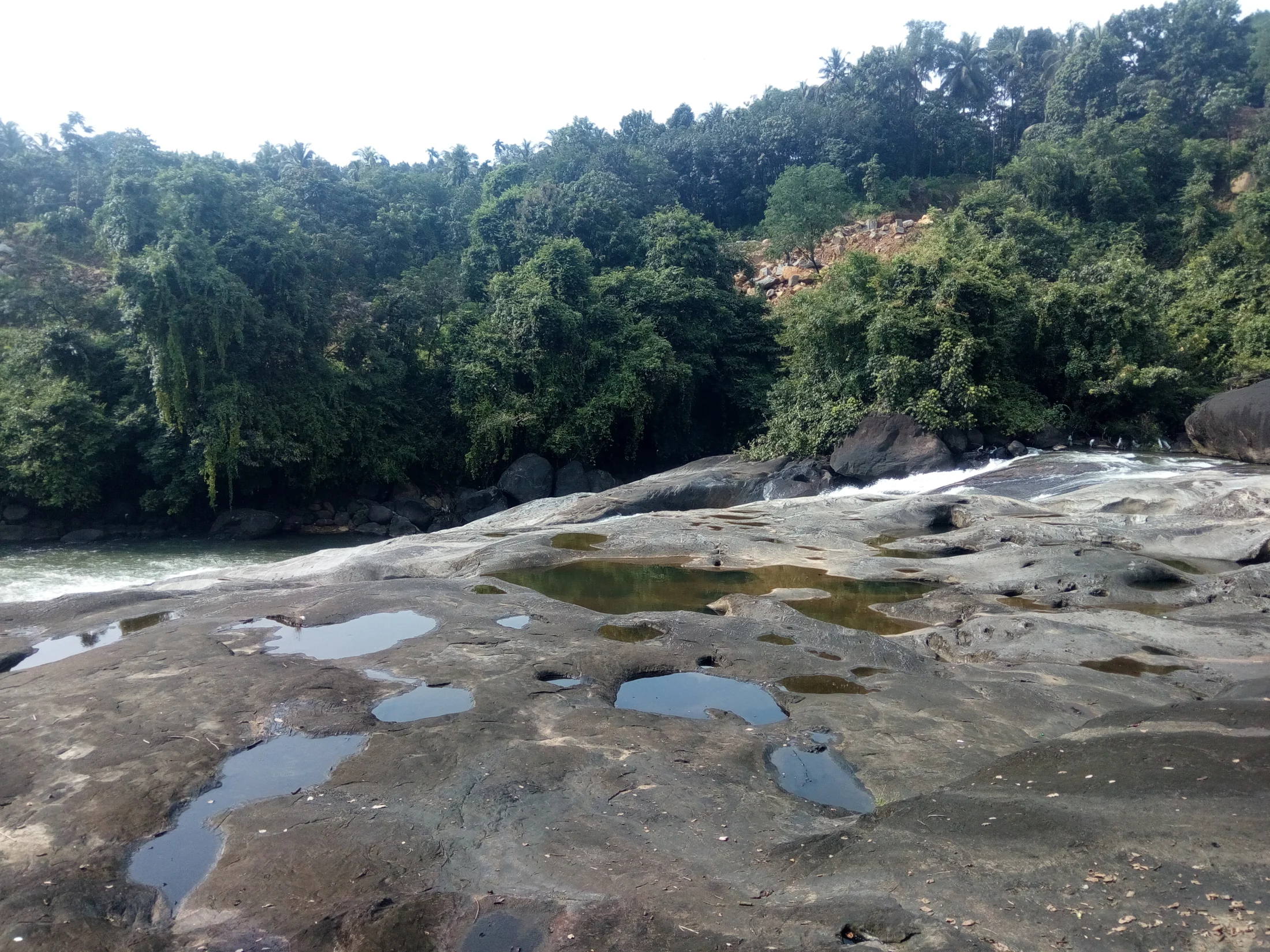
Look at a photograph of Arippara in the dry season and you see a wide grey shelf of rock with the river sliding across one edge of it, and dozens of dark pools scattered over the surface like spilled ink. It looks like the most benign river landscape in Kerala. At least twenty-seven people have drowned here in twenty-three years.
The pools are the reason. They are scour potholes — circular and lobed hollows ground into the bed by pebbles caught spinning in eddies, over a very long time. They range from plate-sized to bigger than a person. And from above, at the angle you look at them from when you are standing on the shelf, a hollow three metres deep and a puddle thirty centimetres deep look exactly the same. There is no rim, no gradient, no shading cue. Only a change in the colour of the water.
The names are the warning
The local vocabulary for this place has been sitting in plain sight for as long as anyone has written about it, and tourism copy has repackaged it as scenery — “eight levels” of a picturesque waterfall.
Vattakkuzhi means round pit. Neelakkayathadaakam is the blue-deep pool. And Shwasakkuzhi means, literally, breath pit. These are not decorative names. They are the names of specific features, given by people who knew what happened in them, and the fact that a brochure can list them as attractions is a small case study in how local knowledge gets laundered on the way to a visitor.
Three mechanisms
The pothole is the first. No depth cue from above, vertical or undercut sides, and no way to brace once you are in one — and Wikimedia Commons files photographs of this site, quite correctly, under fluvial erosion.
The chute is the second. The flow funnels off the shelf into slots barely a metre wide, and wet gneiss has roughly the friction coefficient of wet glass. There is no gradual transition between standing on dry rock and being in moving water.
The flash rise is the third, and it is the one that cannot be seen from the site at all. The Iruvanjipuzha’s catchment head is Vellarimala, at 1,544 metres. Rain falling up there is entirely invisible from the shelf. That matters more now than it used to: in August 2024 the Chooralmala and Mundakkai landslides moved some 86,000 square metres of ground on that same massif and carried debris eight kilometres downstream.
The date that matters most
The toll figures need care, because they get pooled. You will read that nearly fifty people have died at Arippara; that figure covers Arippara, Pathankayam and the wider Iruvanji across twenty years. The Arippara-specific number, reported in April 2023, is twenty-seven in twenty-three years. A separate uncited account gives nineteen since the district tourism body took over the site, with one body never recovered.
Three deaths can be dated. On 1 March 2022, an eighteen-year-old from Vadakara, at about three in the afternoon. On 12 September 2025, a twenty-five-year-old who had entered outside permitted hours without permission, recovered by a lifeguard. We name nobody, though several names have been published.
And on 15 April 2023, at about half past three in the afternoon, two schoolboys aged fifteen and thirteen, from a party of fourteen drawn from three families. Three relatives who went in after them were pulled out alive by the site’s own lifeguards.
Hold on to that date, because it is the reason this article exists. The fifteenth of April is deep dry season. It was mid-afternoon. It was inside opening hours. Lifeguards were on duty and close enough to save three other people. Every piece of safety advice about Kerala’s waterfalls — including ours — is built around avoiding the monsoon, and every bit of that advice is about flooding. None of it says anything about potholes.
A page that implies “come in the dry months and you will be fine” is repeating, word for word, the assumption under which two children died. So: the dry season is when Arippara is approachable at all. The potholes are lethal in every season. Stay off the wet rock and out of the water, whatever the month. And note that reporting from April 2026 describes a summer-holiday visitor surge — the peak of the crowds falls in the same month as those deaths.
What the site actually offers, and what it does not
Arippara is run by DTPC Kozhikode — a district body under the state tourism department, not the panchayat and not the Forest Department. There is no forest permit and this is not reserve forest, which is worth stating because visitors constantly conflate it with Thusharagiri up the road. Entry is ₹10 for an adult and ₹5 for a child. There are iron handrails, an information centre, stationed security, toilets and a pavilion. Hours are nine to five, with lifeguards on station until half past five.
That is a real protection regime and it is worth respecting. It is also, in the end, a shift rather than a fence. The river does not close at half past five and in practice nor does access — which is exactly what the September 2025 death describes.
There is one genuinely good answer to all this, and it is new. A suspension bridge now crosses the river at the falls. Malayalam Wikipedia still lists it as merely approved; it is mapped, built, and named among the attractions in reporting from April 2026. For a place whose central instruction is to stay out of the water, a way to be safely above it is the best thing it could have been given.
One last thing, which tourism writing tends to leave out. Residents of Thiruvambady and Kodenchery have run a campaign asking visitors to stay away from the Iruvanji bathing spots, at least until the start of summer — the precise inverse of the advice the tourism pages give. The same reporting notes that the authorities attribute most drownings to visitors not following guidelines. Both of those are true at once, and neither should be quietly folded into the other.
Frequently asked questions
Can you swim at Arippara?
No. At least 27 people have drowned here in 23 years. Kerala Tourism’s own page describes “natural pools, perfect for swimming” and the district tourism body lists natural swimming pools under Facilities. Neither should be treated as advice.
Why is it dangerous if the waterfall is small?
Because the danger is the bed, not the drop. Scour potholes give no depth cue from above, chutes a metre wide funnel the flow off the shelf, and wet gneiss offers about the grip of wet glass.
Is the dry season safe?
Safer against flooding, and that is all. The 2023 double drowning happened on 15 April, mid-afternoon, inside opening hours, with lifeguards on duty.
How many people have died here?
Twenty-seven in twenty-three years, per April 2023 reporting specific to Arippara. The widely quoted figure of about fifty covers three sites across the wider Iruvanji.
Is there anything safe to do?
Yes — walk the suspension bridge across the river at the falls, look at the pothole field properly, and stay off the wet rock.
