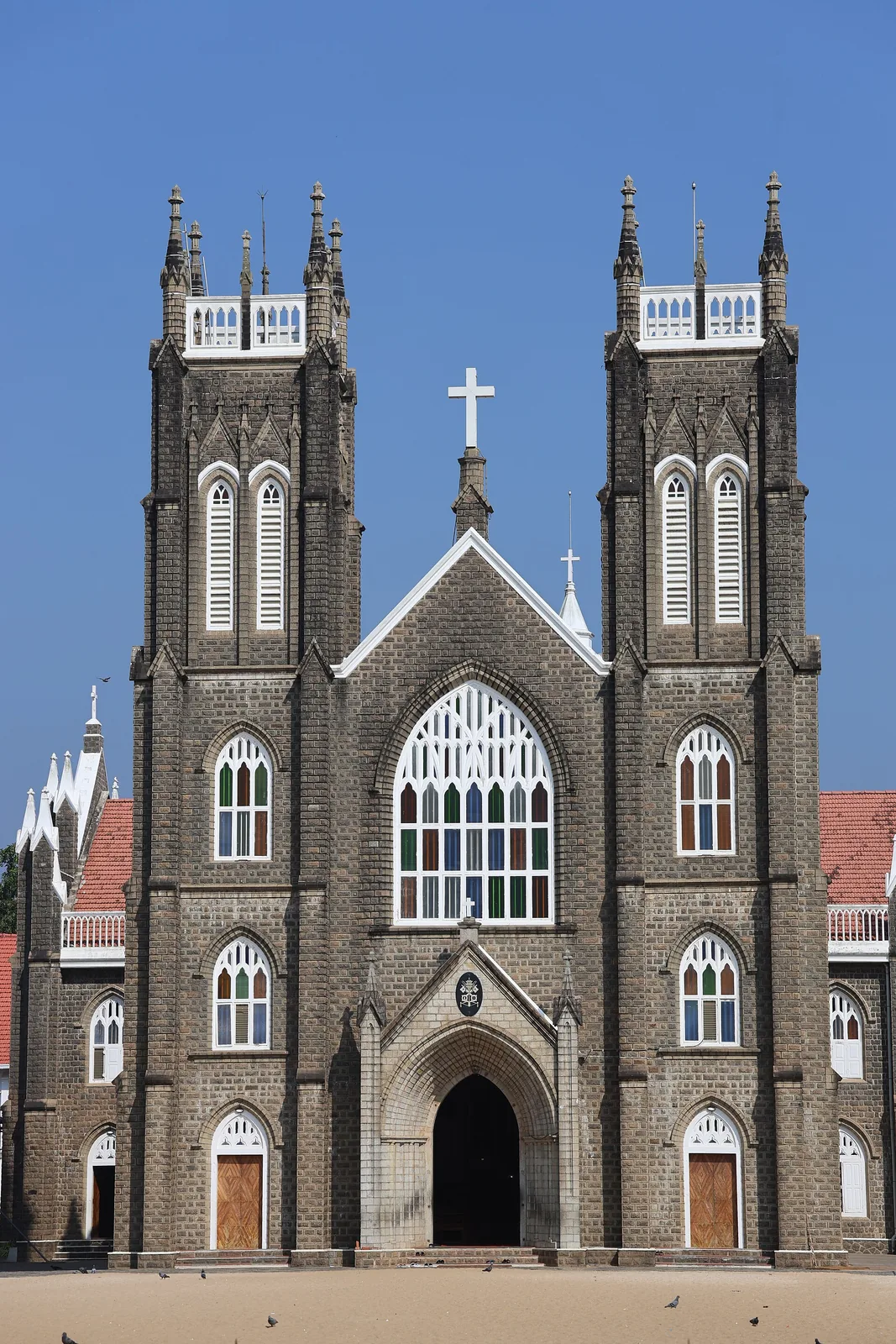
Come to the Alappuzha coast between November and January and you will see something that stops you in your tracks: crowds of Hindu pilgrims dressed in the black of the Sabarimala vow, garlands at their necks, walking not toward a temple but straight into a whitewashed Catholic church beside the sea. They fold their hands before a Christian saint. Some of them kneel here to remove the sacred beads they have worn for weeks. This is Arthunkal Church, and its story is one of the loveliest in all Kerala — a friendship, the people say, between a saint and a god.
The white father
The Portuguese first raised a church on this shore in the sixteenth century. Then, in 1584, an Italian Jesuit named Fr Jacomo Fenicio became its vicar — and the people came to love him so deeply, for his gentleness and his reputation as a healer, that they gave him a name of their own: Arthunkal Veluthachan, “the fair-skinned father.” He rebuilt the church in stone and lime, and when he died in 1632 he was mourned as a saint in his own right. A few years later the church was raised again, this time turned to face west, out toward the white sand and the Arabian Sea.
The martyr from Milan
The heart of the shrine arrived in 1647: a statue of St Sebastian, the Roman soldier executed by the emperor for his Christian faith, shown pierced all over with arrows, his body bleeding. It had been carried all the way from Milan. That image of the wounded martyr became the focus of an ever-growing devotion, and Arthunkal grew into one of the great pilgrim centres of the coast — a place people came, and still come, seeking healing, some completing the last stretch on their knees in a penance called the Urulunercha.
A saint and a god called brothers
Then there is the legend that makes Arthunkal unlike anywhere else. It holds that Lord Ayyappa of Sabarimala and St Sebastian of Arthunkal were the closest of friends — so close that people of both faiths came to speak of them as brothers. And so, for generations, Ayyappa devotees returning from the forest shrine of Sabarimala have broken their journey at Arthunkal to pay their respects to the saint, many of them removing their black pilgrimage beads here in a quiet ritual that marks the end of the vow. Between November and January the church deliberately keeps its doors open to receive them. It is one of the most beautiful expressions of shared faith you will find in India.
The feast by the sea
Each January, from the 10th to the 27th, the Arthunkal Perunnal — the feast of St Sebastian — draws lakhs of pilgrims of every religion. Its great day is the 20th, and its climax a spectacular procession that carries the arrow-struck statue of the saint out from the church to the beach and back, amid fireworks, drums and prayer; devotees speak of an eagle that appears overhead each year as the saint passes. A final observance, the Ettamperunnal, closes the feast on the 27th. In 2010 the church was raised to the rank of a minor basilica.
Visiting Arthunkal
Arthunkal lies on the coast in the Cherthala area of Alappuzha district, about 40 km south of Kochi, an easy detour on any backwater or beach itinerary — and unforgettable if you can time it to the pilgrimage season or the January feast. Details are on the Arthunkal place page; more of the district is on the Alappuzha hub.
Frequently asked questions
Why do Sabarimala pilgrims visit Arthunkal church?
Legend holds that Lord Ayyappa of Sabarimala and St Sebastian of Arthunkal were close friends, even brothers. For generations, Ayyappa devotees returning from Sabarimala have stopped at Arthunkal to pay respects, many removing their black pilgrimage beads there — a celebrated example of Kerala’s religious harmony. The church keeps its doors open for them from November to January.
Who was Arthunkal Veluthachan?
Veluthachan (“the fair-skinned father”) was the beloved name the people gave Fr Jacomo Fenicio, an Italian Jesuit who became vicar of Arthunkal in 1584, rebuilt the church and was revered as a holy man and healer. He died in 1632.
When is the Arthunkal Perunnal?
The feast of St Sebastian runs from 10 to 27 January each year, with the main day on the 20th and a closing observance (Ettamperunnal) on the 27th. It draws pilgrims of all faiths and culminates in a grand procession of the saint’s statue from the church to the sea and back.
What is the St Sebastian statue at Arthunkal?
It is a statue of the Roman martyr St Sebastian, shown pierced with arrows and bleeding, brought from Milan in 1647. It is the devotional heart of the church and is carried in the great seaside procession during the January feast.