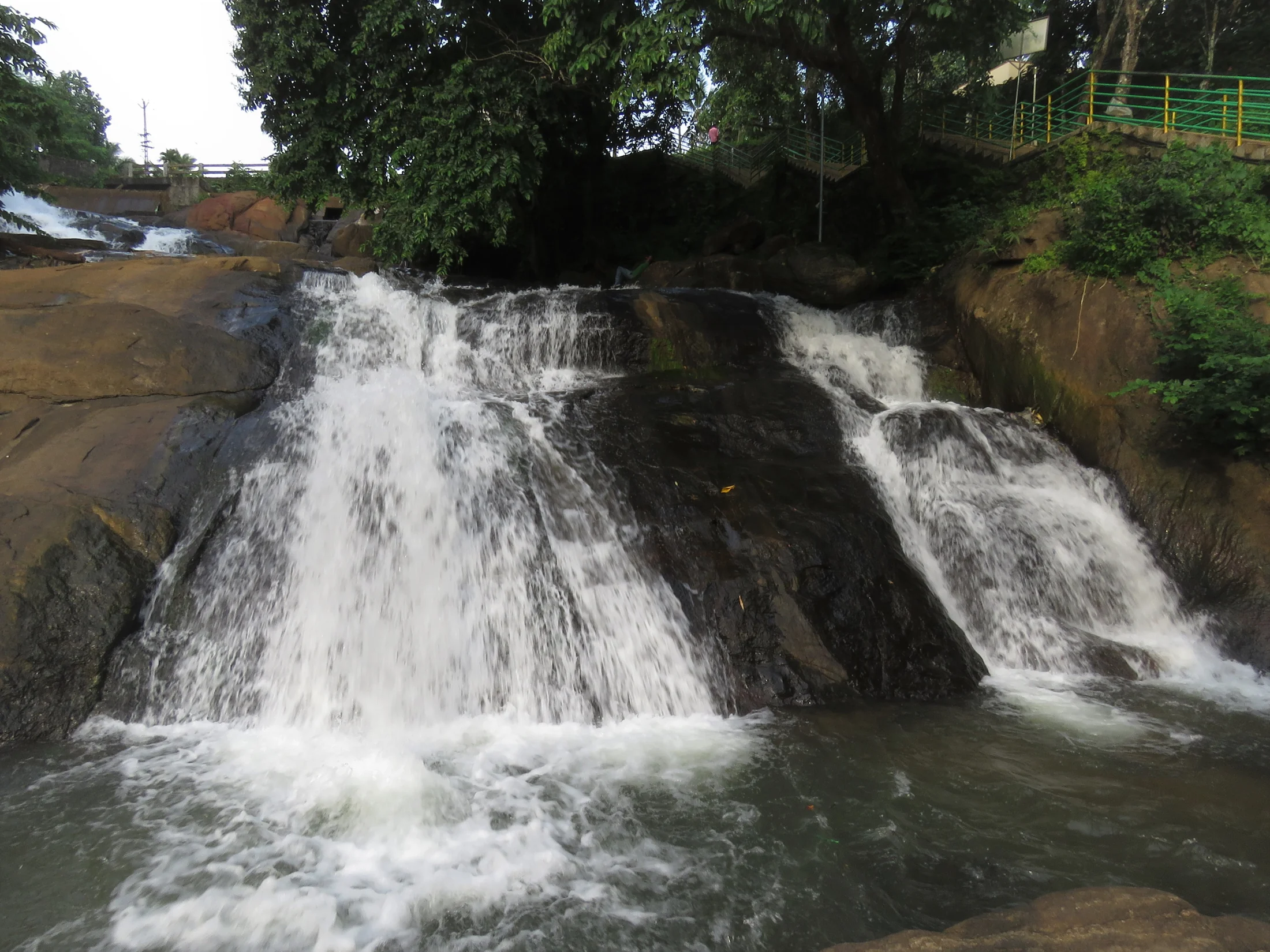
The bridge gives the scene its scale
The photograph shows a bridge crossing the channel above the stepped water. Unlike a tightly framed cascade image, it explains how closely a road structure and the waterfall setting sit together. That relationship is central to planning a short visit at Aruvikkuzhi.
The bridge is a practical landmark for arrival, but it is still part of the local road. A visitor should use a suitable permitted stopping arrangement and keep the crossing available for its ordinary traffic.
A useful map point is beside the water
Use the Aruvikkuzhi Bridge approach on the local road as the arrival reference. From there, follow the permitted pedestrian approach to the waterfall setting. Give the driver the bridge name when arranging the drop-off, and agree a waiting point that leaves the crossing clear.
A driver can understand a bridge approach, while a point in the river does not explain where to stop. Agree the actual waiting or pickup position without blocking the crossing, and make the final viewing stage on foot within the spaces currently permitted.
The nearby locality is Pallickathodu. Retaining that name with Aruvikkuzhi helps distinguish the final inland road journey from a general Kottayam or Kumarakom transfer.
Look at the relationship between crossing and cascade
The bridge’s horizontal line contrasts with the water’s downward movement. Rock steps below it divide the cascade, while vegetation contains the channel on either side. A wider frame can show all three elements and make the site more understandable than a photograph of white water alone.
That view does not require standing in a vehicle lane or leaning beyond a barrier. Use the permitted pedestrian space and allow the available angle to determine the image. If the approach is busy or slippery, shorten the pause rather than occupying an unsafe position for a preferred composition.
The same principle applies below the crossing. A photograph showing rock close to the water is not permission to descend into the channel. The bridge can serve as a landmark without every surface around it becoming a visitor route.
A compact visit can still be attentive
Aruvikkuzhi does not need to be turned into an extended trek to justify a stop. The crossing, the stepped water and the enclosed vegetation provide several distinct things to notice within a small setting. Leave enough time to observe them without rushing between a vehicle and a photograph.
Keep the return arrangement simple. Meet at the agreed road-side position and avoid leaving a vehicle on the bridge while members of the group take different routes around the water. A clear beginning and end make the short visit more comfortable for both visitors and local road users.
The bridge-side perspective gives Aruvikkuzhi a recognisable identity: a cascade closely connected to an inland road landscape, with the water visible as part of a place people also travel through. Respecting both uses is the basis of a good visit.
Sources: OSM Aruvikkuzhi Bridge approach, DTPC Kottayam and the photograph credited below.
Plan the visit: Aruvikkuzhi Waterfall.