Look at Ashtamudi Lake from above and it does not read as a lake at all — it reads as a hand pressed into the land, water reaching inland along eight long fingers. Coconut palms crowd the banks. Chinese fishing nets tilt over the shallows at dawn. Somewhere out on the water, a fisher is pulling up a basket of clams from a bed his family has worked for generations. This palm-shaped sheet of brackish water in Kollam is Kerala’s second-largest lake, a wetland of international importance, and — improbably — the setting for a small quiet revolution in how the world certifies sustainable seafood. This is its story.
A name that means “eight”
The name Ashtamudi is built from the Sanskrit-derived word ashta, meaning eight — the same root behind ashtami, the eighth lunar day. It is the second half that people argue about. Literally, mudi translates as peaks or hilltops, so the standard reading is “eight hills.” But locals more often describe the lake as “eight-braided,” pointing to the eight prominent arms or channels that branch out from the main body like the fingers of a palm or the limbs of an octopus. Either way, the eight is the point: the name is a description of the lake’s own shape, a piece of geography folded into a word. Few place names in Kerala are so literal about the thing they describe.
Second only to Vembanad
Ashtamudi covers roughly 61 square kilometres, which makes it the second-largest lake in Kerala, surpassed only by the vast Vembanad estuary further north. It is not a still freshwater pond but a living estuary — brackish where the tide pushes in from the Arabian Sea near Neendakara, fresher where the Kallada River feeds it from inland. That mixing is what makes it so productive. In 2002 the lake was designated a Ramsar site, a wetland of international importance under the global Ramsar Convention, recognition of the mangroves, fish, molluscs and migratory birds the estuary supports. It remains one of only a handful of such internationally listed wetlands in the state.
The gateway to the backwaters
Alappuzha usually gets top billing as Kerala’s backwater capital, but Kollam and its lake are where the network begins — which is why Ashtamudi is so often called the gateway to the backwaters. From here you can board what is billed as the longest backwater cruise in the state: the eight-hour public boat between Kollam and Alappuzha, run by the District Tourism Promotion Council. Departing around 10:30 in the morning and arriving by early evening, it threads a canal system that stitches together three great lakes — Ashtamudi, Kayamkulam and Vembanad — with a lunch stop at Alumkadavu and a tea break along the way. It is one of the few ways left to cross an entire slice of coastal Kerala the slow, old way, entirely by water.
India’s first certified-sustainable fishery
Ashtamudi’s most remarkable modern chapter is a story about a clam. The lake is home to a short-neck clam fishery — long identified as the species Paphia malabarica, though a 2018 paper in ZooKeys showed that name was wrong twice over and that the clam actually fished here is Marcia recens — that supports around three thousand people who collect, clean, process and trade the shellfish. In the boom years of the 1980s and 1990s, demand from Vietnam, Thailand and Japan drove the annual catch to a peak near 10,000 tonnes, and then, predictably, it crashed by roughly half in 1993 from overfishing. What happened next is the interesting part. Guided by research from the Central Marine Fisheries Research Institute, the community accepted a closed season, minimum mesh sizes, a minimum export size and a ban on mechanised clam collection. The catch recovered. In November 2014 the Ashtamudi short-neck clam fishery became the first fishery in India — and only the third in Asia — to earn Marine Stewardship Council certification, the blue-tick eco-label for sustainable seafood. A crash became a case study in recovery. It did not last: the certificate was suspended in February 2020 and the MSC now lists the fishery as Withdrawn — and, as the paperwork makes clear, not because anything went wrong with the clams.
The old port of Quilon
Kollam, the city on the lake’s right bank, was once Quilon — a port so important it lent its name to an entire era of Kerala’s calendar. For centuries this was one of the busiest trading harbours on the Malabar coast, its wharves handling spices, textiles and goods bound across the Indian Ocean. The Moroccan traveller Ibn Battuta, who journeyed through in the 14th century, singled out Quilon as one of the finest and most significant trading towns he encountered. That commercial pulse never fully faded. To this day the lake and the nearby Neendakara harbour move the trade of a region famous for two things above all — cashew, which Kollam processes and exports on an industrial scale, and coir, the golden fibre spun from coconut husk soaked in these very backwaters.
Munroe Island, where the land is sinking
Tucked inside the lake, at the point where the Kallada River empties into it, lies Munroe Island — not one island but a cluster of tiny islets laced together by narrow canals. Named after Colonel John Munro, a British Resident of the old Travancore state, it is a place best seen from a low country canoe that can slip under the pontoon footbridges and through channels too shallow for anything larger. It is also a landscape under quiet threat: parts of Munroe Island are slowly subsiding, the water creeping into homes and paddy, a reminder that a wetland this delicate lives in a constant negotiation with the sea. For visitors it offers the most intimate version of Ashtamudi — village life at the waterline, coir-making, and herons stalking the shallows.
A wetland alive at dawn and dusk
Spend a morning or an evening on Ashtamudi and you understand why the Ramsar listing matters. At first light the cantilevered Chinese fishing nets dip and rise along the shore, silhouetted against a pale sky, egrets lined along the booms waiting for scraps. The mangrove fringes shelter fish nurseries and a shifting cast of waterbirds, resident and migratory. Houseboats — the same kettuvallam craft that made Kerala’s backwaters famous — drift out for slow overnight cruises, and smaller shikara-style canoes handle the tighter channels. It is a working lake and a wild one at the same time, which is precisely the balance the wetland designation, and the clam certification, were designed to protect.
Visiting Ashtamudi Lake
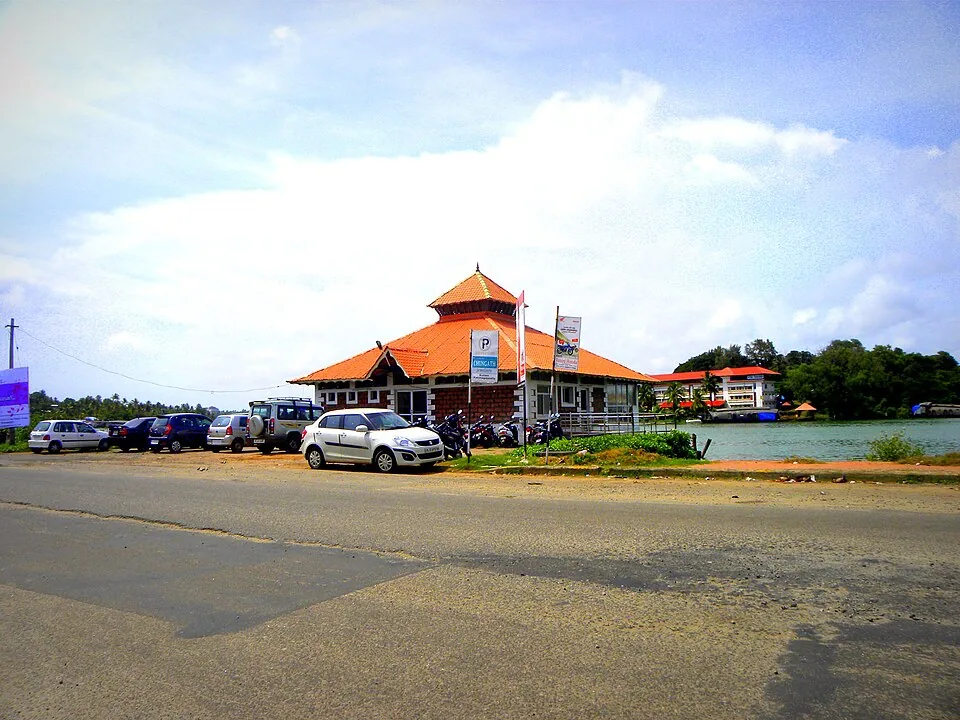
Ashtamudi Lake sits right at the edge of Kollam town, easily reached from the Kollam railway station and KSRTC bus stand, and about 70 kilometres south of Thiruvananthapuram. The main boat jetty and the DTPC office are the places to arrange the long Kollam–Alappuzha cruise, shorter houseboat trips, or a canoe outing to Munroe Island; the November-to-March cool season is the most comfortable time, and peak-season cruise tickets can sell out, so arrive early. Plan your route and find nearby stays and things to do around Ashtamudi Lake, and browse more of the district through the Kollam hub.
Frequently asked questions
What does the name Ashtamudi mean?
It comes from ashta, meaning eight. The literal reading of mudi is peaks or hills, but the lake is popularly described as “eight-braided,” referring to the eight arms or channels that branch out from it like the fingers of a palm — a name that mirrors the lake’s own shape.
Why is Ashtamudi Lake famous?
It is Kerala’s second-largest lake, a Ramsar-designated wetland of international importance since 2002, the gateway to the Kollam–Alappuzha backwater cruise, and home to the short-neck clam fishery that in 2014 became the first Marine Stewardship Council certified sustainable fishery in India — a certificate that was suspended in February 2020 and is now listed as withdrawn, for reasons of paperwork rather than of clams.
What is the Kollam to Alappuzha backwater cruise?
It is billed as the longest backwater cruise in Kerala — an eight-hour public boat run by the District Tourism Promotion Council that links the Ashtamudi, Kayamkulam and Vembanad lakes by canal, departing Kollam mid-morning and reaching Alappuzha by early evening.