On 4 January 1889 a pattemari — a country sailing craft — lay off the premises of Brunton and Co. on the Fort Kochi waterfront, and caught fire.
Wind and current pushed the burning vessel towards the shore. What it drifted into was a working port frontage built largely of timber under thatched roofs, packed with warehouses full of exactly the sort of cargo that burns: coir, timber, oil, spices in sacking. Around three hundred houses and commercial properties were destroyed.
Aspinwall House was among them.
Why this matters when you are standing in the quarter
Fort Kochi is sold as a colonial heritage quarter and read by most visitors as continuous — five hundred years of European building, still standing. A good deal of it is not. The waterfront strip in particular is substantially a post-1889 town wearing a much older name, and once you know the date you start seeing it: the uniformity of certain runs of godown, the absence of anything timber-framed on the front line, the pattern of what survived and what did not.
Aspinwall is the clearest single case. The company was founded in 1867 by an English trader, John H. Aspinwall, who took over the business of Scott Brothers. The compound standing today dates from after the fire, generally given as 1890. So when someone tells you that you are looking at an 1867 building, the arithmetic simply does not hold — you are looking at the replacement, put up by a firm that had just watched its warehouses burn.
- Date: 4 January 1889, at Fort Kochi.
- Cause: a pattemari — a country sailing craft — lying off the premises of Brunton and Co. caught fire.
- Spread: strong wind and current drove the burning craft ashore into timber warehouses with thatched roofs.
- Damage: around 300 houses and commercial properties destroyed.
- Aftermath: Aspinwall’s premises among the losses; the present compound dates from about 1890.
The man, and what the town thought of him
John Aspinwall was not a distant proprietor. He presided over the Cochin Chamber of Commerce and served as Chairman of Fort Kochi Municipality from 1875 to 1878, and when news of his death reached Kochi, shops and businesses across Fort Kochi are recorded as having shut as a mark of respect. That is an unusual tribute for a foreign trader and a fair measure of how completely the firm had knitted itself into the town.
The firm’s ledger is the economic history of Kerala in a list: coconut oil, pepper, timber, lemongrass oil, ginger, turmeric, spices and hides, and later coir, coffee, tea and rubber. The first half of that list is ancient Malabar. The second half — tea, coffee, rubber — is the colonial plantation economy, and its appearance marks the point at which Kerala’s uplands were remade to feed European demand.
What you can and cannot see
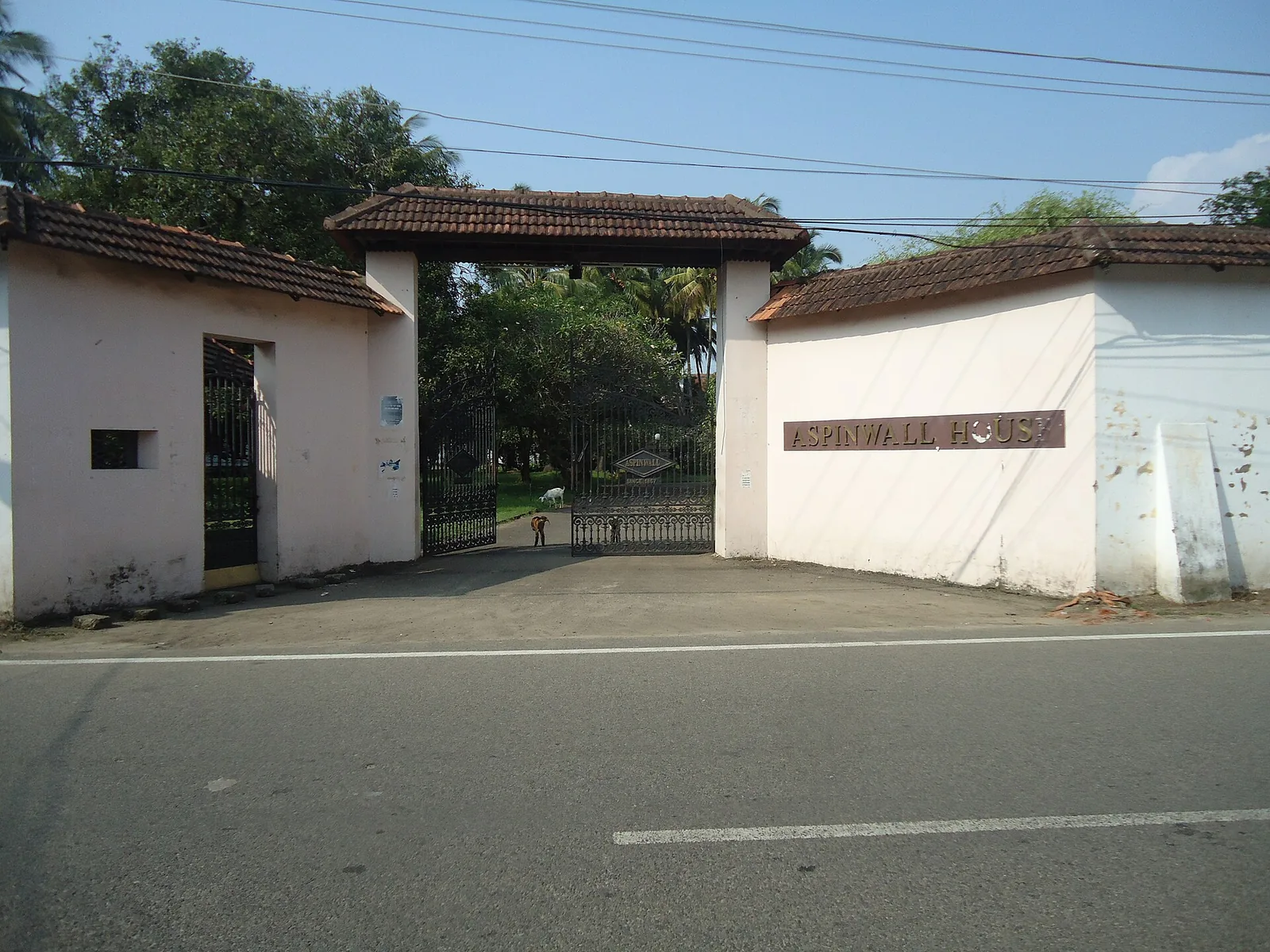
This is the part that disappoints someone every week. Aspinwall House is privately owned and is not a public monument. It opens principally as the main venue of the Kochi-Muziris Biennale, on the Biennale ticket, and typically only parts of it — the coir godown and the director’s bungalow — are given over to visitors. Between editions the gates are often simply shut.
During a Biennale it is the best exhibition space in India and worth two to four hours. Outside one, it is a five-minute look at a gate — and now, at least, a gate with a date and a burning ship behind it.
Frequently asked questions
What was the great fire of Cochin?
A fire on 4 January 1889 at Fort Kochi. A pattemari — a country sailing craft — lying off the premises of Brunton and Co. caught fire, and wind and current drove the burning vessel ashore into timber warehouses with thatched roofs. Around 300 houses and commercial properties were destroyed.
Is Aspinwall House really from 1867?
No. Aspinwall & Company was founded in 1867, but the 1889 fire destroyed its premises, and the compound standing today dates from after that, generally given as 1890. The date belongs to the company, not the building.
Who was John Aspinwall?
An English trader who took over the business of Scott Brothers in Cochin in 1867 and founded Aspinwall & Company. He presided over the Cochin Chamber of Commerce and was Chairman of Fort Kochi Municipality from 1875 to 1878; shops across Fort Kochi are recorded as closing on news of his death.
Can I visit Aspinwall House any time?
No. It is privately owned and not a general walk-in attraction. It opens principally as a Kochi-Muziris Biennale venue on the Biennale ticket, with no standing public timetable between editions. Check the Kochi Biennale Foundation’s current listings before planning a visit.
How much of the compound is open to visitors?
Typically only parts of it — the coir godown and the director’s bungalow are the spaces usually given over. The rest of the estate stays private.
How much of Fort Kochi burnt in 1889?
Around 300 houses and commercial properties, concentrated on the waterfront where the burning craft came ashore. It is a large part of why the “colonial quarter” along the front is substantially a rebuild of about 1890 rather than a continuous survival from earlier centuries.