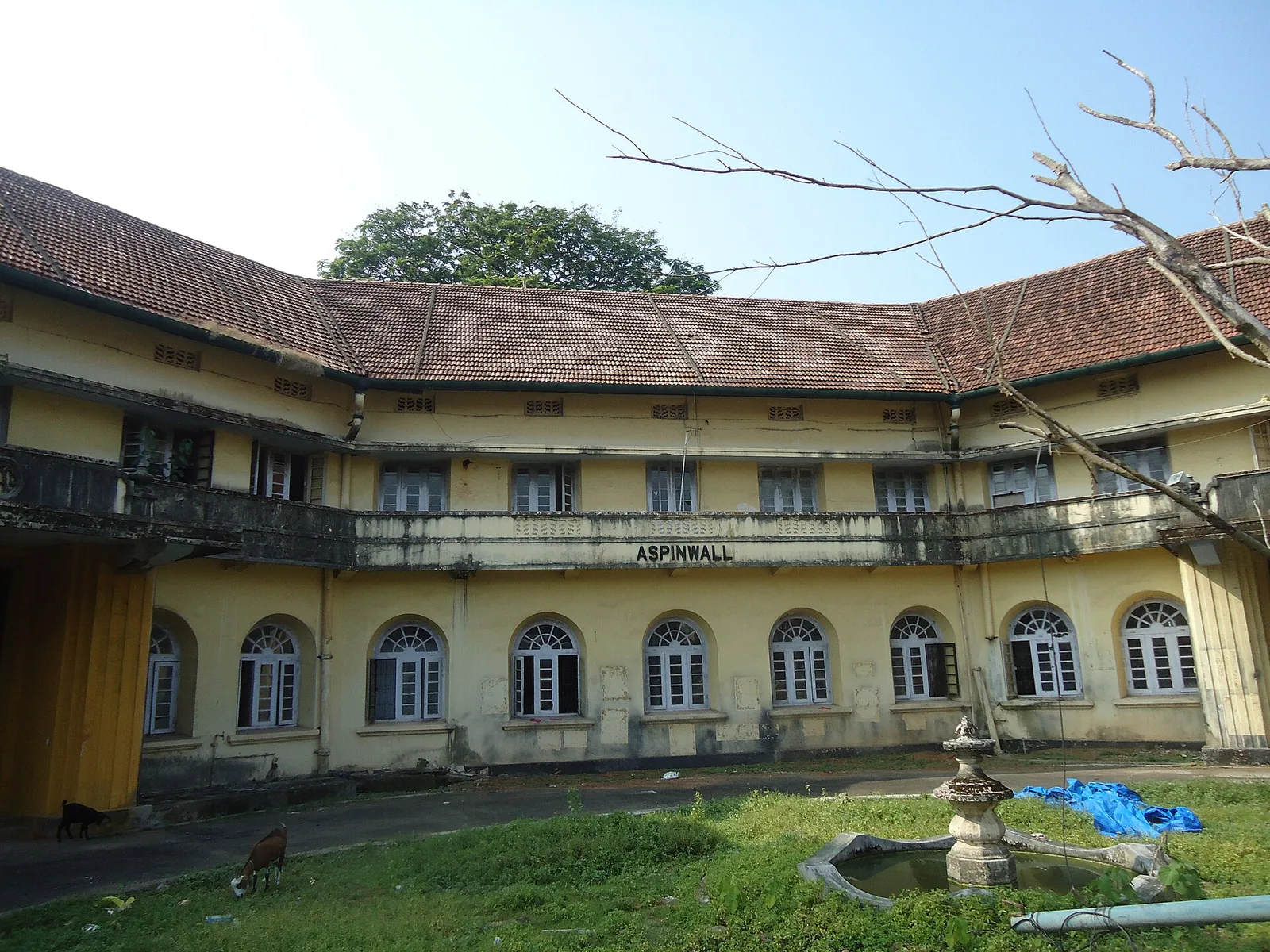
Almost everyone who walks into Aspinwall House for the Biennale reads it as a ruin that art rescued — a colonial trading compound whose company died with the empire, left standing until curators found a use for it. That is not what happened. The company is still there. It never stopped trading, and the ownership of it changed hands in a direction nobody expects.
It began as a purchase, not a founding
The date on every account is 1867, and it is usually told as the year an Englishman arrived and built a trading house. He bought one. What John H. Aspinwall acquired that year was the existing business of Scott Brothers; what he did afterwards was put his name on it and expand it — into shipping alongside timber, spices and agricultural produce.
He then became part of the town rather than merely a trader in it. He presided over the Cochin Chamber of Commerce and served as Chairman of Fort Kochi Municipality from 1875 to 1878. When news of his death reached Kochi, shops and businesses across the quarter are recorded as having closed as a mark of respect — an unusual thing for a foreign merchant, and a measure of how far the firm had embedded itself.
The ledger is Kerala’s economic history
What passed through these godowns is worth reading slowly: coconut oil, pepper, timber, lemongrass oil, ginger, turmeric, spices and hides — and later coir, coffee, tea and rubber.
The first half of that list is ancient Malabar. The second half is not. Tea, coffee and rubber are plantation crops of the colonial economy, and their arrival in the company’s books marks the moment Kerala’s uplands were remade to supply European demand. One firm’s trade list, in order, is the whole transition.
What you are looking at was built after a fire
The compound is not the 1867 premises. On 4 January 1889 a burning vessel drove ashore into a waterfront of timber godowns under thatch, and the fire took something on the order of three hundred properties in Fort Kochi, Aspinwall’s among them. The buildings standing today are the replacement, generally dated to 1890.
Which is the quiet joke of the Biennale. The long spans, the high roofs, the wide cargo doors and the unbroken floors that curators covet are the proportions of a cargo shed put up quickly by a firm doing disaster recovery. The spaces work as galleries because nobody was trying to make one.
The part nobody mentions
Aspinwall and Company did not become history. It is one of the oldest commercial firms on the Malabar coast and it is still headquartered in Kochi, still a listed company, with businesses in shipping and logistics, coffee trading and export, coir, rubber plantations and tourism.
And the ownership moved. In 1956 the firm became a public limited company, and the royal family of Travancore acquired a shareholding. In the early 1970s the English owners decided to disinvest, and the family took over the major part of the stock. It has held the controlling interest ever since.
- 1867 — John H. Aspinwall buys the business of Scott Brothers and renames it.
- 1889 — the great Fort Kochi fire destroys the premises; rebuilt c. 1890.
- 1956 — the firm becomes a public limited company; the Travancore royal family takes a shareholding.
- Early 1970s — the English owners disinvest; the family acquires the major part of the stock.
- Today — still listed, still trading: shipping and logistics, coffee, coir, rubber, tourism.
- 2012 onwards — the Kochi-Muziris Biennale is a tenant here, not the owner.
Stand in the coir godown during a Biennale and take that in. An international art festival, much of it concerned with empire and its aftermath, is hosted in a British colonial trading compound whose controlling stake was bought out by a Kerala royal family half a century ago. The ownership of the place quietly did the thing the art on its walls tends to argue for. There is no plaque about it anywhere on site.
Why this decides your visit
Because it explains the frustration. Aspinwall House has no opening hours, no ticket counter between Biennales and no obligation to let anyone in, and that is not neglect — it is corporate property belonging to a going concern. The compound opens principally as a Biennale venue, on the Biennale’s ticket, and typically only parts of it are given over: the coir godown and the director’s bungalow. The rest is private.
So check the Kochi Biennale Foundation’s current listings before you build a morning around it. Arriving to find the gates shut is the commonest wasted journey in Fort Kochi, and the reason is simply that you turned up at a company’s premises on a day it was not lending them out.
Frequently asked questions
Does Aspinwall & Company still exist?
Yes. It is one of the oldest commercial firms on the Malabar coast, still headquartered in Kochi and still a listed company, with businesses in shipping and logistics, coffee trading and export, coir, rubber plantations and tourism. The Fort Kochi compound is its property, not a museum.
Who owns Aspinwall House?
The controlling interest in Aspinwall and Company is held by the royal family of Travancore. The family took a shareholding in 1956, when the firm became a public limited company, and acquired the major part of the stock in the early 1970s when the English owners disinvested.
Did John Aspinwall found the company from scratch?
No — he bought it. In 1867 he acquired the existing business of Scott Brothers in Cochin and renamed it after himself, then expanded it into shipping, timber, spices and agricultural produce. He went on to preside over the Cochin Chamber of Commerce and to serve as Chairman of Fort Kochi Municipality from 1875 to 1878.
Is the building from 1867?
No. The great Fort Kochi fire of 4 January 1889 destroyed the premises along with some three hundred other properties in the quarter, and the compound standing today is the post-fire rebuild, generally dated to 1890.
Why can’t I just walk in?
Because it is private corporate property, not a public monument. It opens principally as a venue of the Kochi-Muziris Biennale, on the Biennale ticket, and only parts of the estate — usually the coir godown and the director’s bungalow — are given over to visitors. There is no standing public timetable between editions.
What was actually traded here?
Coconut oil, pepper, timber, lemongrass oil, ginger, turmeric, spices and hides, and later coir, coffee, tea and rubber. The older items are traditional Malabar exports; tea, coffee and rubber are plantation crops of the colonial economy, and their appearance in the company’s trade marks the remaking of Kerala’s uplands for European demand.