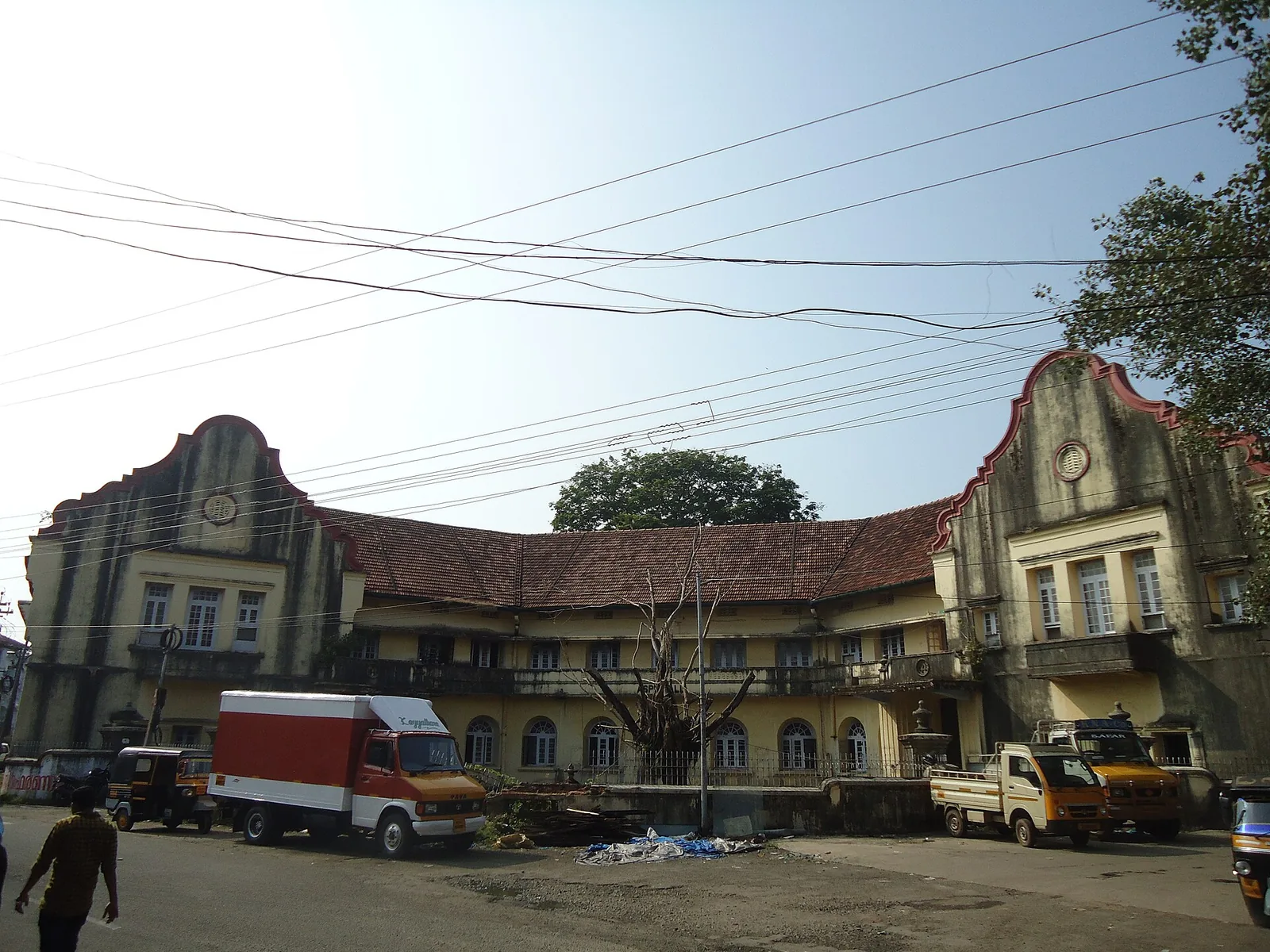
Most art spaces are built to be art spaces. Aspinwall House was built to move pepper, and it shows — which turns out to be the whole point.
The compound sits on the Fort Kochi seafront: a long, low run of colonial-era offices, godowns and open yards facing the harbour, with the water close enough that the trade it was built for makes immediate sense. It is now the principal venue of the Kochi-Muziris Biennale, and for a few months every other year it holds the largest contemporary art exhibition in India.
The trading house
Aspinwall & Company was established in Cochin in the second half of the nineteenth century by an English trader, John H. Aspinwall, and it dealt in what this coast has always sold: black pepper and other spices, coir, coconut oil, timber and related produce, shipped out through the harbour the compound faces. It was a working business rather than a residence, and the architecture is the architecture of storage and shipping — thick walls, wide doors, deep shade, floors built for weight.
The company outlived the empire that founded it, passing into Indian ownership in the twentieth century and continuing as a commercial concern. Precise ownership history and the current status of the buildings are matters for the company and the Biennale foundation rather than for a travel guide, and this page does not attempt to settle them.
Why the Biennale went there
The Kochi-Muziris Biennale launched in 2012, founded by the artists Bose Krishnamachari and Riyas Komu under the Kochi Biennale Foundation, and it did something unusual for a large international art event: instead of commissioning a building, it moved into the ones already standing empty.
That decision is why the show feels the way it does. Work is hung in rooms with salt damage, in godowns with the roof structure exposed, in yards that still read as loading areas. A video installation in a room that smelled of coir for a century carries a charge that the same work in a white cube does not. The buildings are not a backdrop to the art; they are the reason a Biennale in a small peninsula town became a serious international fixture rather than a provincial imitation of one.
The Muziris in the name
The second half of the Biennale’s name points at something that is not there. Muziris was the ancient port of this coast, trading with Rome and named in classical sources, and it is generally thought to have been rendered unusable when catastrophic flooding silted its harbour and shifted the Periyar — the same event tradition credits with opening Kochi’s own harbour in 1341. Archaeological work at Pattanam, north of Kochi, is the main modern evidence for the site.
Invoking Muziris frames the Biennale as a return rather than an arrival: an argument that this coast was cosmopolitan and outward-facing two thousand years before anyone called it that. Whether a contemporary art festival can inherit a Roman-era port is a fair question, and the claim is a curatorial one rather than a historical finding.
What this means if you turn up
Aspinwall House is a fundamentally different visit depending on the calendar. During a Biennale it is a several-hour proposition and the single biggest thing to do in Fort Kochi. Between editions there is far less to see, and visitors who arrive expecting a permanent museum are routinely disappointed — the venue is not one. Check whether an edition or an associated programme is running before you build a day around it.
Frequently asked questions
What was Aspinwall House originally?
A seafront trading compound in Fort Kochi belonging to Aspinwall & Company, established in Cochin in the later nineteenth century by the English trader John H. Aspinwall. It handled pepper and other spices, coir, coconut oil and timber shipped through Kochi harbour.
Is Aspinwall House a museum?
No. It is the main venue of the Kochi-Muziris Biennale, so it holds a major contemporary art exhibition during Biennale editions and has much less to see between them. It has no permanent collection.
When did the Kochi-Muziris Biennale start?
It launched in 2012, founded by the artists Bose Krishnamachari and Riyas Komu under the Kochi Biennale Foundation. It is India’s largest contemporary art exhibition.
Why is it called the Kochi-Muziris Biennale?
Muziris was the ancient Roman-era trading port of this coast, thought to have been destroyed or silted up by flooding, with Pattanam north of Kochi the leading candidate site. The name frames the festival as a continuation of the coast’s long history of outside contact.