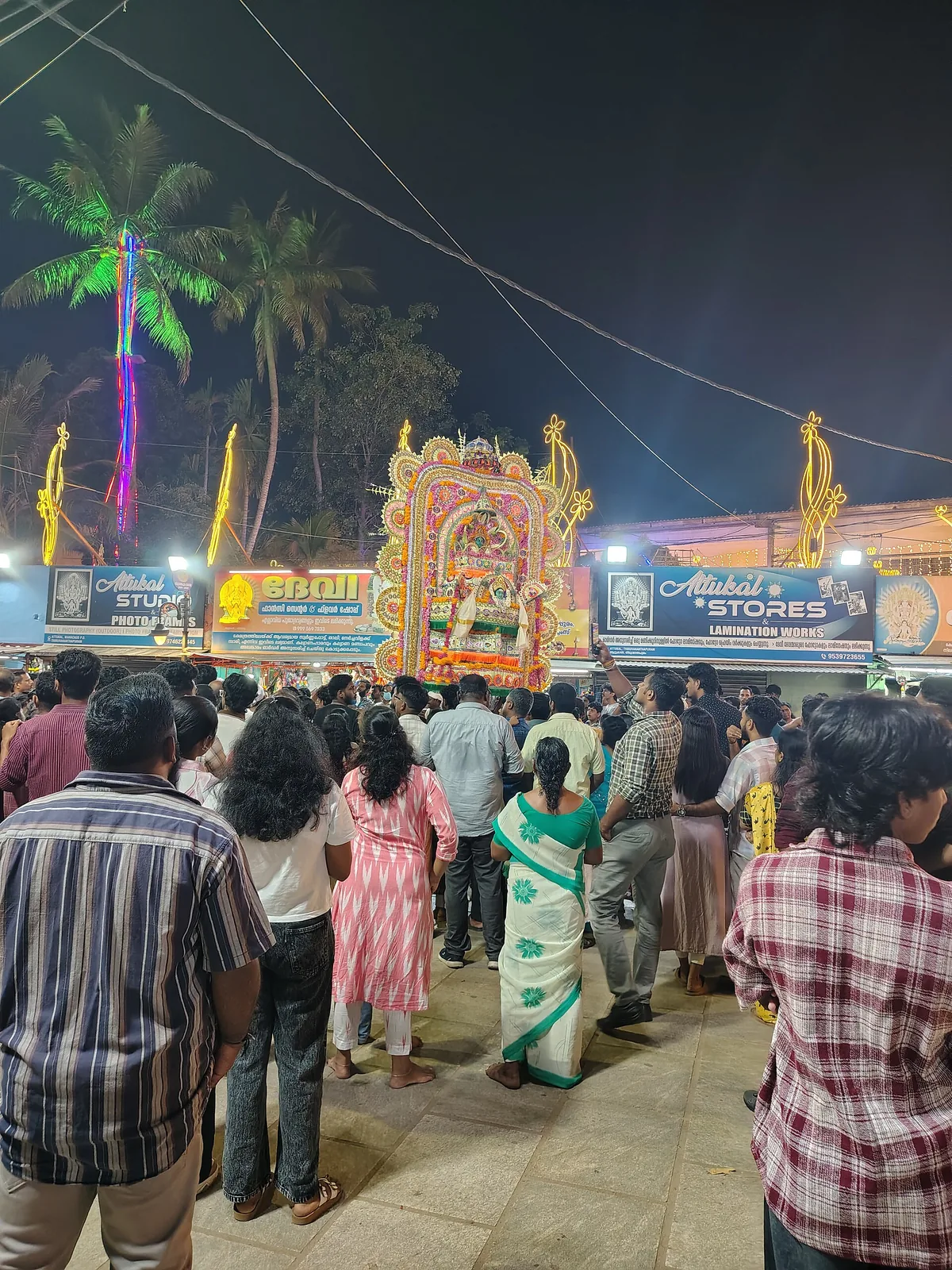
Search for the Attukal Pongala and you will read, in a great many places, that the festival breaks its own world record every year. It does not. It holds exactly one certified record, it was set on 10 March 2009, and it has never been superseded — not because the crowds have shrunk, but because nobody has counted them to the standard a record requires. The gap between those two statements is the most interesting thing about the numbers attached to this festival, and it says something about what happens when a neighbourhood shrine on the Killi river becomes an event with the population of a large city.
The record, precisely
The entry is specific and checkable. Guinness World Records lists the largest annual gathering of women as 2.5 million, achieved in an event organised by the Attukal Bhagavathy Temple Trust in Kerala on 10 March 2009. That is the whole of it: a named holder, a date, a figure. There is also an earlier entry, dated 23 February 1997 and usually quoted at 1.5 million, which is repeated in almost every article on the subject — including, until recently, ours — but which does not appear in the record Guinness publishes today. We now pass that one on as received tradition rather than as something we have been able to verify.
And the numbers since
Reported crowds have kept climbing. Three million, then four; the 2026 festival was widely reported at around forty lakh. Those figures are almost certainly in the right region — the offering grounds have visibly spread across more of the city over two decades. But they are estimates made on the day by police, organisers and the press, and no published methodology explains how they are arrived at. That is not a criticism of anyone. It is a genuinely hard measurement problem: the crowd is not in a stadium with turnstiles, it is distributed along tens of kilometres of street, pavement, rooftop, railway platform and open ground, it assembles before dawn, and much of it disperses within a couple of hours of the pots boiling over. Counting it properly would be a serious remote-sensing exercise, and there is no particular reason for the temple to fund one.
Why nobody has re-certified it
A Guinness record is not an observation, it is an evidenced claim — it needs a defined counting method, documentation and adjudication, all organised in advance by whoever wants the title. The Trust pursued that in 2009 and got it. Having got it, the incentive to repeat an expensive and logistically brutal audit is close to zero: the temple already holds the record, the phrase ‘largest gathering of women in the world’ is already attached to it in every guidebook, and on the day the Trust has several million people’s safety to think about. So the record sits where it was left. The honest formulation, and the one we now use across this site, is that Attukal holds a 2009 record for 2.5 million and today draws crowds that are plausibly considerably larger but uncounted.
What hosting it actually takes
Strip out the record and the logistics remain astonishing. For one morning Thiruvananthapuram gives its public space over to cooking fires: roads close, traffic is rerouted across the whole city, transport runs to festival timetables and is overwhelmed anyway, and accommodation is gone weeks ahead. Water has to reach people spread over kilometres. So does sanitation. So do medical teams, because a dense crowd of that size in February heat, much of it elderly, tending open flames on tarmac, is a public health operation whatever else it is. And then the bricks — hundreds of thousands of three-brick hearths — have to be cleared, along with the ash, and the streets returned to use. Coordinating that has turned the Attukal Bhagavathy Temple Trust into something closer to an events authority than a shrine committee.
The scale is not the point, which is why it survives
It is worth ending where the numbers do not reach. What makes the Pongala unusual is not its size but its structure: there is no procession at the centre of it, no stage, no ticketed enclosure, no priest at each fire. There are only rows of women on open ground, cooking the same dish at the same hour, with a flame that was passed hand to hand from the temple’s own hearth. Most of the people who come will never enter the sanctum at all; their temple for the day is the patch of pavement where their pot sits. A festival built that way does not need a record to justify it, and would be exactly the same event if the record were withdrawn tomorrow.
If you are planning around it
Assume the city is closed to ordinary movement on Pongala day and plan accordingly, or plan deliberately for one of the quieter festival evenings instead — we have set out the full ten-day sequence in Nine Nights Before the Fire. Dates follow the Malayalam calendar and move each year. Timings, access and dress notes are on the Attukal Bhagavathy Temple page.
Frequently asked questions
Does the Attukal Pongala break a world record every year?
No. It holds one certified record — 2.5 million women, on 10 March 2009 — which has never been superseded. Larger crowds since then are day-of estimates by police, organisers and the press, not new certifications.
What exactly does the Guinness record say?
That the largest annual gathering of women is 2.5 million, achieved in an event organised by the Attukal Bhagavathy Temple Trust in Kerala, India, on 10 March 2009.
Was there a 1997 record too?
It is very widely reported — usually as 1.5 million on 23 February 1997 — but it does not appear in the record Guinness publishes today. Treat it as received tradition rather than a verified figure.
How many women attend now?
Recent festivals are reported at roughly three to four million, with the 2026 festival put at around forty lakh. These are estimates made on the day; no published method explains how a crowd distributed across an entire city is counted.