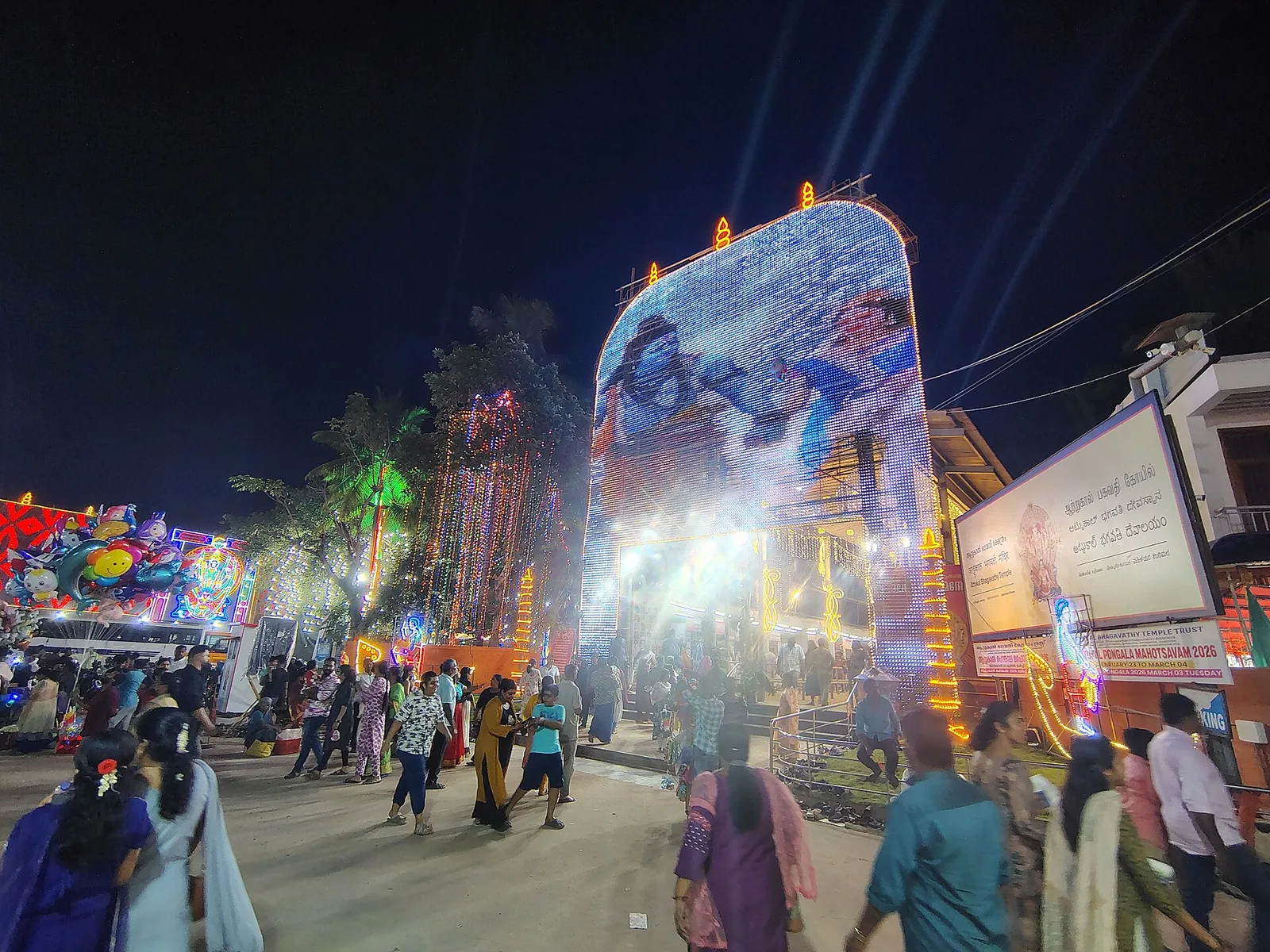
Almost everyone who knows the Attukal Bhagavathy Temple knows exactly one morning of its year: the Pongala, when several million women fill the streets of Thiruvananthapuram with small brick hearths and the city disappears under woodsmoke. That morning is genuinely extraordinary. It is also the ninth day of ten, and the temple itself treats the nine nights leading up to it as the festival proper. They are almost entirely uncrowded, they are where the ritual substance of the thing actually lives, and a visitor who turns up on the right evening can stand a few feet from all of it.
The bracelet and the sword
The festival opens with the Kappukettu, and the detail worth knowing is who gets invoked. The presiding deity here is understood by devotees as Kannaki, heroine of the Tamil epic Silappadikaram — but the ceremony that begins her festival calls in Kodungallur Bhagavathy, the great Bhadrakali of central Kerala, into the Goddess’s sword. The kappu itself is a bracelet, prepared under strict observance, brought to the temple, sprinkled with holy water and handed to the Melshanti, the chief priest. Two are tied: one onto the sword, one onto the priest’s own wrist. From that moment the priest is bound to the festival and cannot step outside its disciplines until it ends. It is a small, precise piece of ritual engineering — the human officiant and the divine weapon put under the same vow at the same instant.
Nine nights of the Kannaki story, told in instalments
Then the singing starts. Each evening for the first nine nights, an asan — a lead singer — and his troupe perform the Thottam Pattu, drawing on the Kannaki Charitam, the story of Kannaki. This is not a recital of highlights. It is serialised: the epic is worked through in nightly instalments, so that the narrative arrives at its end just as the hearths are being built outside. By the time the pots boil over on the ninth morning, the story of the wronged wife who burned Madurai has been sung to completion in the courtyard. The women cooking in the street are, whether they can hear the singing or not, cooking at the exact point in the story where Kannaki is done with her grief. Sitting through one of these evenings is the single best way to understand why the Pongala feels the way it does.
The third day, when the boys begin
On the third day another observance begins, and it is the one part of the festival that has drawn public argument. A group of young boys enter a seven-day vow called Kuthiyottam, living at the temple, eating plainly, bathing three times a day and performing repeated prostrations, before dancing to drums on the Pongala morning in ceremonial dress. Its meaning is understood as a symbolic substitute for human sacrifice, the boys standing in for the wounded soldiers of the Goddess. At some temples it ends with a thin piercing of a fold of skin, and in 2018 that drew a formal complaint from Kerala’s child rights commission. We have written about the vow, its symbolism and the argument around it separately, in The Boys Who Keep the Vow.
The first fire is the temple’s own
On the ninth morning the ignition sequence matters. The first hearth lit is not a devotee’s but the Pandara Aduppu, the temple’s own, inside the compound. Every other fire in the city descends from it: the flame is carried out and passed from pot to pot, hearth to hearth, until it has travelled kilometres in every direction. Nobody lights their own. Alongside it comes the Thalappoli, in which girls process with lamps and flowers, and then the offering itself — rice, jaggery, coconut, ghee and plantain simmered in earthen pots until the mixture froths over the rim, which is the sign the Goddess has accepted it. Priests move through the streets sprinkling holy water to consecrate what has been cooked. Then, remarkably quickly, several million people pack up and go home.
And the night after
The festival does not end with the Pongala, which is the second thing most accounts get wrong. There is a tenth day, and it closes on that night with the Kuruthi Tharpanam, a pooja that formally releases what the Kappukettu bound ten days earlier. By then the streets have been swept, the bricks have been carted away and the city has gone back to being a city. The shape of the whole thing is worth holding onto: it is bound at one end and released at the other, and the vast public morning everyone photographs sits inside that frame rather than being the frame itself.
Coming on one of the quiet nights
The practical takeaway is that the best value visit to Attukal during its festival is not on Pongala day at all. On Pongala day the roads close, the trains and buses are impossible, accommodation has been booked out for weeks, and as a visitor you will mostly experience a very large crowd from behind. On the second, fourth or sixth evening you will find the Thottam Pattu in progress, the temple lit and busy, food stalls up, and room to stand. Dates move with the Malayalam calendar — the 2026 festival ran from 23 February to 4 March with the Pongala on 3 March — so confirm the current year’s dates before booking anything. Full timings, access and dress notes are on the Attukal Bhagavathy Temple page.
- Day 1 — Kappukettu: Kodungallur Bhagavathy invoked into the sword; the kappu bracelet tied to sword and chief priest.
- Nights 1–9 — Thottam Pattu: the Kannaki story sung in nightly instalments by the asan and his troupe.
- Day 3 — the Kuthiyottam boys begin their seven-day vow.
- Day 9 — Pongala: the Pandara Aduppu lit first, the Thalappoli procession, then the citywide offering.
- Night 10 — Kuruthi Tharpanam closes the festival.
Frequently asked questions
Is the Attukal Pongala a one-day festival?
No. It is the ninth day of a ten-day festival. The nine evenings before it carry the Thottam Pattu recitation of the Kannaki story, and the festival is formally closed on the tenth night with the Kuruthi Tharpanam.
What is the Kappukettu?
The ceremony that opens the festival. The priest invokes Kodungallur Bhagavathy into the Goddess’s sword, and a bracelet called the kappu is tied both to the sword and to the wrist of the chief priest, binding him to the festival’s observances until it ends.
Who lights the first hearth on Pongala day?
The temple does. The first fire is the Pandara Aduppu inside the temple compound, and the flame is then passed outward from pot to pot across the city, so that every hearth descends from that single source.
When should I visit if I want ritual without the crowds?
One of the earlier festival evenings, when the Thottam Pattu is being performed. Pongala day itself means road closures, packed transport and accommodation booked out weeks ahead. Festival dates follow the Malayalam calendar and shift each year.