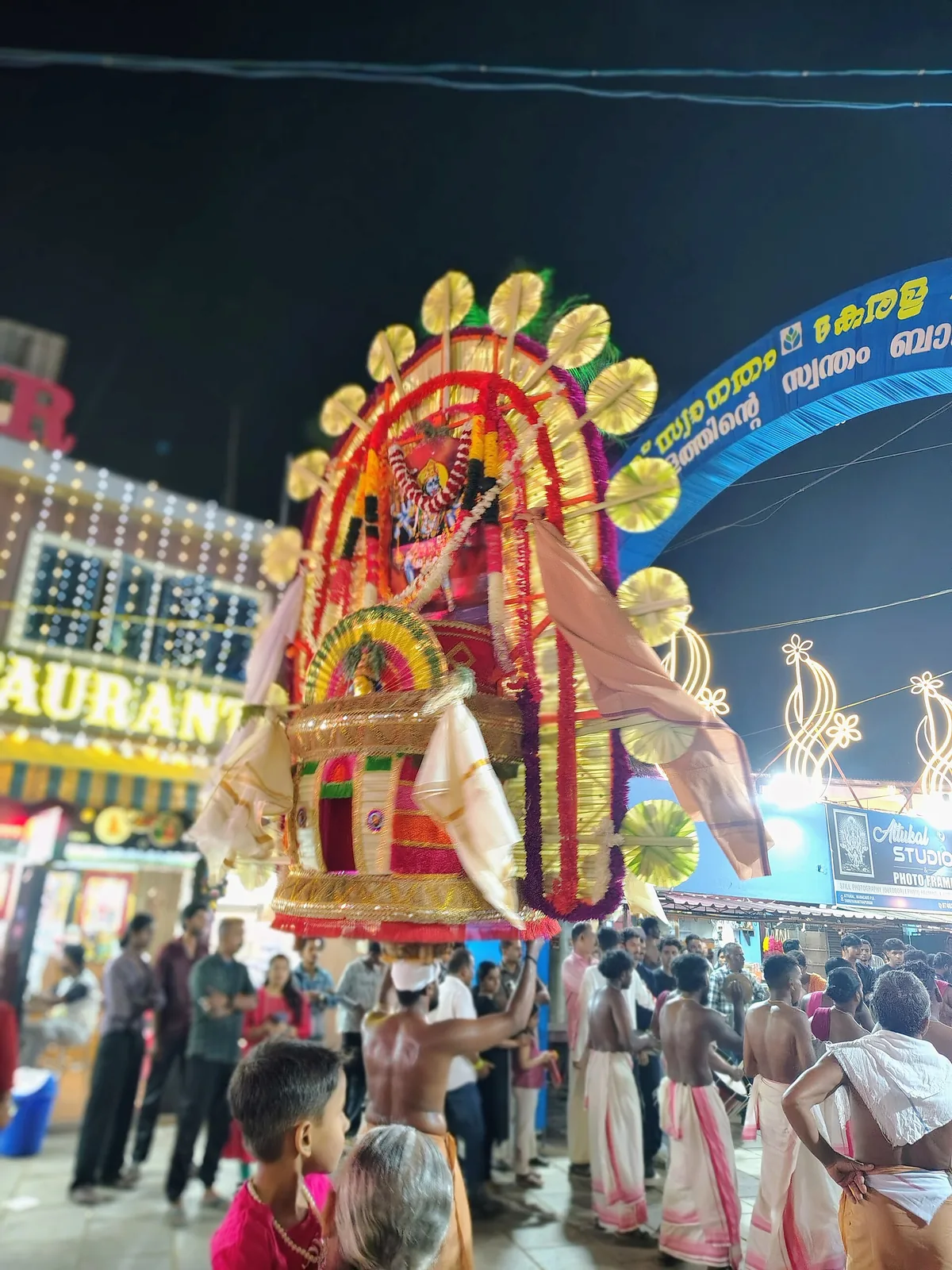
The Attukal Bhagavathy Temple is known worldwide for an offering made by millions of women. Its oldest and strangest offering is made by a few dozen boys. Kuthiyottam is a vow kept by children during the temple’s ten-day festival, and it is simultaneously one of the most respected observances in the shrine’s calendar and the only part of it that has been the subject of a formal complaint to a state child rights commission. Both of those things are true, and a page about this temple that mentions only the first is not describing the place honestly.
What the vow involves
The boys are young — commonly described as between about five and twelve. From the third day of the festival they enter a seven-day observance, the Kuthiyotta Vratham, which ends on the Pongala morning. For that week they live at the temple rather than at home, sleep on the floor, keep to a plain vegetarian diet, and bathe three times a day. They are set a discipline of repeated prostrations before the Goddess after the morning and evening oblations, a count usually given as 1,008. On the final morning they are dressed in ceremonial costume and perform as singers and dancers under an asan, the conductor who has trained them, in a form paced to hard, fast drumming.
A sacrifice performed instead of made
The meaning attached to all this is not decorative. Kuthiyottam is understood as a ritual substitute for human sacrifice — a rite that stands in the place of something that is no longer done, and that scholars have connected to older sacrificial practice in this part of Kerala. The boys are said to represent the wounded soldiers of the Goddess in her form as Mahishasura Mardini, the slayer of the buffalo demon. That is why blood belongs to the symbolism at all. In some temples of the Thiruvananthapuram, Kollam and Alappuzha region the boys’ ceremonial make-up incorporates blood, either represented symbolically or drawn from a thin piercing of a fold of skin. Read in its own terms, the rite is a substitution: the Goddess is owed a life, and is given a vow, a week of austerity and a token of blood instead.
The argument of 2018
That last element brought the practice into open conflict with Indian child protection law. In early 2018, R. Sreelekha — a senior Kerala police officer, and the state’s first woman IPS officer — wrote a blog post calling the ritual regressive and arguing that a practice involving the piercing of children’s bodies should be stopped. The Kerala State Commission for Protection of Child Rights registered a case. The story was picked up nationally and internationally, including by the BBC, and it ran for weeks. Families whose sons had taken part pushed back firmly and publicly: the rite was voluntary, they said, nobody had compelled them, and an observance of this age was not for outsiders to dismantle. Critics replied that consent given by a parent on a child’s behalf is not the child’s consent.
What actually happened next
Nothing, in the formal sense. No ban followed, no regulation was framed, and the commission’s case did not produce a change in the practice; Kerala reporting has since noted that recommendations to regulate religious practices affecting children have remained on paper. Kuthiyottam continues to be performed each year, and continues to be described by the temple and by participating families as one of the most meritorious offerings a family can make. The 2018 episode is best understood not as a scandal that was resolved but as an unresolved standoff — one that recurs quietly whenever the festival comes round.
How to think about it as a visitor
It is worth being clear about what a visitor is and is not entitled to here. This is a living observance inside a functioning temple, made by families who have thought about it a good deal more than any traveller passing through will. It is not a spectacle staged for anyone. If you are at Attukal during the festival and encounter the Kuthiyottam boys, the correct posture is to watch quietly, not to photograph children without permission, and not to interview anyone about a controversy they did not invite. Equally, nobody visiting is obliged to find every practice at every shrine congenial. Holding both — genuine respect for the tradition and an honest awareness of why the child rights commission took an interest — is the only defensible position, and it is the one this site takes.
Where it sits in the festival
Kuthiyottam runs from the third day of the ten-day festival to the ninth, so it overlaps almost the entire sequence: the nightly Thottam Pattu recitation of the Kannaki story, the Kappukettu that opened proceedings, and the Pongala itself. If you want the full shape of those ten days and the quieter evenings that are the best time to visit, we have set it out in Nine Nights Before the Fire. Practical details for visiting the temple at any time of year are on the Attukal Bhagavathy Temple page.
Frequently asked questions
What is Kuthiyottam?
A seven-day vow kept by young boys at the Attukal Bhagavathy Temple from the third day of the ten-day festival until the Pongala morning. They live at the temple, keep a plain diet, bathe three times daily, perform repeated prostrations — usually counted as 1,008 — and finally dance to drums in ceremonial dress under a trainer called an asan.
What does the ritual mean?
It is understood as a symbolic substitute for human sacrifice. The boys represent the wounded soldiers of the Goddess in her form as Mahishasura Mardini, which is why blood — symbolic, or drawn from a thin piercing of a fold of skin — features in the ceremonial make-up at some temples.
Why is Kuthiyottam controversial?
Because it involves children and, in some forms, a piercing of the skin. In 2018 the senior police officer R. Sreelekha publicly called for it to end, and the Kerala State Commission for Protection of Child Rights registered a case, drawing national and international coverage. Participating families defended it as voluntary, and no ban or regulation followed.
Can visitors watch Kuthiyottam?
It takes place within the temple’s festival and is not staged for visitors. Watch quietly if you encounter it, follow any instructions from temple staff, and do not photograph children without permission.