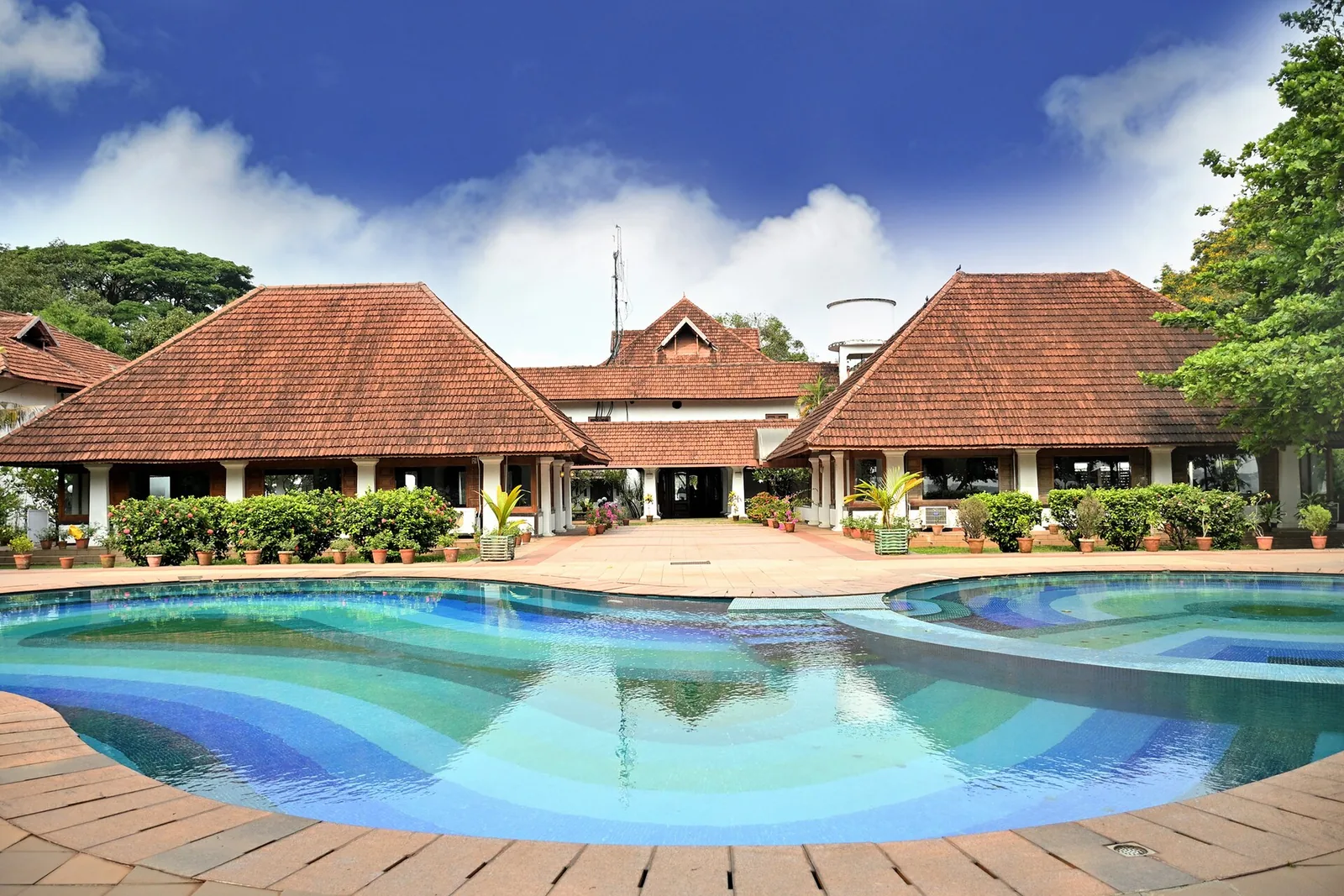
On a small green island in the Kochi backwaters, a whitewashed mansion has been watching ships come and go for nearly three centuries. Bolgatty Palace was raised by a Dutch trader in 1744, and it has since served three flags — the Dutch, who built it; the British, who leased it; and independent India, which turned it into a hotel. It is, by most accounts, one of the oldest Dutch palaces still standing anywhere outside the Netherlands, and to reach it you still have to cross water.
A Dutch trader’s house on a backwater island
The palace was built in 1744 by Dutch traders, at the height of the Dutch East India Company’s hold over the Malabar coast and its pepper trade. It sits on the island of Mulavukad, known locally as Bolgatty Island, a low green sliver in the broad Vembanad backwaters just off Kochi’s Marine Drive. From the start this was no modest counting-house: it became the Governor’s palace for the commander of Dutch Malabar, the official residence from which the Company’s senior officer administered the region. The long, low, verandah-wrapped building — thick walls, high ceilings, wide shaded galleries to catch the lake breeze — is Dutch colonial architecture adapted to the tropics, and its plan survives largely intact today.
One of the oldest Dutch palaces outside Holland
What gives Bolgatty its outsized reputation is simply how much of it has lasted. Kerala Tourism and the state tourism corporation both describe it as the oldest Dutch palace of its kind that still exists outside Holland — a rare surviving piece of the Netherlands’ seaborne empire on Indian soil. Much colonial-era construction in the tropics rotted, burned, or was demolished; Bolgatty stayed standing, in continuous use, through changes of ruler and changes of century. That continuity — Dutch mansion to British lodge to Indian hotel, all in the same walls — is precisely what makes it worth the short boat ride.
Not the Mattancherry palace — and not Hill Palace either
It is easy to muddle Kochi’s palaces, so it is worth being clear. Bolgatty is not the building most people mean when they say “Dutch Palace”: that is the Mattancherry Palace, on the mainland peninsula, actually built by the Portuguese and only later renovated by the Dutch, and famous for its Ramayana murals. Nor is it the Hill Palace at Tripunithura, the sprawling former seat of the Cochin royal family that is now a museum. Bolgatty is a third and separate thing — a genuinely Dutch-built residence, on its own island, that never belonged to the local kings until the twentieth century. Three palaces, three very different stories.
When the British Residents moved in
In 1909 the property was leased to the British, and it took on a new role for a new empire. Through the closing decades of the Raj it served as the home of the British governors — the seat of the British Resident to the Kingdom of Cochin, the crown’s diplomatic agent attached to the princely state. An island a short row from the mainland made a neat posting for a Resident: close enough to keep an eye on the harbour and the court, yet set apart on its own quiet ground. For roughly the first half of the twentieth century the Dutch trader’s mansion flew, in effect, under British colours.
From colonial seat to state property
When India became independent in 1947, the palace passed out of colonial hands and became the property of the state. In time it was placed with the Kerala Tourism Development Corporation, the government-run body that operates it today as a heritage hotel resort. The transition is a tidy summary of the wider change on the coast: a building that had housed the agents of two European powers was reopened, under Indian management, to anyone willing to book a room — its history no longer a matter of governors and residents, but of guests.
A golf course laid out in 1925
The grounds are part of the appeal, and one feature predates the hotel by decades. A nine-hole golf course, established in 1925, still encircles the palace, wrapping the old mansion in fairway and lawn — a reminder of the leisured colonial world of the Residency years. Around it the resort has added the ordinary comforts of a KTDC property: an ayurvedic centre, a swimming pool, a restaurant, lake-view cottages set apart from the historic mansion block, and daily Kathakali performances that bring Kerala’s classical dance-drama to the palace lawns after dark.
An island of water, yachts and open horizons
Bolgatty’s setting is its quietest pleasure. The island sits in the Vembanad backwaters where the lake meets Kochi’s harbour, so the views run out over water in almost every direction — toward the Cochin seaport, the moored freighters, and beyond them the Arabian Sea. The modern Kochi International Marina, with berths for dozens of yachts, shares the island, and boats still handle much of the coming and going. It is the kind of place where the practical detail — that you arrive by water — turns out to be the whole point.
Visiting Bolgatty Palace
Bolgatty Island lies just off Kochi’s Marine Drive on the mainland, and is reached by a short boat crossing (a road link via the container-terminal bridge also serves the island). You can stroll the palace grounds, walk the golf course, and take in the harbour views even if you are not staying, and the evening Kathakali is a draw in itself; the mansion block’s few heritage rooms fill quickly, so book ahead through KTDC if you want to sleep inside history. For opening details, boat timings and directions, see the Bolgatty Palace place page, and browse more of the region’s heritage on the Ernakulam hub. Pair it with a day in Fort Kochi and Mattancherry to see how the Portuguese, Dutch and British layers of the old port fit together.
Frequently asked questions
Who built Bolgatty Palace, and when?
It was built in 1744 by Dutch traders and became the Governor’s palace for the commander of Dutch Malabar. It is often described as one of the oldest Dutch palaces still standing outside the Netherlands.
Is Bolgatty Palace the same as the “Dutch Palace” in Mattancherry?
No. The Mattancherry “Dutch Palace” is a separate mainland building that was actually built by the Portuguese and later renovated by the Dutch. Bolgatty is a genuinely Dutch-built mansion on its own island, and Hill Palace at Tripunithura is a third, unrelated royal palace.
Can you stay at Bolgatty Palace today?
Yes. After passing to the state at independence in 1947, it is run by the Kerala Tourism Development Corporation (KTDC) as a heritage hotel, with a few rooms in the historic mansion block plus lake-view cottages, a 1925 golf course, an ayurvedic centre and daily Kathakali performances.