The one causal claim that both the Malayalam and English accounts of Chalakudy Market make is this: trade centred on the Kunnathangadi chantha declined because of the expansion of road infrastructure. It is a single sentence, carried in the same words in two languages, and it is easy to read past. It should not be read past, because it is counter-intuitive and it is the key to everything that happened to this town afterwards.
Why better roads hurt a market
The intuition is that better roads bring more trade. For a market town, they can do the opposite, and the reason is bulk.
A bulking market exists because cargo has to be broken up. When the only way down from the hills was a forest tramway and a bullock track, everything that came off the mountain stopped at the bottom of the mountain by physical necessity. It was unloaded, sorted, sold, reloaded onto whatever went further. The place where that happened captured the margin, employed the porters, fed the moneylenders and paid the tax. That place was Chalakkudy.
Metalled roads and lorries removed the necessity. A load could now go from an estate to a buyer in Thrissur or Kochi without being touched in between. Goods did not stop passing through Chalakkudy — more of them passed through than ever. They simply stopped stopping, and a bulking yard earns nothing from cargo that does not get off the lorry. That is the mechanism behind the flat sentence in the sources, and it is the same mechanism that hollowed out market towns from Rajasthan to the English Midlands in the same century.
The 1928 answer
The response is the one dated event in the market’s history. A new market complex was built in 1928 to arrest the decline and revive the trade. That is the whole of what the sources say. Nobody records who built it, what it cost, what it looked like, or which part of the site it occupied, and we could not establish from any source whether that 1928 fabric is still standing. The tarpaulin-covered sheds visible in a 2007 photograph of the yard could be of almost any date.
What can be said is that the intervention was not futile. A century on, the customary weekly markets still convene on Tuesdays and Fridays and the yard still fills on those mornings. Whether that is because of the 1928 building or because of the geography that no building could change is not something the record will settle.
The town’s centre of gravity moved
The clearest evidence of what the roads did is the shape of Chalakkudy itself. The built-up strip runs from Anamala Junction in the north to the Chalakudy bridge in the south, and it has two centres rather than one. North Junction is the market end — the yard lies about 250 metres south of it on Market Road, and the streets around it carry the textile shops, the furniture workshops, the old bakeries and the co-operative banks. South Junction is the transport end, where both the KSRTC and private bus stands are, on and around the national highway.
That is a town whose commercial heart and whose traffic heart are 1.5 kilometres apart. It did not start that way. The market came first and the highway centre grew up around the road, and over the twentieth century the second one took the town’s energy from the first. The street names still record the transition: the roads through the older centre are Market Road, Trunk Road and Old NH — three generations of through route, all of them superseded.
What 2007 looked like
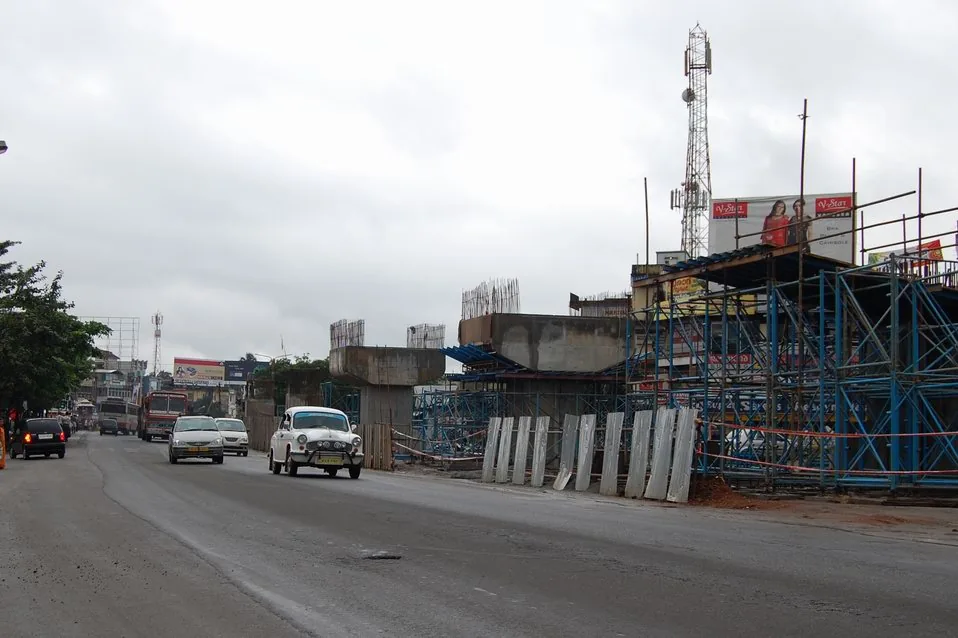
Two photographs from that one year show the process at its sharpest. In January 2007, the highway through the town is a divided carriageway with a central kerb, tanker lorries and goods vehicles in both directions and shops set well back behind the road reserve — an artery, and a place to get past rather than into. By September of the same year, concrete piers and blue scaffolding stand along the eastern side for the four-lane works, with pre-cast panels stacked on the verge and an old Ambassador picking its way past the site.
The flyover those piers became now carries through traffic over the southern junction. It is a real improvement for anyone driving from Kochi to Thrissur and it is the final stage of the same long process: every upgrade since the 1920s has made it easier to reach Chalakkudy and less necessary to stop in it.
The thing the roads could not take
And yet the yard is still there and still busy two mornings a week, which is more than can be said for the tanneries, the potteries, the rubber works, the chemical plant, the tapioca factory, the tram workshop or the electric-vehicle company that closed after a labour dispute in 1987. The reason is the one thing a better road cannot change.
State Highway 21 begins in this town and runs 86 kilometres east to the Tamil Nadu boundary at Malakkappara. It is the only road off that ridge on the Kerala side. Improve it as much as you like and it still arrives at Chalakkudy, and the produce of every settlement and estate along it still meets its first buyer here. The highway took the town’s through trade. It could not take its catchment.
Frequently asked questions
How did better roads damage Chalakudy Market?
By removing the need to break bulk. When the only route down from the hills was slow and awkward, cargo had to be unloaded and sold at the bottom, and Chalakkudy captured that trade. Once lorries could run straight from the estates to Thrissur or Kochi, goods passed through without stopping, and a bulking yard earns nothing from a load that stays on the lorry.
What happened in 1928?
A new market complex was built to arrest the decline and revive the trade. That is the entire documented content of the event — no source names the builder, the cost or the design, and we could not establish whether any of that 1928 fabric survives in the present yard.
Why does Chalakkudy have two centres?
North Junction is the market end, with the yard, the textile and furniture shops and the co-operative banks around it. South Junction, about 1.5 km away, is the transport end, with the KSRTC and private bus stands on the highway. The market came first; the highway centre grew around the through road and took the town’s energy.
Did the flyover kill the market?
No. The flyover completed a process that started decades earlier, and the market survived it for a reason that has nothing to do with through traffic: State Highway 21 is the only road down from the Malakkappara ridge on the Kerala side, so the produce of that whole road still has to meet a buyer in this town.