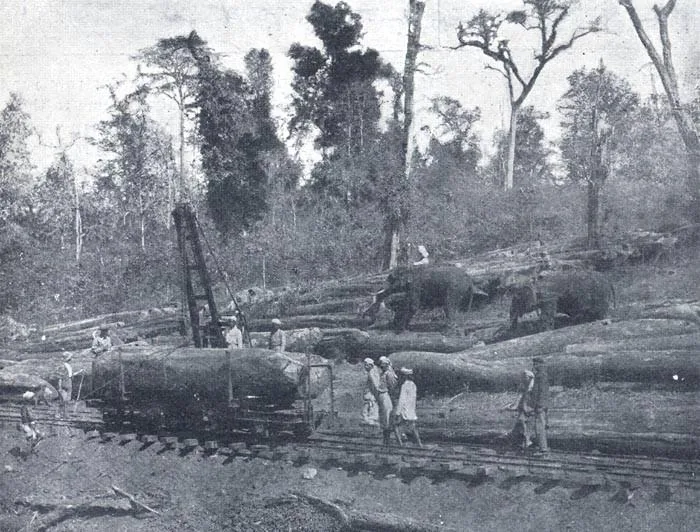
Most people who write about Chalakudy Market describe it as old. Almost nobody describes what is on the floor. That is a shame, because the goods are the whole argument: they explain why the yard is the size it is, why it survived the collapse of every other business in the town, and why it is worth forty minutes of a traveller’s morning.
A yard, not a bazaar
The marketplace polygon in OpenStreetMap encloses about 7,660 square metres — roughly three quarters of a hectare — measuring some 133 metres north to south and about 69 metres across at its widest. That is a very large open floor for a municipal market in a town of 25 square kilometres, and the size tells you what it was built for. Retail vegetable selling does not need that much room. What needs it is a place where lorries come in, turn, unload, and are loaded again.
The word for that is bulking. Produce arrives from many small growers in small quantities, is sorted and consolidated on an open floor into loads worth moving, and departs to a bigger buyer somewhere else. It is the least glamorous operation in agriculture and the one that determines what a farmer is paid. Chalakkudy has been doing it on this patch of ground since at least the end of the eighteenth century, which is why the eighteenth-century word for the institution — pandikasala, a wholesale depot — still fits the twenty-first-century yard.
The photograph that settles it
On 17 April 2007 a Malayalam Wikipedian photographed the market from a first-floor vantage on its western side and released the image into the public domain. It is the single most informative document about this place, and it is worth reading carefully.
Green plantain bunches are stacked directly on the beaten earth in heaps most of a metre high, running the length of the yard — dozens of them, hundreds of bunches. A yellow lorry stands in the middle of the open ground with its bed already piled with green produce, and a second waits behind it with a third parked beyond. Down the near edge stands a line of wooden handcarts on bicycle wheels, the standard Kerala market barrow, carrying shallots, small onions and tomatoes. Blue and green tarpaulins are lashed over permanent shed roofs on both flanks. Motorcycles and autorickshaws are wedged in wherever there is space. There are perhaps eighty people in frame, and not one of them is standing still.
What that image shows is not a weekly village fair. It is a working freight terminal with a retail fringe. The handcarts along the edge sell to households, and they are the tail of the operation, not the point of it. The point is the lorries.
The road that supplies it
Chalakkudy has a catchment no other lowland town in Thrissur district has. State Highway 21 begins in the town and runs 86 kilometres east, climbing through Thumboormuzhi, Athirappilly and Vazhachal, past the Sholayar reservoirs, to the Tamil Nadu boundary at Malakkappara. Along its upper stretch lie the Vazhachal and Malayattoor forest divisions, and at the top there are tea estates held by Tata.
Everything produced on that road — tea and coffee at the top, pepper, cardamom and nutmeg in the middle, plantains and tapioca in the settlements between — has one practical route down to a buyer, and it ends in Chalakkudy. There is no second road off that ridge on the Kerala side. A grower at kilometre 60 does not have a choice of markets; he has a market. That single geographical fact has kept this yard in business through the closure of the tanneries, the potteries, the rubber works, the chemical plant, the tapioca factory and the tram workshop, and it is why the town’s market outlived the town’s industries.
Add to that the lowland side of the catchment: the plantain, vegetable, tapioca and fish production of the villages spread around Chalakkudy on the river’s alluvium. The yard sits at the seam between hill produce and paddy-country produce, and the two arrive on the same floor on the same morning.
How the goods used to come down
Before lorries there was a railway in the forest. The Cochin State Forest Tramway brought timber down from the hills to Chalakkudy, and the photograph at the head of this article — dated 1907 on its Commons file — shows what that meant in practice: a cutting in the hill forest, felled trunks the size of small buildings, elephants working them into position, and a hand-operated derrick loading one onto a flat wagon on a narrow track. The tramway’s own history, including a genuine dispute in the sources about when it was built, belongs to our Chalakkudy town page.
What matters here is the shape of the system. Bulk cargo came off the mountain at a fixed rate, arrived at a fixed point, and had to be broken up and sold at that point. A market at the bottom of such a line is not an amenity; it is a necessary part of the machine.
The trades that grew around it
Walk a 450-metre circle around the market and the old economy is still legible in the shopfronts. There are at least four furniture and timber businesses inside that circle — C.V. Woods, Kidangans Modern Furniture, Happy Birthday Furnitures, and one signed simply Modern Furniture — which is the surviving retail end of the timber trade the tramway once fed. Malayalam sources note that a furniture unit under the Chalakudy–Kunnathunad Technical Co-operative Society still trades profitably on a co-operative basis.
There is also an unusual density of bakeries: Mody, Joy Luck, Navya, Minerva, Orange and Chacko’s all trade within the same short radius, several with more than one outlet. And there are at least eight banks and co-operative societies in the same circle, among them the Thrissur District Co-operative Bank, the Irinjalakuda Town Co-operative Bank and the Chalakudy Service Co-operative Bank. That last cluster is the most telling. Wholesale produce runs on short-term credit, and the number of small co-operative lenders around a market yard is a fair measure of how much of its trade is done on paper rather than in cash.
Seeing it
Come on a Tuesday or a Friday, the two traditional weekly market days, and come between six and eight in the morning. Kerala wholesale produce markets do their business early; by mid-morning the loads have gone and what is left is the retail fringe. Stand at the north end where the lorries turn and watch for an hour. You will have seen the working part of a town that four million people a year drive straight through on their way to a waterfall.
Frequently asked questions
What is actually sold at Chalakudy Market?
Hill produce and spices brought down State Highway 21 from the Athirappilly, Sholayar and Malakkappara stretch — pepper, cardamom, nutmeg and the produce of the settlements on that road — together with plantains, vegetables, tapioca and fish from the lowland villages around the town. The 2007 photograph of the yard shows plantain bunches heaped on the ground the length of the market, with shallots, onions and tomatoes on handcarts along the edge.
Why is the market so large?
Because it is a bulking yard rather than a retail bazaar. The OpenStreetMap polygon measures about 7,660 square metres, roughly 133 m by 69 m, which is the space needed for lorries to enter, turn, unload and reload. Retail selling would not require it.
Is there another road down from Malakkappara?
Not on the Kerala side. State Highway 21 is the route, and it ends at Chalakkudy. Traffic can continue east into Tamil Nadu towards Valparai, but produce heading for a Kerala buyer comes down this road and through this town.
When is the market busiest?
Tuesday and Friday mornings, between roughly five and nine. Both the Malayalam and English sources record Tuesday and Friday as the traditional weekly market days, and they still are.