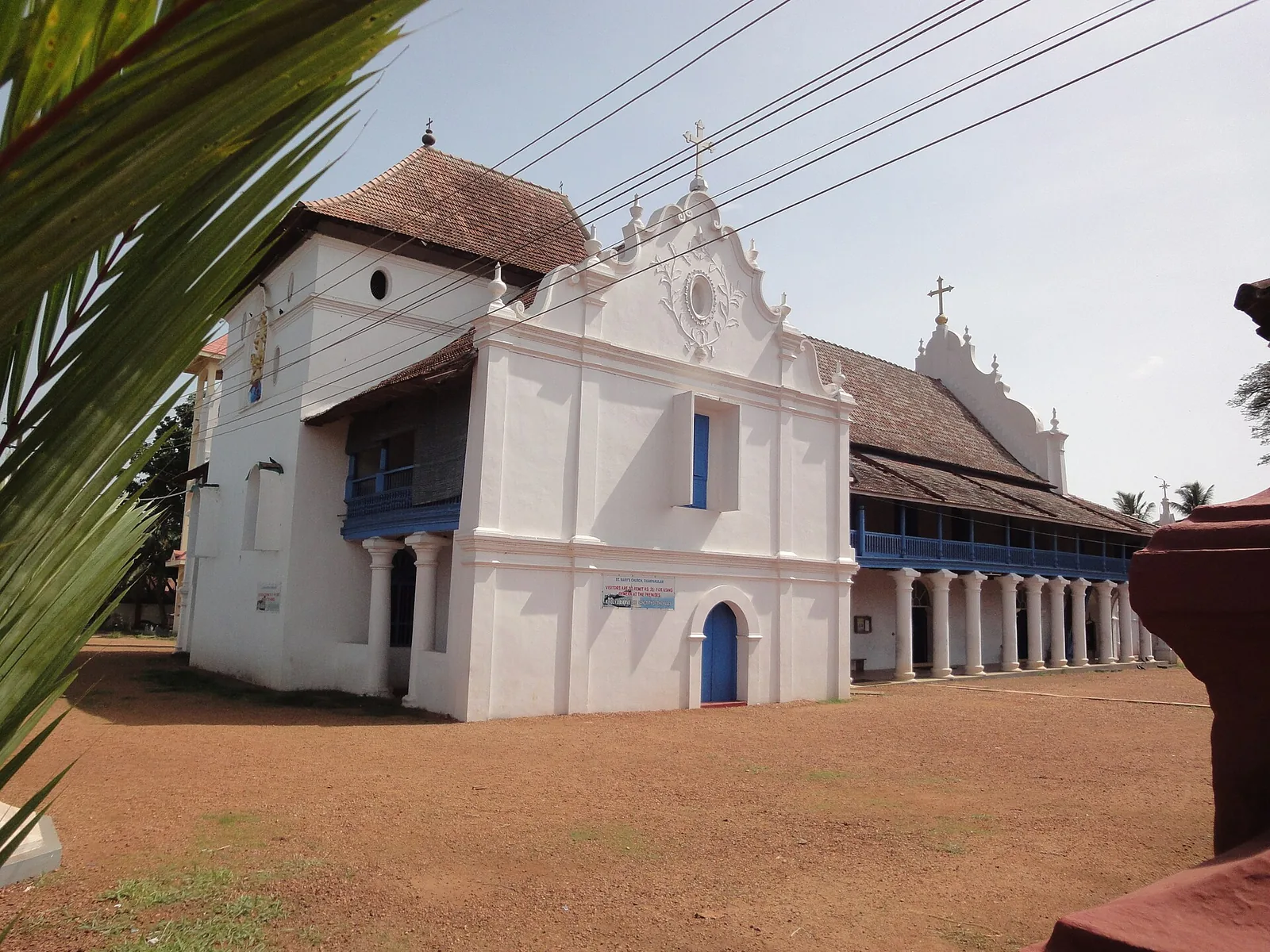
Kalloorkad St Mary’s Basilica at Champakulam — the Champakulam Valia Palli — is described almost everywhere as one of the oldest churches in India, founded in AD 427, and as one of the seven churches established by St Thomas. Those are three separate claims of very different quality, and it is worth separating them, because when you do, the church comes out looking more interesting rather than less.
AD 427 — attributed, not evidenced
The AD 427 founding is the date the parish gives and the date the reference works repeat. It would put the church within four centuries of the apostolic period and make it one of the oldest Christian foundations in the country.
It is also unevidenced. Even Wikipedia hedges it: “believed to be established in AD 427.” There is no contemporary documentation, and the building has been rebuilt many times over, so there is no fabric to argue from either. That does not make it false. Kerala’s Christian communities are genuinely ancient and their traditions are not lightly dismissed. It does mean the honest word is “traditionally”, and we have used it.
AD 1151 — documented
Meanwhile, standing in the open in the churchyard, is a rock cross dated to AD 1151, described as one of the most ancient crosses in India with clear documentation of its antiquity. There are further inscribed stones around the church.
This is the thing to walk up to. A twelfth-century Christian monument, outdoors, in a Kerala village, with a date you can defend — that is remarkable without any help from AD 427. It is also the only object at Champakulam that fixes a floor under the tradition: whatever the founding date, there was a Christian community substantial enough here to raise and inscribe a stone cross before the Third Crusade.
The St Thomas claim — false, and the truth is better
Champakulam is routinely called one of the seven churches founded by St Thomas. It is not one, and this is checkable rather than a matter of opinion. The Ezharappallikal — the seven and a half churches — are Kodungallur, Kollam, Niranam, Nilackal, Kokkamangalam, Kottakavu at Paravur and Palayoor, with Thiruvithamcode as the half. Champakulam appears on no version of the list.
What the parish itself actually says is different and more precise: that Champakulam was once under Niranam — and Niranam genuinely is a St Thomas foundation. The claim being made is descent, not foundation. That is a real and honourable thing to be able to say, and it gets flattened every time someone shortens it.
There is a nice postscript. Alappuzha district does contain a church from the actual list. Kokkamangalam, one of the true Ezharappallikal, is up at the north end of the district, a couple of kilometres from the Thanneermukkom bund. So the district has its St Thomas church; it simply is not this one.
2016 — fully documented
On 27 November 2016 the church was declared a Minor Basilica: the title granted by Pope Francis, the declaration performed at Champakulam by Mar Joseph Perumthottam, Metropolitan Archbishop of Changanacherry. It was the first basilica in that archdiocese, the fourth in the Syro-Malabar Church, the ninth in Kerala and the twenty-third in India.
One correction worth making in passing, because it circulates: Pope Francis did not come to Champakulam. He has never visited India. He granted the title; the archbishop performed the ceremony.
What the building is actually like
For all the argument about dates, the reason to come inside is that the church is genuinely strange and very beautiful, and hardly anyone describes it properly.
From the west it is spiky Gothic Revival — a tiered gable bristling with pinnacles under a gold sunburst medallion. From the other end it is something else entirely: a curvilinear baroque gable with a scrolled cartouche, closer to Goa than to Gothic. A long open colonnade runs the full flank between them with a timber gallery above under a tiled roof. It reads as several centuries of church stitched end to end, which is more or less what it is.
Inside, a coffered barrel vault of painted timber curves over the sanctuary, and under it climbs a polychrome and gilt reredos two storeys tall: the Virgin crowned in a stiff gold robe at the centre, the Sacred Heart above her, St Joseph and a pierced St Sebastian in the lower niches, saints in oval medallions to the sides, and the whole flanked by two life-size painted archangels in Roman armour and plumed helmets holding garlands. On the altar a gilt sunburst monstrance is lettered VENITE ADOREMUS. Over the nave the ceiling is painted pale blue: clouds, trumpeting angels, the Virgin rising in white inside a ring of stars, putti, a gilt roundel, and the Last Supper stretched along a panel.
The pulpit
And then the thing that ought to be famous and is not. The pulpit is a hexagonal painted box set high on the nave wall, its panels showing Christ teaching. It is carried on a long stem that descends the wall in coloured bands, turns scaly halfway down, and terminates in the open, fanged mouth of a makara — the sea-monster of Indian temple sculpture, the creature you meet on temple doorways and on the ends of Kerala roof beams.
A Catholic preaching box, resting in the jaws of a makara, between painted pilasters of grapevines and flower-filled urns. It is the whole argument about Kerala Christianity compressed into one piece of joinery, and you can stand under it any day of the week.
- Kerala Tourism: Champakulam church and rock cross
- The 427 foundation date is a church tradition; the rock cross is dated to 1151 in Kerala Tourism’s account.
Frequently asked questions
Is Champakulam one of the seven churches of St Thomas?
No. The Ezharappallikal are Kodungallur, Kollam, Niranam, Nilackal, Kokkamangalam, Kottakavu and Palayoor, with Thiruvithamcode as the half — Champakulam is on no version of the list. The parish’s actual claim is that it was once under Niranam, which is a St Thomas foundation: descent, not foundation.
How old is the church?
Traditionally AD 427, but that date is attributed rather than evidenced and the building has been rebuilt many times. The oldest firmly dated object is the open-air rock cross in the churchyard, documented to AD 1151.
When did it become a basilica?
27 November 2016. The title was granted by Pope Francis and the declaration performed by Mar Joseph Perumthottam, Metropolitan Archbishop of Changanacherry. It is the first basilica of that archdiocese, the fourth in the Syro-Malabar Church, the ninth in Kerala and the twenty-third in India. Pope Francis did not attend — he has never visited India.
What should I look for inside?
The pulpit, which is carried on a stem ending in the fanged head of a makara; the two-storey polychrome and gilt reredos under a coffered barrel vault, flanked by life-size painted archangels; and the painted nave ceiling of clouds, trumpeting angels, the Assumption and the Last Supper.