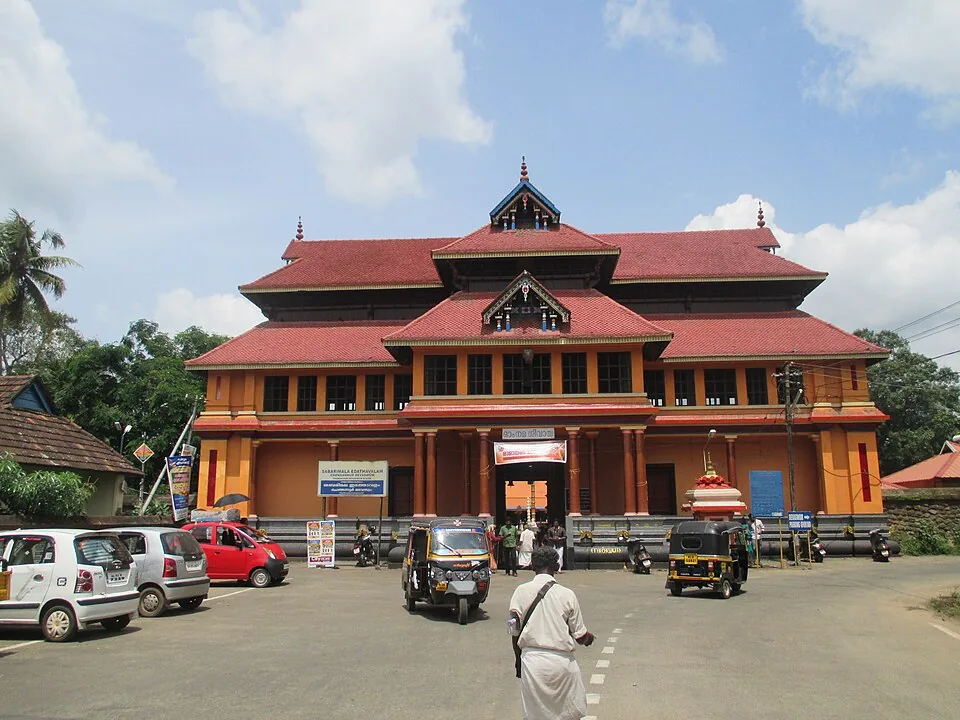
At Chengannur Mahadeva Temple, on the night of Shivaratri, families come up from the coast to pay a bride-price. They are Arayans — a fishing community — from Alappad, the long sandspit between the Arabian Sea and the backwater in what is now Kollam district, seventy-odd kilometres away. They arrive not as pilgrims but as relatives: as the goddess’s father’s people. The rite is called Parisham Vayppu, parisham vaykkal being the betrothal payment of their own marriage custom, and it is one of the strangest and most specific obligations in Kerala’s temple life.
The claim
The claim behind it is old. One tradition holds that Chengannuramma is the daughter of an Araya king — that Parvati, under a curse from Shiva, was born into a fishing family, and that at her swayamvara she chose a fisher youth who was Shiva himself. The Arayans of Alappad hold that they descend from that family. On that reading, Shiva married into a fishing community, and Chengannur’s goddess is a fisherman’s daughter who married up.
And the reason it is still paid
But the reason the payment is still made every year is a much more concrete story, and it runs like this.
The temple burned. In the fire the Devi’s image melted. Metalworkers were brought in to cast a replacement in panchaloha, the five-metal alloy, and one after another they failed — nobody could reproduce what had been lost.
Then the ruler was told, in a dream, to look through the palm-leaf records. Among them was an ola in the hand of Uliyannur Perunthachan, the master carpenter who had built the temple generations earlier. On it he had written that one day fire would destroy this temple and melt the image of the goddess — and that he had therefore made a second panchaloha image of her and sunk it in the deep pool beside Parakkadavu, on the Pampa.
The townspeople went into the pool and found nothing. Then Arayans from Alappad, who had come upriver to fish, went down and brought her up, and carried her to the temple.
The day they did it was Shivaratri. And because it was they who gave the god his goddess back, they have come every Shivaratri since, as her father’s people, to pay the parisham to Mahadeva. Chengannuramma is worshipped as the kuladaivam, the family deity, of the Araya community.
What the story is doing
It is worth pausing on the shape of this. A temple whose ritual order is emphatically brahminical — the tantric authority belongs to Thazhamon Madom, one of the two oldest tantri families in Kerala — carries at its centre two stories in which the decisive act is performed by people outside that order. The temple’s own foundation is discovered by a Pulaya woman cutting grass, who stops to sharpen her sickle on a stone and finds it bleeding. And its goddess is recovered from a river by fishermen after everyone else has failed.
Neither figure has been tidied out of the tradition. Both are still told, and in the second case the tradition did something more than tell it: it turned the debt into an annual obligation that the temple discharges publicly, in front of the town, once a year, for as long as anyone can remember.
For a visitor, the practical point is simple enough. If you are at Chengannur at Shivaratri, what you are watching is not a performance and not a folk display. It is a family arriving to keep an appointment. Watch as one more person in the crowd.
Frequently asked questions
What is Parisham Vayppu?
A Shivaratri rite at Chengannur in which Araya families from Alappad, on the Kollam coast, come as the goddess’s father’s people and pay the parisham — the bride-price of their own marriage custom — to Shiva.
Where is Alappad?
A narrow sandspit between the Arabian Sea and the Kayamkulam backwater in Kollam district, roughly seventy kilometres from Chengannur. The Arayans there hold that they descend from the family into which Parvati was born under Shiva’s curse.
Is the melted-idol story recorded anywhere, or is it purely oral?
It is set out in the Malayalam account of the temple, alongside the older tradition of the Araya king’s daughter. We give both, because the community’s obligation is explained by the second and justified by the first — and because the two are told as one story locally.
Who was Perunthachan?
Uliyannur Perunthachan, the legendary master carpenter of the Parayi Petta Panthirukulam, the twelve siblings of Kerala folklore. He is credited with building the Chengannur temple, and his other work here — an elliptical koothambalam — has its own story.