Most temple festivals are announced a year ahead. This one is announced when it happens, in the newspapers, because nobody knows when it will. At Chengannur Mahadeva Temple the goddess is held to menstruate, and the temple’s response to that is one of the most remarkable observances in Kerala.
How it is found
The mechanism matters, because it is what makes the whole thing unschedulable. Each morning the melsanthi removes the nirmalya — the previous day’s flowers, left on the image overnight. If, when he lifts them, there is a stain on the udayada, the cloth that covers the goddess, then she is rajaswala, and the temple changes state.
The western nada — hers — closes. For three days it stays shut. Her chaitanya, the living presence, is moved out of the image and into the balibimba, the subsidiary figure used for processions, so that worship of her continues without her being in her own sanctum. On the eastern side of the same building, Shiva’s doors go on opening as usual. This is the practical reason the architecture of Chengannur is what it is: god and goddess share a single sreekovil, back to back, he facing east and she facing west, an arrangement read as Ardhanarishwara — and it gives the temple two doors that can be in two entirely different conditions at the same time.
The arattu
On the fourth morning she goes to the river. The procession takes her down to Mithrappuzhakkadavu, a ghat on the Pampa, for the arattu, the ritual bathing that every Kerala temple performs at the end of its festival — except that here it is being performed for a reason no other temple has. Afterwards she is rested in the kulippura, the bathing house on the bank, and then brought home in state on a pidiyana, a female elephant.
The return is the part people describe most. Chengannurappan comes out to the eastern anakkottil to receive her. The two are carried together, and then she is taken in through the west door and he completes his circuit and goes in through the east — each by their own side of the building they share.
For twelve days from the onset, the temple offers the Haridra Pushpanjali, an archana with turmeric, and the Malayalam sources state flatly that this offering is made at no other temple. Thousands come for it. Devotees bring, in particular, difficulties with marriage, difficulties within marriage, and gynaecological and menstrual illness.
Why here
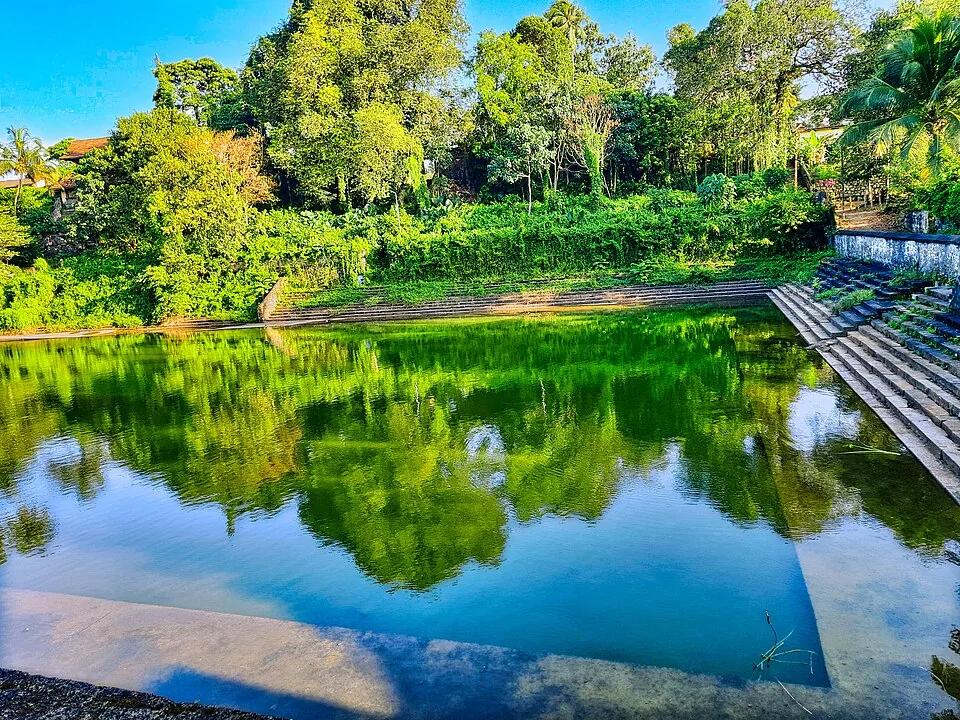
Chengannur’s own explanation is not that the observance is an oddity attached to the temple. It is that the observance is the temple’s founding event, repeated. The legend says that when Shiva married Parvati in the north, the weight of the assembled gods threatened to tip the earth, and Agastya was sent south to sit on the other end. He held the world level from the hill of Shonadri — which is Chengannur — and afterwards Shiva brought Parvati south to visit him. It was here, at Shonadri, that the goddess had her first period, and here that the ritushanti, the rite that follows a girl’s first menses, was performed. The tank called Shakti Theertham is said to mark the spot.
The Malayalam sources also make the comparison themselves, and it is worth quoting rather than paraphrasing: they hold that Chengannur is the equal in Kerala of the Kamakhya temple in Assam, and they offer the Thripputhaarattu as the proof. That is not a travel writer reaching for a headline. It is the tradition’s own claim about itself.
The thing that is easy to miss
By the ritual book, Chengannur is a Shiva temple and not a joint one. The flag-hoisting festival is his. The five daily pujas are his. The sreebalis are his. The goddess has three pujas and a deeparadhana, and even on her own occasions he takes the first turn; she does not have a melsanthi of her own. And yet it is she who fills the town, she whose name the temple is often known by, and she whose observance made the place famous across Kerala.
The Malayalam account is unusually honest about this and says so directly: her greater standing came from what devotees believe, not from what the ritual order grants her. That gap — between the liturgy and the devotion, between what the rulebook allots a goddess and what people actually bring her — is the most interesting fact about Chengannur, and it is not a modern development.
⚠ One source disagreement, reported rather than resolved: the English Wikipedia article credits Parvati with three sreebalis of her own, where the Malayalam article says she has three pujas and a deeparadhana only. We follow the fuller Malayalam account, and we would rather flag the difference than choose silently.
Frequently asked questions
What is the Thripputhaarattu?
The observance of the goddess’s menstruation at Chengannur. When the priest removes the previous day’s flowers and finds a stain on the image’s garment, her western nada closes for three days; on the fourth morning she is taken to Mithrappuzhakkadavu on the Pampa for the arattu and returns on a female elephant, met by Shiva at the eastern gate.
How often does it happen, and can I plan for it?
The temple says several times a year, and it is announced through the media when it does. It cannot be planned for, because the sign is discovered rather than scheduled. Seeing it means watching the Malayalam news and being able to travel at short notice.
Is Chengannur really comparable to Kamakhya?
The comparison is made by the Malayalam sources themselves, which hold Chengannur to be the Kerala equivalent of the Kamakhya temple in Assam and cite the Thripputhaarattu as the evidence. Both traditions centre on a goddess held to menstruate; we report the comparison as the tradition’s own, not as a scholarly finding.
What is Haridra Pushpanjali?
A turmeric archana offered on the twelve days from the onset of the thripputhu, and held to be the goddess’s favourite offering. The Malayalam sources say it is performed at no other temple, which is why those twelve days draw such crowds.