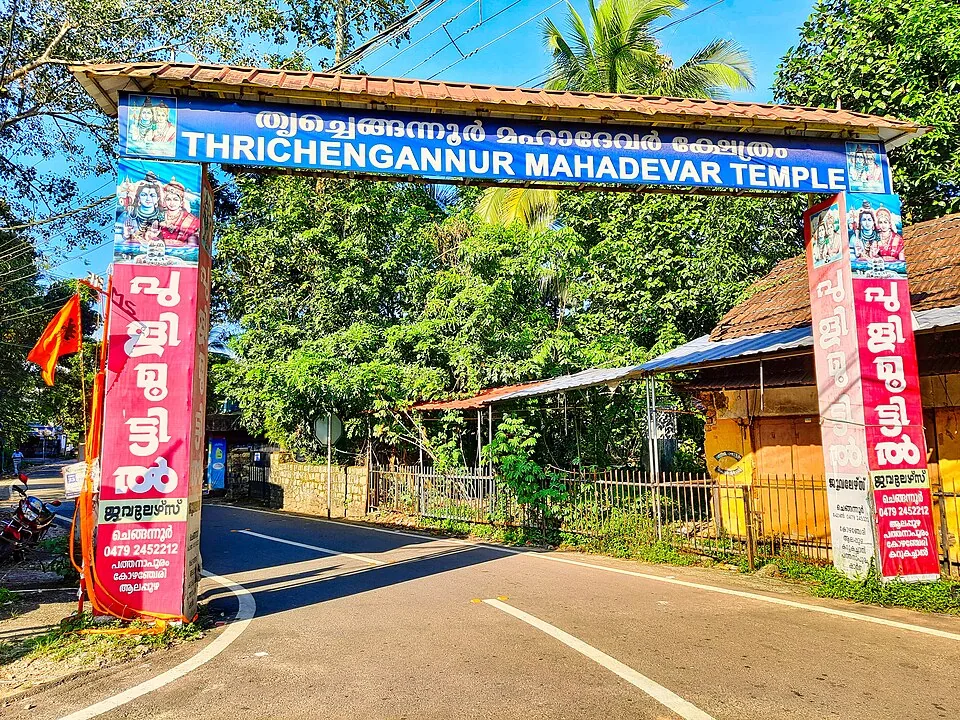
There is a phrase in Malayalam — Chengannur mathilkkakathe pani, “the work inside the Chengannur walls” — for a job that goes on and on and never quite finishes. It is named after this temple, and it was earned.
The ellipse
The story starts with Uliyannur Perunthachan, the master carpenter of Kerala legend. He came to Chengannur while the temple was being planned, drew up the measurements for the sreekovil, the mandapams, the gopurams and the koothambalam, and went away saying he would return shortly.
He came back three months later to find everything built except the koothambalam — the theatre hall where temple drama is performed. It had not been started. The design called for it to be built as an ellipse, and no craftsman on site could raise one. Perunthachan took the job himself and finished it in a matter of days, and carved a stone image of the goddess to go in it.
The fire
Then the temple burned. The Malayalam sources place the fire in the era of the Vanjippuzha Thampurans, the house that ruled from Chengannur and had built the temple, and they attribute it, in the manner of the Aithihyamala, to the sheer fierceness of the deity here: Chengannurappan is installed not as a benign presence but as Mahakala, and the belief is that even while he blesses, his eyes are full of wrath.
The rebuilding was done under experts brought from Thanjavur, in the time of the Travancore kings. It went badly. Work stopped repeatedly and dragged on for years, and that is where the proverb comes from — a job so long that the language borrowed it as a byword.
The empty ground
Almost everything lost in the fire was rebuilt. The exception is Perunthachan’s koothambalam. Nobody could reproduce the ellipse, and the sources record something quieter and more final than failure: nobody has since attempted it. The ground where it stood is still empty.
That absence is, in its way, the most honest thing at Chengannur. A temple that can tell you at length how the earth was kept from tipping over, and where the goddess bathed, and which sage sat where, also has a patch of bare ground in the middle of it that means, simply, we could not do this again.
What is actually old here
The Malayalam account is unusually willing to date its own building down rather than up. Whatever antiquity the legends claim, it says, the Shiva temple at Chengannur is historically not very old. What is old at this site is the goddess: worship of a mother deity of fertility, in the Kannaki conception, is held to have gone on here long before the Shiva temple was raised over it. The temple as a structure belongs to the Vanjippuzha period.
That is a rare shape for a temple record — a source that sets out its legend in full and then declines to use it as a date — and it deserves to be repeated rather than smoothed away, which is what most retellings do.
And what the walls still hold
The tantric authority at Chengannur belongs to Thazhamon Madom, seated at Mundankavu a short way off, reckoned one of the two oldest tantri families in Kerala. They are known worldwide as the tantris of Sabarimala — and the connection runs the opposite way from what most people assume. When a member of the family completes his training, his first puja is performed here, at Chengannur. Only after that is he entitled to officiate at Sabarimala, or anywhere else.
It is the sort of fact that explains a building. A town of some twenty-three thousand people has a temple on this scale because of what begins at its altar — and because, as the board on its street front says, this is an official Sabarimala Edathavalam, a halt on the pilgrim road, ninety-two kilometres short of the hill.
Frequently asked questions
What does “the work inside the Chengannur walls” mean?
It is a Malayalam proverb for a task that never ends, taken from the long and repeatedly stalled rebuilding of this temple after the fire that destroyed it.
Can I see the koothambalam?
No — it is the one part of the temple that was never rebuilt. Perunthachan’s hall was elliptical, nobody could reproduce it after the fire, and the sources record that no attempt has since been made. The ground where it stood is empty.
How old is the temple, really?
The Malayalam sources say plainly that the Shiva temple is historically not very old, and that the building as it stands belongs to the era of the Vanjippuzha Thampurans, with a post-fire reconstruction under Thanjavur craftsmen in the Travancore period. What is held to be genuinely ancient at the site is goddess worship in the Kannaki conception, which is said to predate the Shiva temple.
What is the connection with Sabarimala?
Two connections. The tantri family of Sabarimala, Thazhamon Madom, is based at Mundankavu near Chengannur, and its members perform their first puja at Chengannur before they may officiate on the hill. And the temple is an official Sabarimala Edathavalam — a halt on the pilgrim road — with its own board giving Sabarimala as 92 km away.