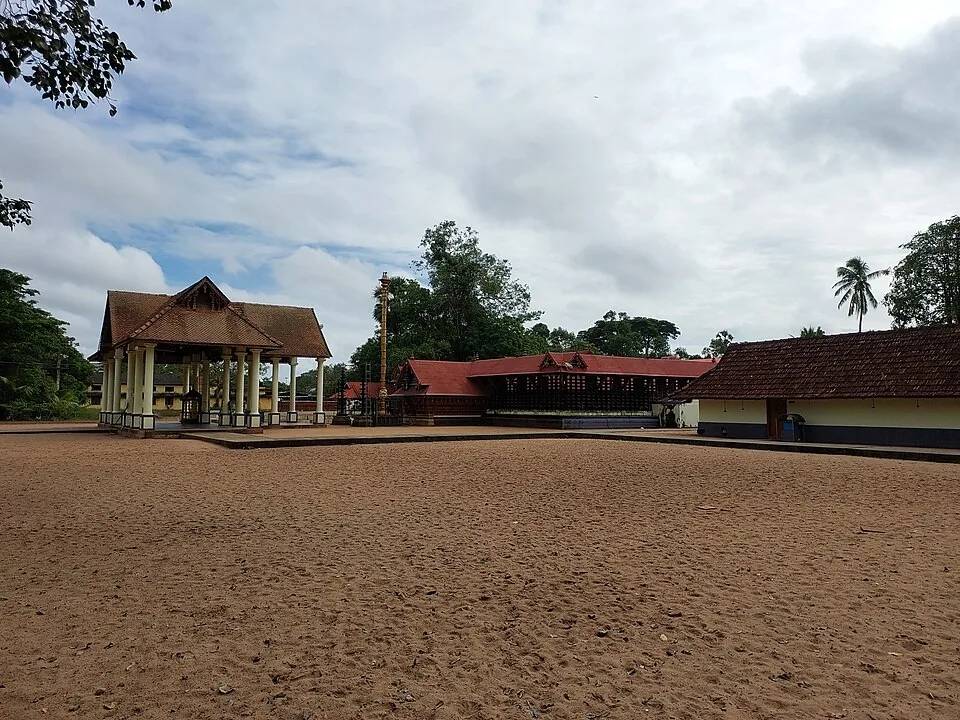
The principal offering at Cherthala Karthyayani Temple is not a lamp, a garland or a payasam. It is a live cockerel.
The birds
A devotee buys a bird and releases it into the temple, and that is the whole of the rite. The released birds are not taken away afterwards and they are not sacrificed. They stay. The consequence is that the compound has hundreds of them — roosters on the red sand, along the plinths, up on the walls, entirely unbothered by anybody — and you meet them the moment you walk through the gate.
It is worth knowing this before you arrive, for two reasons. The first is simply that it is startling if you do not. The second is that it changes what you are looking at: the birds are not a nuisance the temple has failed to deal with, and they are not strays. Every one of them is somebody’s vow, still standing about in public years later. Very few religious practices leave a physical residue you can count.
The thing baked in the ground
The other great offering here is the thadi, and it is as much cookery as ritual. Rice flour is mixed with honey, banana, grapes, sugar candy, dry ginger, cardamom and cumin. The mixture is packed into a tube rolled from an areca palm sheath — the pala, the tough leaf-base sheath that falls from the tree. The tube is buried in the earth, and a fire is lit on top of it, and the offering bakes underground.
It is vowed against illness. The Sastha here, known by the local name Kavudayon and carrying more weight than a sub-deity usually does, has a version of his own called the Aalthadi, offered by people seeking relief from bodily ailments.
The rest of the offering list is more familiar — archana, Rakta Pushpanjali, the Swayamvara Pushpanjali for a marriage, muzhukappu with sandalwood paste, kalabham, and the thalappoli in which women carry lit lamps on flower-dressed plates in the goddess’s processions. But the two that define the place are a bird set free and a sweet cooked in a hole in the ground.
What the offerings are for
Cherthala’s goddess is known as Mangalya Dayini, the giver of marriage, and families come to her about obstacles to a daughter’s wedding — which is the same errand that fills the Swayamvara Pushpanjali counter. Against that, the thadi and the Aalthadi are health offerings. So the two currents running through this temple are marriage and illness: the two things ordinary households actually worry about, rather than the grand favours temple literature tends to advertise.
There is a small irony in the marriage business, given the legend. The goddess who is petitioned to remove obstacles to a wedding spent six days, in her own founding story, comprehensively refusing to be caught.
Frequently asked questions
Are the chickens sacrificed?
No. The offering is the release of the bird, and the released birds live in the temple compound afterwards. There is no sacrifice involved in it.
What is thadi made of?
Rice flour with honey, banana, grapes, sugar candy, dry ginger, cardamom and cumin, packed into a tube rolled from an areca palm sheath, buried in the earth and baked under a fire lit on top. It is offered against illness.
What is Aalthadi?
A version of the thadi offered to the Sastha here, who is known locally as Kavudayon, by devotees seeking relief from physical ailments.
Why do people come to this temple in particular?
The goddess is known as Mangalya Dayini, the giver of marriage, so families come about obstacles to a daughter’s wedding — the Swayamvara Pushpanjali is offered for exactly that. The thadi offerings are for health.