Two things about the calendar at Cherthala Karthyayani Temple do not behave the way Kerala temple calendars normally behave. We are going to set them down carefully and then decline to explain them, because no source we have explains them either.
The flag goes up late
In almost every Kerala temple, the kodiyettam — the hoisting of the festival flag on the dhwajastambham — is what opens the utsavam. It is the starting gun. Everything that follows is inside the flag.
At Cherthala, the Malayalam account states plainly that the festival begins first and the flag goes up some days afterwards. The kodiyettam falls on the Makayiram asterism in Meenam; the festival’s main day is Pooram. A temple that starts its festival before raising its flag is not being careless — a ritual order this visible is deliberate, and somebody in Cherthala will know why. We do not, and we would rather record the oddity than invent a reason for it.
The arattu happens far too often
The arattu, the ceremonial bathing of the deity, is normally the closing act: once, at the end of the annual festival. The famous exception is Chottanikkara, where it is daily through the festival.
Cherthala is another exception, and here our two sources both say so without saying the same thing. The English article says the arattu is held twice every day through the annual festival, and offers Chottanikkara as the comparison. The Malayalam article says there is an arattu on each of the seven days. Those are not the same claim — one is fourteen bathings, the other seven — and we cannot reconcile them from what we have. So we print both and tell you which source says which, rather than splitting the difference into a number nobody actually wrote down.
The padayani
What surrounds all this is the Cherthala Pooram, in Meenam, March or April, and its padayanis — the masked, drummed ritual performance of central Travancore. There is a Saraswati Padayani on Pooyam, and further padayanis on Ayilyam, Makam and Pooram, which is the principal day.
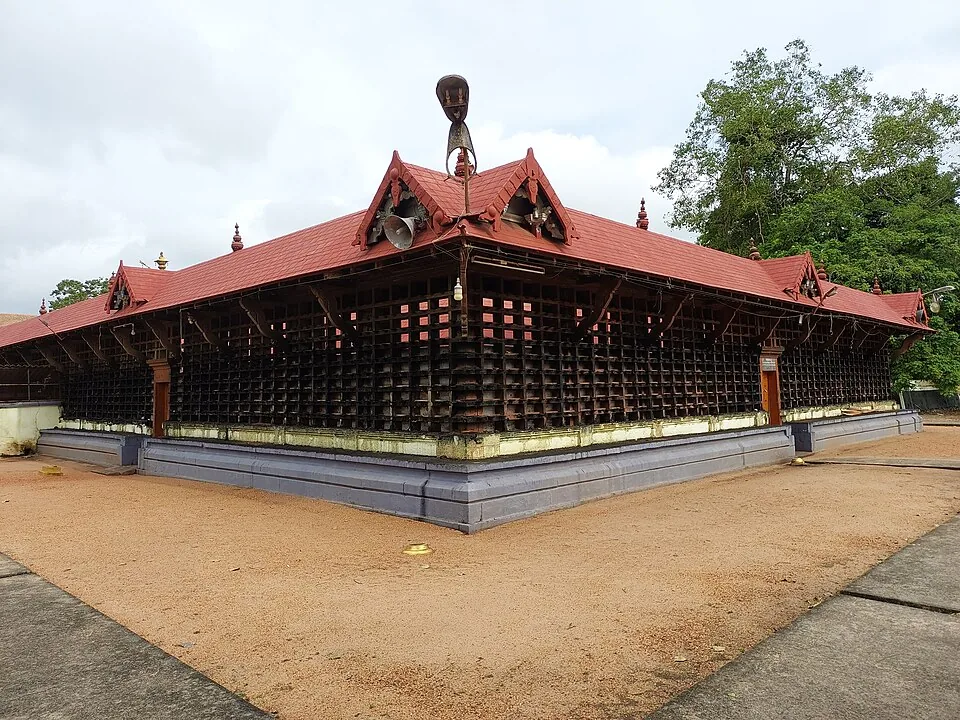
You can see what the festival needs simply by standing in the compound on an ordinary morning: a very large, flat expanse of red laterite sand, wide open, with the mandapam and the flagstaff at one side. Temples do not keep ground like that for the sake of it.
And the building itself is built for the same nights. The outer wall of the nalambalam is a solid grid of oil-lamp niches — hundreds of small black cells from plinth to eave, right around the rectangle — so that the temple can be outlined in flame. It is the most striking piece of construction here and it is designed for exactly one purpose, which is to be seen after dark.
One claim we are not making
The English article describes the Cherthala Pooram as “the second famous pooram in Kerala”, presumably behind Thrissur. No source is offered for that ranking, and a superlative copied from page to page is not evidence — it is the same shape as the stock phrases we have had to strip off other temples on this site. So: the claim is made, and we are reporting that it is made. What is not in doubt is that this is a major regional festival with a real padayani tradition, run over several asterism-days on a ground built to hold it.
Frequently asked questions
When is the Cherthala Pooram?
In Meenam, roughly March–April, with padayanis on the Pooyam, Ayilyam, Makam and Pooram asterisms. Pooram is the main day.
Why does the flag go up after the festival starts?
We do not know, and we have not found a source that explains it. The Malayalam account records it as a peculiarity of this temple: the utsavam begins, and the kodiyettam follows on Makayiram some days later, where almost every other Kerala temple hoists first.
How often is the arattu held?
More often than the usual once a year, but our sources differ: the English article says twice every day through the festival, the Malayalam article says once on each of seven days. We print both rather than choosing.
What is padayani?
A masked, drummed ritual performance tradition of central Travancore, performed at Devi temples. At Cherthala it runs across several days of the pooram, including a Saraswati Padayani on Pooyam.