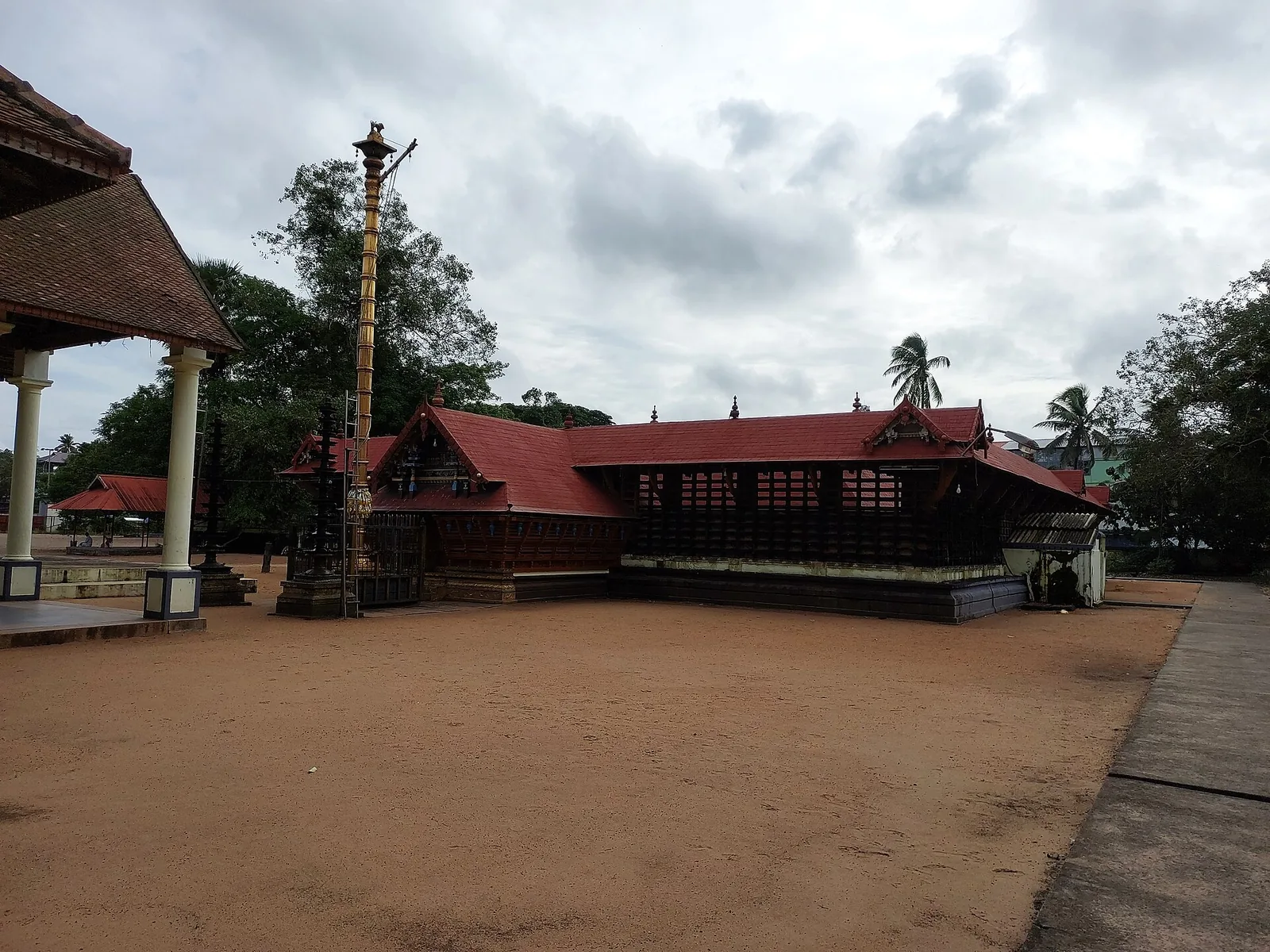
The legend of Cherthala Karthyayani Temple is a chase, and it ends with the name of the town it is told in.
Six days, six ponds
Vilwamangalam Swamiyar — the sage who turns up throughout Kerala’s temple stories — stopped to rest at Cherthala under a tree. Around him lay a scatter of ponds with swans on them. While he sat, he caught sight of a young woman of unmistakable divinity and knew her at once for Karthyayani, one of the Navadurgas. He rose to approach; she slipped away and went into one of the ponds.
The next day it happened again. And the next. Six days, six ponds — each time he saw her, each time she went into the water and was gone.
On the seventh day she leapt again, and the seventh pond was not clear water. It was thick with cheru, mud. Before she could go under, the Swamiyar caught her by the hair and pulled her head clear. From that — cheru, mud, and thala, head — the tradition says the place took the name Cherthala. And the goddess, having been held, stayed.
Why this one is worth telling
We are ordinarily wary of Vilwamangalam stories, and we should say why. He is attached to sites all across Kerala, from Guruvayur to Ambalappuzha — our own Pathiramanal page makes exactly this point about him. A legend whose only requirement is a wandering sage can be picked up and set down anywhere, and a great many have been. His appearance in a story is not, by itself, evidence of anything at all.
What makes the Cherthala episode different is that it is not portable. It is an explanation of one specific town’s name, tied to a specific count of specific ponds, and it cannot be lifted and used elsewhere without becoming visibly absurd. The story and the place are locked together in a way that most temple legends are not.
And why we still call it a folk etymology
Because that is what it is. A name-story that fits this neatly is exactly the kind of explanation that assembles itself after the fact, and no source we can check offers independent evidence for the derivation. What can be said is that the tradition is local, specific, and the standard account in the town. So we give it as what Cherthala believes about its own name, not as settled linguistics — the same treatment we give Shonadri and Chengannur a little way down the road, where the Malayalam Wikipedia flags its own derivation as unsourced.
Refusing to launder a folk etymology into a fact is a harder discipline than refusing a borrowed legend, because there is nothing to trace and nobody to contradict. A moved legend can be sent home. An invented derivation just enters circulation and becomes what everyone knows.
Where the sources disagree
On one point the two accounts part company, and it changes the tone of the story. The Malayalam article has the Swamiyar travelling from the Anantha Padmanabha temple at Thiruvananthapuram towards Guruvayur, resting at Cherthala on the way — a man passing through, ambushed by a vision. The English article has him on his way back after consecrating Padmanabhaswamy, seeing the Devi here and consecrating her in this place — a man arriving to do a job.
We give both rather than choosing. On the substance they agree, and the substance is what survives: a sage, a divine woman, water, and a goddess who ended up staying. The seven ponds, incidentally, are not purely narrative furniture — accounts of the temple’s annual festival mention them as real features of the place, which is the usual and rather satisfying shape of a Kerala origin story. The legend explains a landscape that is still, more or less, there to walk around.
Frequently asked questions
What does Cherthala mean?
By tradition, “the head in the mud” — cheru, mud, and thala, head — from the moment Vilwamangalam Swamiyar caught the goddess by the hair as she sank into the seventh pond. We print it as the town’s own tradition rather than as established etymology.
Who was Vilwamangalam Swamiyar?
A sage who appears throughout Kerala temple legend, attached to sites from Guruvayur to Ambalappuzha. Because he is so portable, his presence in a story is not evidence for it; the Cherthala episode earns its place by being an explanation of one town’s name rather than a story that could be told anywhere.
Are the seven ponds real?
Accounts of the temple’s annual festival refer to them as features of the place, so the legend maps onto a landscape rather than floating free of one. We have not independently surveyed them.
Do the sources agree on the story?
On the essentials, yes. They differ on where the Swamiyar was heading — to Guruvayur from Thiruvananthapuram (Malayalam), or returning after consecrating Padmanabhaswamy (English) — and we report both.