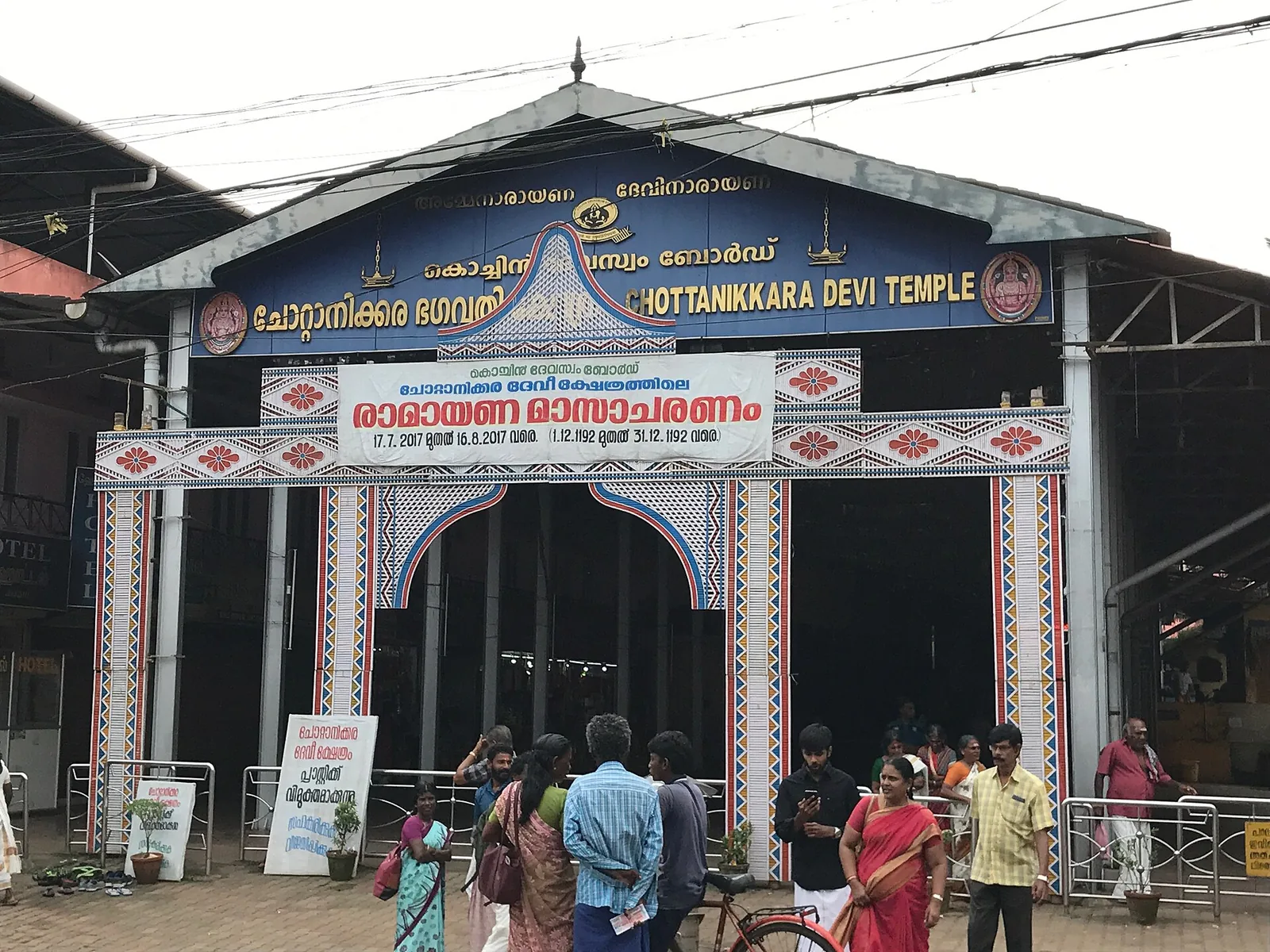
Look up as you go in. Across the gable above the entrance to Chottanikkara Temple, in Malayalam letters, is the line you will hear murmured in every queue on the hill: “Amme Narayana, Devi Narayana.” The full chant runs to four: “Amme Narayana, Devi Narayana, Lakshmi Narayana, Bhadre Narayana.”
It reads like a devotional refrain, and it is. It is also the most compressed statement of what this temple believes, and once you see what it is doing, the whole layout of the place stops being a curiosity and becomes an argument.
One goddess, three costumes, one day
At the upper shrine, the Melkkavu, the deity is Rajarajeswari — the sovereign Mother, Adiparashakti. She is not, however, presented the same way all day. In the morning she is adored as Saraswati and robed in white. At noon she is Lakshmi, in crimson. By evening she is Durga, in deep blue.
This is not three goddesses taking turns and it is not a rota of visiting deities. It is one presence, dressed and addressed differently as the light changes — learning in the morning, abundance at midday, protection at nightfall. Kerala has many Bhagavathy shrines; very few work a full theological cycle into the working day like this, and almost nobody tells visitors that turning up at eight and turning up at six means meeting a different aspect of the same deity.
- Morning — Saraswati, in white. Learning, clarity, steadiness of mind.
- Noon — Lakshmi, in crimson. Prosperity and abundance.
- Evening — Durga, in blue. Protection, and the vanquishing of what threatens.
- Evening at the lower shrine — Bhadrakali, and the Guruthi. A different temperature entirely.
The detail almost nobody mentions
Sharing the pedestal with her is an image of Mahavishnu.
That is unusual and it is the key to the chant. A Kerala Bhagavathy shrine is normally the goddess's own house; she does not typically stand alongside Vishnu on the same seat. Here she does, and the pair is therefore invoked as Lakshmi-Narayana — which is why every line of the chant hangs the name Narayana off a different aspect of her. Amme, mother. Devi, goddess. Lakshmi. Bhadre, the fierce one. Four names for her, one name beside each of them.
Read it that way and the chant is a claim that the four faces you meet here — the Mother at the top of the hill, the goddess in her three daily robes, and the Bhadrakali down at the lower shrine — are not four powers to be negotiated with separately. They are one, and they are inseparable from Narayana. For a temple whose lower shrine is famous for something as raw as the Guruthi, that is a surprisingly precise piece of theology to have painted over the front gate.
The stone has a name
The central image is not a carving. It is a laterite formation held to be swayambhu — self-manifested, risen out of the ground rather than made — and it has a name that guidebooks rarely give: the “Rudraksha Shila”, the rudraksha rock.
The founding legend explains where it came from, and it is one of the bleakest in Kerala: a forest chieftain, Kannappan, a calf brought home for sacrifice, his motherless daughter who begged for its life, and both girl and calf found dead the next morning with a single radiant stone lying where they had been. The stone sat unnoticed for generations until a woman clearing the ground struck it with her sickle to sharpen the blade, and blood ran from the rock. We tell that as legend, and it is worth knowing before you stand in front of the thing.
Up and down the hill
The two-shrine layout is the same idea worked out in geography. The Melkkavu above holds the benign sovereign Mother. The Keezhkkavu below holds her as Bhadrakali, and the walk between them takes about as long as it takes to change your frame of mind, which is roughly the point.
The conventional order is upper first, then down — grace before ferocity — and it is worth following even if you are only looking. The lower shrine at dusk, during the Guruthi, is not an atmosphere you want to arrive at cold. We describe what happens there, and the families who come for it, in the evening Guruthi.
And the name of the place is contested too
Two derivations circulate and they are not compatible. One reads Chottanikkara from Malayalam roots meaning roughly the small forest — which suits the legend, since the story begins in woodland. The other holds that the name is a worn form of Jyotiannakkara, Sanskritised as Jyotikara: she who gives light, the one who enlightens.
You can guess which one a temple prefers, and that is exactly why we would not put money on it. A place-name meaning "clearing in the trees" is the sort of thing that is usually true; a place-name meaning "the illuminatrix" is the sort of thing that is usually arrived at later. Both are repeated confidently. Neither is settled.
Going
It is about 20 km southeast of Kochi. Come early if you want the Saraswati darshan and a temple you can move around in; come at dusk if you want the Guruthi, and accept that you will be among a very large crowd. Makam Thozhal, on the Makam star in the Malayalam month of Kumbham — February or March — is the biggest day of the year and the queues are formidable.
Traditional dress is required, entry may be restricted to those of the Hindu faith as at many Kerala temples, and photography inside is generally not allowed. Confirm the current rules locally rather than relying on any listing, ours included.
Frequently asked questions
Why is the goddess worshipped in three forms at Chottanikkara?
Because she is understood as one sovereign deity, Rajarajeswari, presented in three aspects as the day turns: Saraswati in white in the morning, Lakshmi in crimson at noon, Durga in blue in the evening. It is not three separate goddesses sharing a shrine. The practical consequence for a visitor is that the time you arrive determines which form you are meeting.
What does "Amme Narayana, Devi Narayana, Lakshmi Narayana, Bhadre Narayana" mean?
It pairs four names of the goddess — Mother, Goddess, Lakshmi, and Bhadra, the fierce one — each with Narayana, that is Vishnu. It reflects the fact that an image of Mahavishnu shares the pedestal with the goddess here, so the deity is invoked as Lakshmi-Narayana. The chant is a statement that her four aspects are one, and inseparable from Narayana.
What is the Rudraksha Shila?
The name of the central image: a laterite formation revered as swayambhu, self-manifested rather than carved. It is the object the founding legend of the calf, the child and the bleeding stone is attached to, and it is why devotees speak of the Mother here as having come out of the ground rather than having been installed in it.
Is Vishnu really worshipped at a Bhagavathy temple?
Here, yes, and it is genuinely unusual. Kerala Bhagavathy shrines are normally the goddess's own, without a consort sharing the seat. At Chottanikkara an image of Mahavishnu occupies the same pedestal, which is the reason for the Lakshmi-Narayana invocation and for the form of the chant.
What is the difference between the Melkkavu and the Keezhkkavu?
The Melkkavu is the upper shrine, where the goddess is the benign sovereign Rajarajeswari. The Keezhkkavu is the lower shrine, a short walk down, where she is Bhadrakali — fierce, and the focus of the evening Guruthi. Pilgrims traditionally go up first and then descend, and the emotional shift between the two is most of what people mean when they describe a visit here.
What does the name Chottanikkara mean?
It is disputed. One derivation gives roughly "the small forest", which fits the legend's wooded setting. Another holds that the name is a worn form of Jyotiannakkara — Sanskritised as Jyotikara, "she who enlightens". Both are repeated with confidence and neither is settled.