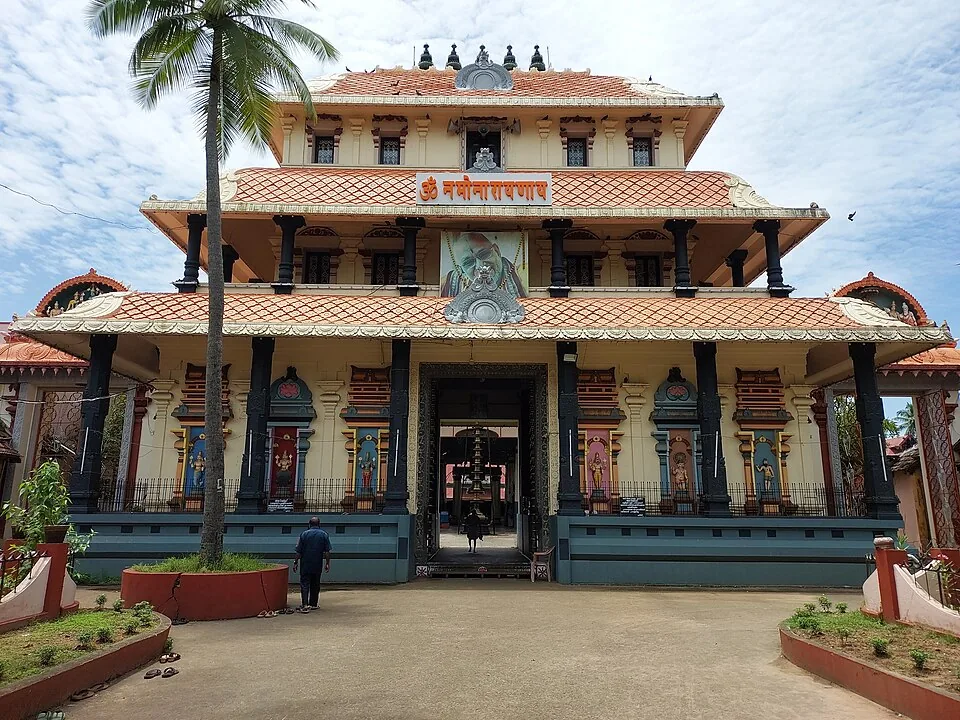
The Cochin Thirumala Devaswom at Gosripuram is the largest and most important institution of the Gowda Saraswat Brahmins in Kerala, and the community around it has kept Konkani alive in a Malayalam city for four and a half centuries. Two things explain why it is here: a founding myth about a river that no longer exists, and a documented refusal at the doors of other people’s temples.
The river and the axe
The Gowda Saraswats carry one of the great migration myths of the Indian west coast, set down in the Sahyadri Khanda of the Skanda Purana. Their ancestors, it holds, were Saraswat Brahmins of the ancient Gauda country, living on the banks of the river Saraswati. When the Saraswati failed and dried into the sand, they were scattered southwards. And Parashurama — the axe-bearing avatar of Vishnu, who had reclaimed the whole Konkan coast from the ocean by hurling his weapon out over the water — settled them on the new land he had made.
Read it slowly and it is a startling self-description: a people who belong to a river that no longer exists, placed on a coast that had to be pulled out of the sea before they could stand on it. For a community that has since been displaced from Goa, and then repeatedly from Cochin, a founding story about ground that is provisional and a homeland that has vanished has proved unnervingly apt.
Why they left Goa
The historical migration is dated to 1568 in the temple’s own account, though you will also see 1560, and the year is not settled. Two pressures converged. The Vijayanagara Empire, which had been the community’s political shelter, collapsed after the battle of Talikota in 1565. And the Portuguese in Goa were pursuing a policy of coercive conversion to Christianity that made staying untenable.
They did not travel light in the sense that matters. Tradition holds that Swami Vijayendra Tirtha of the Kumbakonam Math carried the image of Venkatachalapathy down from Goa during the migration. The community moved its god before it moved its houses, and everything at Gosripuram follows from that: the temple is named Thirumala because the deity is the Venkateshwara of Tirumala in Andhra, and re-founding that worship in a new city is how a displaced people made Cochin home.
The part that is usually left out
Gosripuram is normally told as a story about the Raja of Cochin’s hospitality, and that part is true — he gave the incomers shelter and trading rights, as he did for the Jewish, Jain and other merchant communities who arrived in the same centuries. But the hospitality of the state was not matched by the hospitality of the altar.
The established Brahmins of Cochin regarded the incoming Saraswats as their social inferiors and refused them entry to the local temples. For a community whose entire vocation was temple priesthood, that was not merely a slight; it removed their livelihood along with their worship. The Devaswom exists because of the refusal. They built their own temple because there was no other door, and then laid out the streets of Cherlai and Gosripuram around it in agraharam fashion, living in concentric rings from the deity outwards.
- The Gowda Saraswats were refused entry to Cochin’s existing temples, so they built Gosripuram.
- A few hundred metres away, the Paradesi Synagogue kept its own three-tier hierarchy — Malabari Jews barred from full membership, Meshuchrarim barred from the building.
- Mattancherry’s reputation for tolerance is real. It is also partial.
- The honest version of the quarter is more interesting than the brochure version.
What survived, and what to look at
Ritual practice here is Konkani rather than Kerala-standard, and that is the most interesting thing about visiting: the language, the festival calendar and the conduct of worship all descend from the community’s Goan and wider Saraswat tradition, kept deliberately distinct inside a state with an extremely strong temple culture of its own. This is not a Kerala temple with Konkani devotees. It is a Konkani temple that happens to be in Kerala.
In the compound: four upakovils — subsidiary shrines to Mahalakshmi, Hanuman, Garuda and Vigneshwara — a temple pond, the gopuram, and a bronze bell of roughly four feet in diameter and six feet in height, among the largest in the state. As at most active Hindu temples in Kerala, entry to the inner areas is generally restricted to Hindus, there is a dress code and photography inside is not welcome. The streets around it are part of the visit and open to everyone.
Frequently asked questions
Who are the Gowda Saraswat Brahmins of Kochi?
A Konkani-speaking community who migrated from Goa to Kochi in the mid-sixteenth century — the temple’s own account gives 1568 — escaping Portuguese forced conversion at a moment when the Vijayanagara Empire, their political shelter, had just collapsed after Talikota in 1565. The Cochin Thirumala Devaswom is their principal institution in Kerala.
What is the Parashurama legend of the Saraswats?
Recorded in the Sahyadri Khanda of the Skanda Purana: the community’s ancestors were Saraswat Brahmins of the Gauda country living by the river Saraswati; when the river dried up they were scattered south, and Parashurama — who had reclaimed the Konkan coast from the sea with his axe — settled them on the land he had made. It is told as sacred tradition, not as history.
Why did the Gowda Saraswats build their own temple in Cochin?
Because the existing temples would not admit them. The established Brahmins of Cochin treated the migrants as socially inferior and denied them entry — a serious exclusion for a community whose livelihood was temple priesthood. The Raja gave them land and trading rights; the temples did not give them a door.
Why is it called Thirumala?
The presiding deity is Sree Venkateshwara, the same form worshipped at Tirumala in Andhra Pradesh, so the temple and its quarter carry the name of that older centre. Tradition holds that Swami Vijayendra Tirtha carried the image down from Goa during the migration itself.
Can non-Hindus enter the Cochin Thirumala Devaswom?
As at most active Hindu temples in Kerala, entry to the inner areas is generally restricted to Hindus. The surrounding precinct and the Konkani streets of Cherlai and Gosripuram can be walked by anyone. Check on the day and follow what staff tell you.
What is an agraharam, and does Gosripuram have one?
An agraharam is a settlement laid out around a temple, with Brahmin houses arranged along streets radiating from or ringing the shrine. The Gowda Saraswats settled Cherlai and Gosripuram in exactly that pattern, which is why the quarter still reads as a distinct Konkani neighbourhood rather than as a temple with a city around it.