On 2 March 1662 the Portuguese burned the Konkani quarter of Mattancherry. The houses were ransacked, the shops looted and the temple at Gosripuram destroyed. The community had backed the Dutch in the struggle for Cochin, and this was the reprisal.
They left the city, carrying the image of Venkateswara with them, and sheltered at Udayamperur near Tripunithura. They were there about ten months — refugees a second time, four generations after the first flight from Goa — and they had nothing to do but think about what had just happened.
What they decided in those ten months is the reason there is not one Cochin Thirumala Devaswom but sixteen.
The pledge
The community's own record is specific: while at Udayamperur, without shelter, they took a pledge to spread their habitation across sixteen places — eight in the Kingdom of Cochin and eight in Travancore — building a Tirumala Devaswom in each and calling each settlement a gramam.
Read that as engineering rather than piety and it is remarkable. A community that had just watched its single point of failure burn resolved never to have a single point of failure again. Sixteen temples, sixteen settlements, two kingdoms — so that a hostile power, a bad ruler or a fire could take one and not the institution. It is the logic a merchant community would apply to a warehouse, applied to a god.
The Dutch defeated the Portuguese on 6 January 1663. The Konkanis came back to Mattancherry and rebuilt the temple with Dutch assistance. But the sixteen gramams went ahead anyway, and they are the reason Konkani Kerala is a network rather than a neighbourhood.
It was tested, and it worked
The test came 129 years later, and it did not come from a European power. In 1791 Sakthan Thampuran imprisoned the temple's trustees and demanded illegal contributions from the community. On 12 October leading Konkani merchants including Dewaresa Kini were killed and the shops were plundered — the episode is remembered as the Dewareshan war, named after him.
The community fled again, this time south to Alappuzha in Travancore, and took the deity with them. And this is where the Udayamperur decision paid: they were not fleeing into nowhere. Travancore already held eight gramams of their own people. The community prospered there around the deity, and the image stayed in Travancore for sixty-one years.
It returned to Cochin on 7 February 1853, in the reign of Kerala Varma IV — and its return set off a legal dispute between the two kingdoms, which is its own comment on how much an idol in a temple can be worth to a state. That sixty-one-year absence, and not the 1662 fire, is the longest interruption in this temple's history. It is also the one almost nobody mentions.
What it left behind in the building
Three consecrations in three centuries is the visible residue of all this. The first pratishtha was performed in 1599 by Swami Sudhindra Tirtha of the Kumbakonam Math, in the lunar month of Chaithra on the full-moon day with the moon in conjunction with Chitra — which is why the temple's six-day Araat festival falls where it does. The second came in 1719, after the Portuguese fire and the rebuild, conducted by Swami Devendra Tirtha with Swami Madhavendra Tirtha of Sri Kashi Math. The third came in 1881, after the sixty-one-year exile, under Swami Bhuvanendra Tirtha and Swami Varadendra Tirtha.
A temple gets reconsecrated when worship has been interrupted. Count the consecrations and you have counted the catastrophes.
Why it is worth knowing at the gate
Because it changes the scale of what you are looking at. Cochin Thirumala Devaswom presents as a large, busy, handsome temple in a quarter full of them — one item on a walk that also takes in the palace, the synagogue and Jew Town, the Jain temple and the spice godowns.
It is actually the head of a sixteen-node network laid across two former kingdoms, designed in a refugee camp by people who had learned exactly how much a single building can be relied upon. The Konkani community around Cherlai and Gosripuram still speaks Konkani after four and a half centuries in a Malayalam city. Distribution is how a minority survives, and this temple is where that was decided.
Frequently asked questions
Why are there sixteen Tirumala Devaswoms?
Because of a pledge taken during exile. After the Portuguese burned the Mattancherry temple and the Konkani quarter on 2 March 1662, the community sheltered at Udayamperur for about ten months and resolved to spread its habitation across sixteen places — eight in the Kingdom of Cochin and eight in Travancore — building a Tirumala Devaswom in each and calling each a gramam.
Did the community come back to Mattancherry?
Yes. The Dutch defeated the Portuguese on 6 January 1663, the Konkanis returned and the temple was rebuilt with Dutch assistance. The sixteen gramams were established anyway — the point of them was that the community should never again depend on one place.
What was the Dewareshan war?
The 1791 episode in which Sakthan Thampuran imprisoned the temple's trustees and demanded illegal contributions from the Konkani community. On 12 October leading merchants including Dewaresa Kini were killed and shops plundered; the conflict is named after him. The community fled to Alappuzha in Travancore, taking the deity.
How long was the deity away from Cochin?
Sixty-one years. It went to Alappuzha after 1791 and was brought back on 7 February 1853, in the reign of Kerala Varma IV, its return prompting a legal dispute between Cochin and Travancore. That absence, not the 1662 fire, is the longest interruption in the temple's history.
Why has the temple been consecrated three times?
Because worship was interrupted three times. The first pratishtha was in 1599 under Swami Sudhindra Tirtha of the Kumbakonam Math; the second in 1719 under Swami Devendra Tirtha with Swami Madhavendra Tirtha of Sri Kashi Math, after the Portuguese destruction and rebuild; the third in 1881 under Swami Bhuvanendra Tirtha and Swami Varadendra Tirtha, after the deity returned from Travancore.
Can I visit?
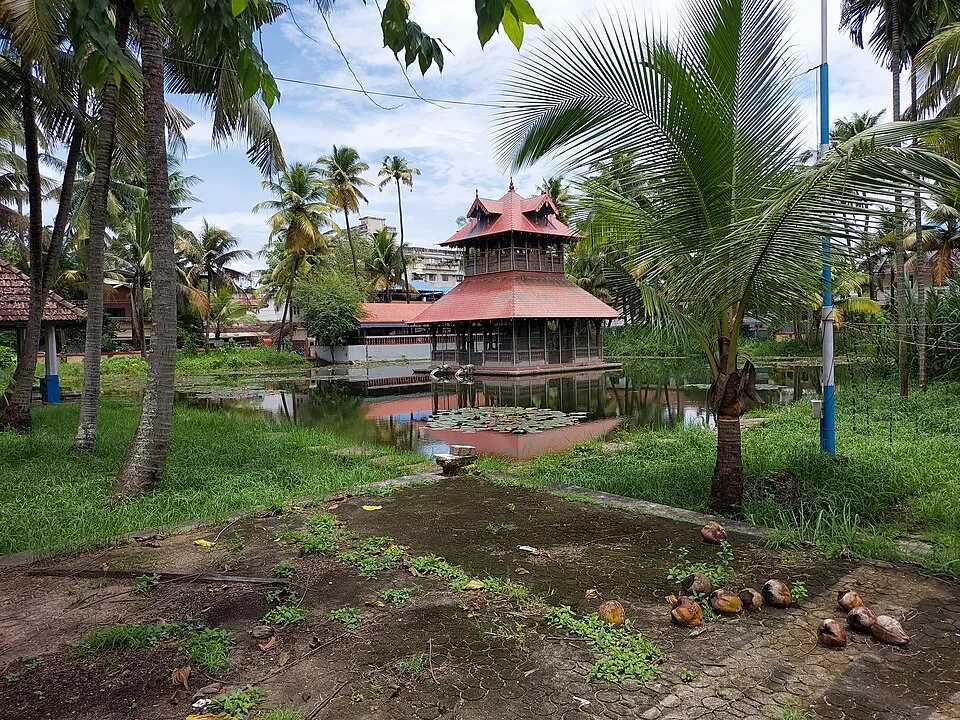
It is an active temple with daily worship rather than a heritage site. As with most working Hindu temples in Kerala, entry to the inner areas is generally restricted to Hindus, a dress code applies, and photography inside is not welcome. The compound, the pond, the gopuram and the agraharam streets of Cherlai and Gosripuram around it are worth the walk regardless.