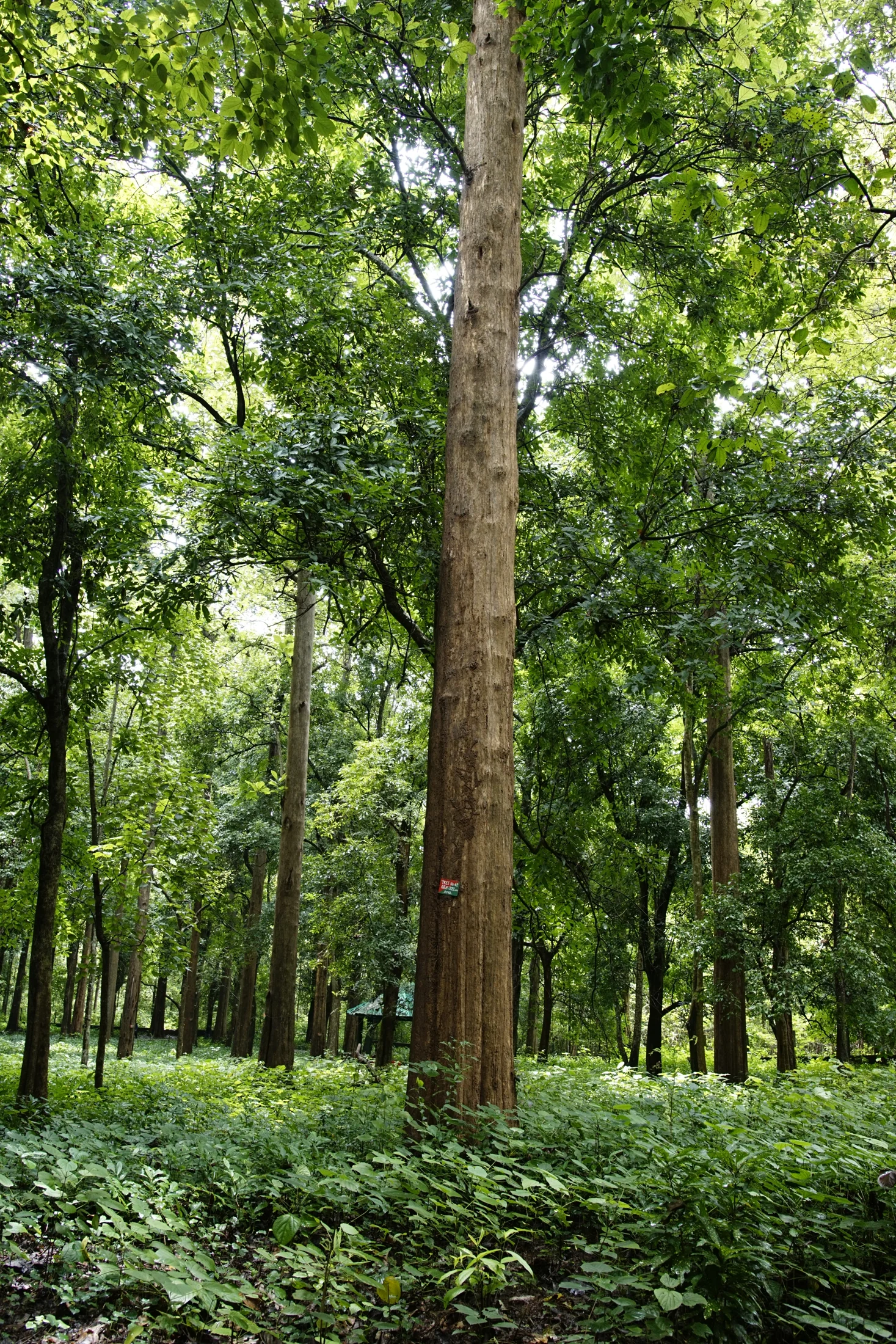
The tall trees at Conolly’s Plot can make the plantation’s beginnings seem inevitable. They were not. Raising a managed teak stand required seed, nursery work and repeated attempts to establish young plants. The mature trunks are the visible result of that process, while the early failures are easier to miss during a walk beneath the canopy.
A plantation had to be made
Kerala’s forest-history account places experiments with teak seed in the early 1840s. It describes work involving Graham and Chathu Menon before the plantation expanded. The practical problem was germination: acquiring seed did not automatically produce a reliable supply of seedlings for a large planting programme.
That distinction changes how the grove is read. The trees are not simply a convenient natural concentration discovered beside a river. They belong to a deliberate experiment in cultivation and management. The surviving stand therefore connects botanical knowledge with labour, administration and demand for timber.
Two names in the story
The plot is named for H. V. Conolly, the Malabar collector associated with the enterprise. Kerala Tourism also identifies Chathu Menon’s role in developing the plantation. Remembering both prevents the history from collapsing into a single colonial official’s name on a destination sign.
Chathu Menon belongs to the practical work that made the planting possible. The Forest Department’s history describes the sequence of trials and the development of seedlings, giving substance to that role. A mature tree cannot display those experiments directly, but knowing about them makes the labelled trunks more than a picturesque avenue.
The surviving plot is not the original whole
The modern visitor grove is a remnant of a much larger planting history. Kerala Tourism describes extensive original plantations and later wartime felling, with a smaller area surviving as the present plot. The size of the visit should therefore not be confused with the scale of the original enterprise.
This is also why a photograph of one large teak should not be used to claim an uninterrupted untouched forest. The site’s value lies partly in its history of planting, selection and survival. Those human interventions are central to its identity, even when the present canopy feels enclosed and green.
Continue the question at the museum
Nilambur Teak Museum supplies a useful second perspective through displays of seeds, planting material and the wider biology of teak. The two places can be connected by a question: how did the small starting material become the kind of tree visible at Conolly’s Plot? That is a more rewarding link than merely adding another teak-named stop.
At the grove, look upwards once more with the nursery stage in mind. Height and girth are late results in a long sequence. The story begins with the less spectacular work of getting a seed to grow, then keeping the young tree alive long enough to become part of a managed stand.
Sources: Kerala Tourism’s Conolly’s Plot account and Kerala Forest Department’s forest history.
Plan the visit: Conolly’s Plot.