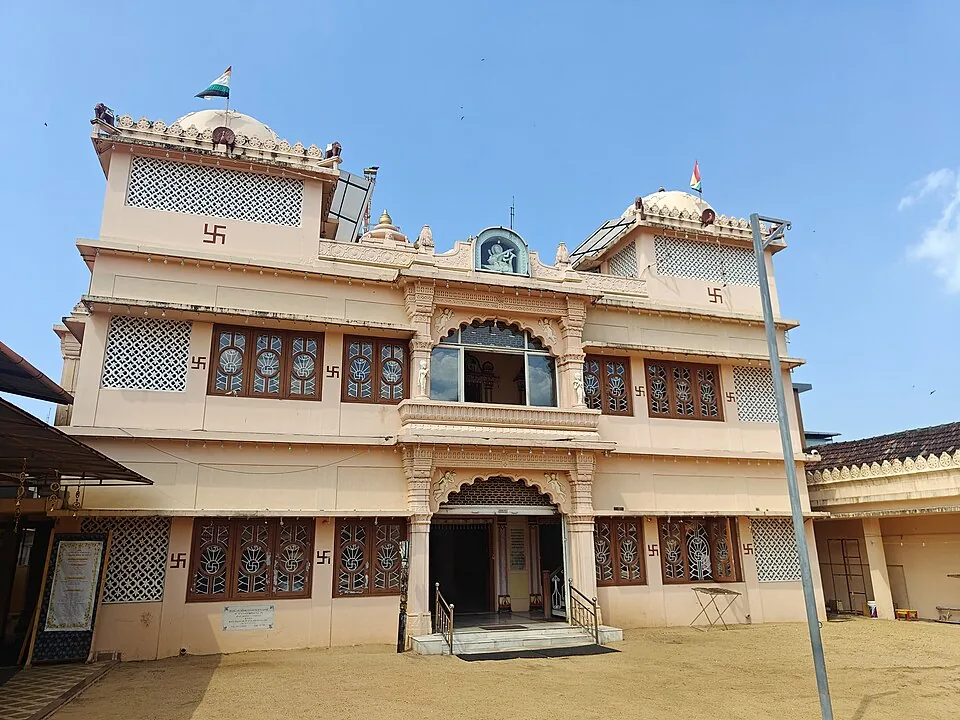
Shortly after noon, in a back street of Mattancherry, someone at the Dharmanath Jain Temple strikes a steel plate and calls out a single word — chalo, come — and the sky above the spice quarter fills with pigeons. They arrive in a mass off the surrounding roofs, make three circuits of the temple dome, and settle. Prayers are recited. Only then does the grain go down.
What actually happens, in order
The window is roughly 12:00 to 12:30, with 12:15 the time most often quoted, and it is the same every day. The sequence matters more than the spectacle: the signal, the arrival, three clockwise circuits of the dome, the recitation, and then the feeding. Devotees read those three circuits as pradakshina — the clockwise circumambulation a worshipper performs around a shrine — and the birds do not touch the grain until the prayers finish.
Whatever you conclude about the birds’ intentions, all of that is observable and you can time it yourself. There is no second showing. If the feeding is why you are coming, build the rest of your Mattancherry morning around it — the palace, Jew Town and Bazaar Road are all within a few minutes’ walk and can be arranged either side.
Why a temple feeds birds at all
This is not a display laid on for visitors. Jiva daya — active compassion towards living beings — is a working principle of Jain life rather than a slogan, and feeding birds and animals is one of its most ordinary expressions. Ahimsa, non-injury, is the tradition’s central commitment, and it extends a good deal further down the ladder of creatures than most religious ethics bother to go.
What this temple has added is scale and infrastructure. A purpose-built birdhouse stands in the compound: a tower of roughly thirty metres divided into some three hundred individual nesting compartments. That is a serious quantity of masonry to devote to pigeons, and it is the clearest physical statement of the principle anywhere in Kochi.
- Arrive by about 11:50. The whole thing is over inside half an hour.
- Shoes off. Leather — belts, bags, straps — is generally left outside.
- Modest dress; scarves and dhotis are usually available at the entrance.
- Photography is generally fine, but not during prayers and not of worshippers without asking.
The monk who set the clock
The tradition told at the temple is that the fixed hour was not the community’s idea. A visiting monk, the story goes, instructed that the birds be fed at one appointed time each day rather than whenever anybody happened to feel charitable — so that discipline would be taught to the birds and to the people at once. Whether a particular monk said this, and when, is not something we can source, and we tell it as tradition rather than record.
The honest explanation for the punctuality is less mystical and no less impressive: birds fed at a fixed hour by a fixed signal learn the signal extremely well, and generations of pigeons in this quarter have now been trained by a steel plate. That the result looks like reverence is the interesting part. The temple is more careful about the distinction than most retellings of it are.
What else is in the building
Do not leave straight after the birds. The interior is faced throughout in white marble with carved pillars and Tirthankara figures, in the idiom of the Jain temples of Gujarat and with essentially nothing in common with Kerala’s laterite-and-timber temple architecture. The principal image is Dharmanatha, the fifteenth Tirthankara; a separate shrine within the complex holds Chandraprabhu.
The whole thing takes twenty to thirty minutes without the birds, forty-five with them, and costs nothing. Almost nobody on the standard palace-and-synagogue route comes in, so outside the noon window it is one of the quietest places in Mattancherry.
Frequently asked questions
What time are the pigeons fed at the Dharmanath Jain Temple?
Shortly after midday — usually given as a 12:00 to 12:30 window, with 12:15 the time most often quoted. Someone strikes a steel plate and calls out, the birds come in, circle the dome three times, prayers are recited and then the grain is put down. There is only one feeding a day.
Why do the pigeons circle the temple three times?
Devotees read it as pradakshina, the clockwise circumambulation a worshipper performs around a shrine. The circling and the waiting before feeding are both observable; whether they constitute reverence is an interpretation. Birds fed at a fixed hour by a fixed signal learn the signal very thoroughly.
What is the birdhouse in the temple compound?
A purpose-built pigeon tower of roughly thirty metres, divided into around three hundred separate nesting compartments. It is the most substantial physical expression of jiva daya — Jain compassion towards living beings — in Kochi.
Can non-Jains watch the pigeon feeding?
Visitors are plainly welcomed and the temple receives them daily; it is listed as an attraction by Kerala Tourism. We have not found a published statement about access to the inner shrine specifically, so ask at the door and behave as you would in any active place of worship.
What should I wear and what are the rules at the door?
Modest dress with covered shoulders and legs; women may be asked for a scarf, and scarves and dhotis are usually available at the entrance. Footwear comes off, and leather items are generally left outside, following the Jain principle of ahimsa. Photography is usually permitted but not during prayers.
Is the Dharmanath Jain Temple worth a special trip?
Not on its own from across the harbour, but certainly as part of a Mattancherry morning — it is minutes from the Dutch Palace, Jew Town and Bazaar Road, it is free, and it takes half an hour. Timed for noon, it goes from a pleasant stop to a memorable one.