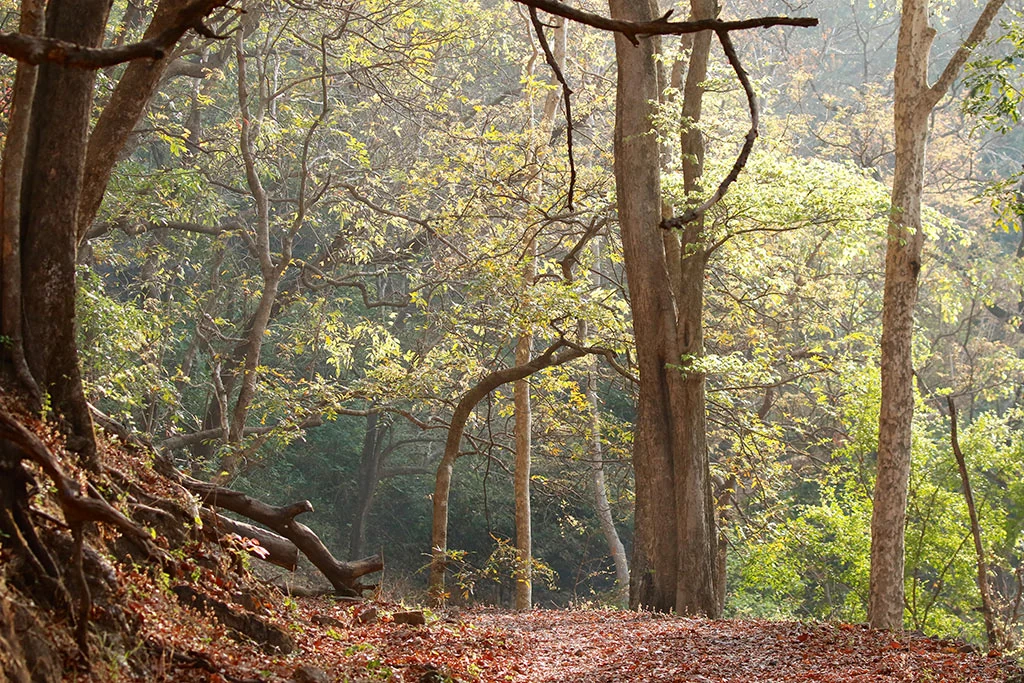
Sunlight falls through tall trees onto the leaf-covered Dhoni walking route. The forest floor can look like background on a waterfall outing, but a scientific discovery gives it a more particular interest. In 2025, zoologists described Gnomognathus dhoni, a millipede whose name refers to Dhoni Reserve Forest in Palakkad.
A small habitat produced a precise record
Nikhila Sudhakaran and Manju Elizabeth Kuruvila’s paper in Zootaxa records specimens collected in August 2024 near a stream beside teak plantations. The material came from soil and leaf debris. The description therefore concerns a specific kind of habitat within the reserve, not simply an animal associated loosely with the whole Western Ghats.
The authors distinguished the new species through detailed anatomy, including male reproductive structures. That is a reminder of the difference between noticing an animal and identifying it scientifically. A brown millipede seen on a walk cannot be assigned this name confidently from colour and location alone.
The scientific name is also a geographical record. The paper explicitly ties the epithet to the reserve. Dhoni now appears in the species’ identity because of the locality where the described material was found.
Look at the floor without disturbing it
For a visitor, the discovery changes the attention given to ordinary ground. Leaf litter, soil and a shaded stream margin are not empty spaces between scenic trees. They provide the setting in which small organisms live, including some that may require careful study before their identity is understood.
That does not turn the tourist route into a collecting expedition. Leave litter, stones and fallen wood in place. A photograph from the permitted path or a question to the guide can express curiosity without changing the habitat.
The research locality should not be used as an invitation to search off the visitor route. Scientific fieldwork and an ordinary trek operate under different purposes and permissions. The useful lesson is to value the forest at a smaller scale, not to imitate specimen collection during a holiday.
A known destination can still hold new knowledge
Dhoni is familiar to visitors because of its waterfall. The millipede paper adds another way to understand the reserve: as a place where close biological work can reveal distinctions invisible in a broad landscape photograph.
This makes the walk interesting even before water comes into view. Notice the transition from dry-looking leaves to a damp patch, the shelter beneath vegetation and the way light reaches the ground. Those observations do not require a rare-species sighting to be worthwhile.
Read the original study or its taxonomic treatment. The finding is specific and modest in scale, which is what makes it valuable: a forest known for one visible cascade also contains subjects that demand much closer attention.
Plan the visit: Dhoni Waterfalls trek.