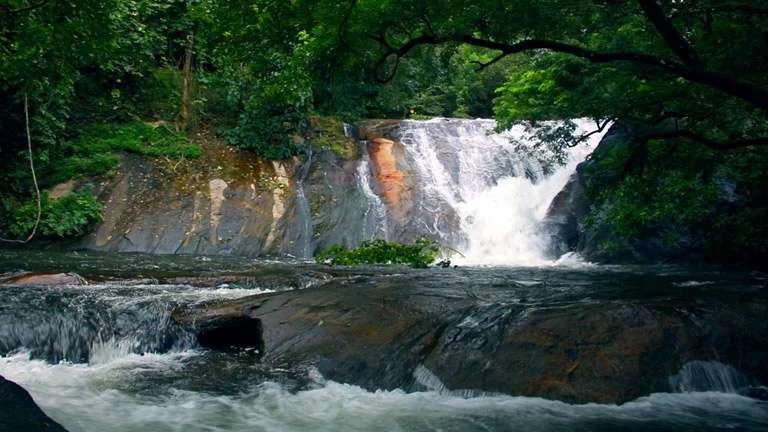
Water drops over a rock ledge, then spreads across lower slabs beneath trees. The Dhoni photograph shows a cascade with several surfaces rather than a single narrow vertical fall. Following the water through that visible sequence gives the scene more interest than judging it only by how much white water fills the frame.
Begin where the water changes direction
Notice the edge at which the flow leaves the upper rock, then the lower surfaces that interrupt and redirect it. A ledge can divide water into separate strands; a sloping slab can gather those strands again. The pattern is visible from the viewing area and does not require climbing into the stream.
Rainfall changes how much of the rock is covered. A photograph taken under one set of conditions cannot promise the same width or force on another visit. Exposed stone is part of the waterfall’s shape, not evidence that the place has somehow ceased to be the destination described.
The surrounding trees also affect the view. Shade can make the water appear brighter against dark rock, while leaves partially conceal the upper ledge. Retain some of that setting in a photograph to show how the cascade belongs to the forest.
A pool is a view before it is an activity
Tourism images can make a pool appear calm, shallow or inviting. They do not reveal every submerged surface or the force of water entering it. Nor does a photograph establish what the current visitor rules permit.
Follow the Forest Department’s instructions for the actual day. Older promotional descriptions of bathing should not be treated as a standing authorisation when access conditions have changed. Keep the ordinary trekking visit and any explicitly permitted water activity separate.
Wet rock beside the cascade can be difficult even without entering the pool. Avoid moving onto a slab for a less obstructed photograph, particularly when it lies beyond the viewing route. A secure, slightly wider frame is a better record than a close angle obtained by ignoring the site’s limits.
Let the waterfall be one part of the walk
Dhoni’s approach through the forest gives the cascade its context. The destination is reached after moving under trees and across changing ground, then followed by a return through that setting. Keep time and energy for both legs rather than spending the entire outing beside the water.
If conditions reduce the permitted viewing area, use the view available. A glimpse through vegetation can still reveal the ledge, flow and surrounding canopy. The guide’s decision about where the group stops is part of the visit.
Kerala Tourism’s Dhoni account introduces the waterfall landscape. At the site, let the visible water and current staff directions determine the experience. The cascade’s changing form is worth observing without converting it into an unsupervised bathing plan.
Plan the visit: Dhoni Waterfalls trek.