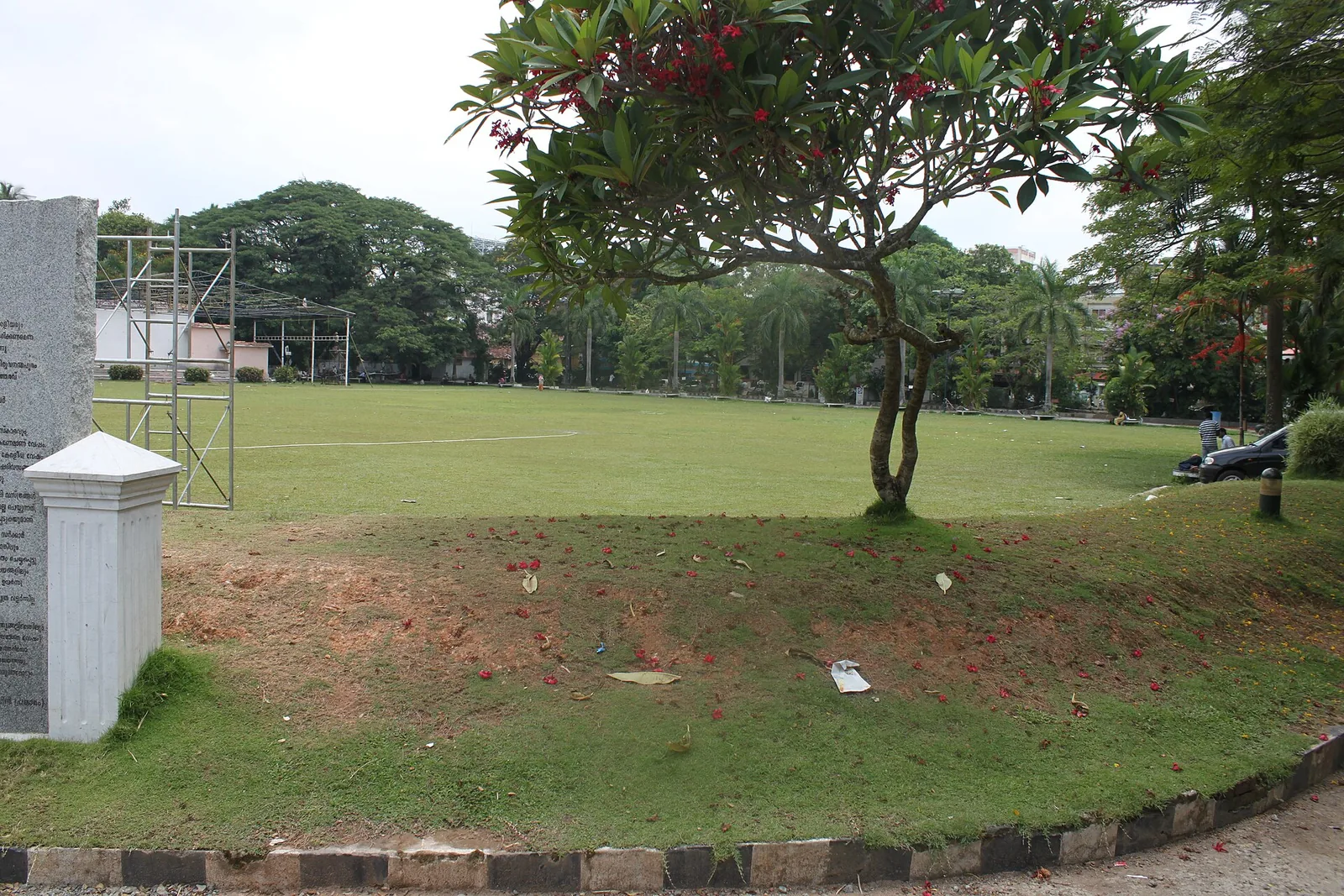
The visitors go to the hall. Durbar Hall Art Centre is a free contemporary gallery, well lit and well run, and it is a genuinely good twenty minutes. But almost everything that happened on this site happened outside it, on the grass — and inside that outdoor history there is a corner nobody writes about at all.
The Kulapuramalika
At one end of the ground stands a building called the Kulapuramalika. In 1903 a Malayalam literary monthly called “Rasikaranjini” was launched from it. It ran until 1907 and then stopped.
Four years of a small magazine is the kind of fact that gets one clause in a guidebook, if it gets anything, and it got exactly one clause on our own page until we looked properly at who was running it.
The man who translated the Mahabharata in 874 days
Kodungallur Kunjikkuttan Thampuran, 1864 to 1914, is known in Kerala as “Kerala Vyasa” — the Vyasa of Kerala — and the epithet is not decorative. He translated the entire Mahabharata into Malayalam single-handed, word by word and metre by metre, as “Bhasha Bharatam”, in 874 days.
Take a moment with that number. The Mahabharata is the longest poem in the world. Doing it word by word is one order of difficulty; doing it metre by metre, so the Malayalam carries the Sanskrit prosody, is another entirely. And it was finished inside two and a half years by one man who also edited a magazine, wrote his own verse and ran two literary movements.
And who wanted Sanskrit out of Malayalam
Here is the contradiction that makes him interesting rather than merely prodigious. Kunjikkuttan Thampuran was among the finest Sanskrit scholars Kerala produced. He was also the driving force behind “Pacha Malayalam” — pure Malayalam — a movement to write the language with its Sanskrit borrowings stripped out.
A man arguing that Malayalam should be able to stand without Sanskrit, while personally carrying the largest Sanskrit text in existence over into Malayalam, is not being inconsistent. He is somebody who had worked out precisely what he thought a language was for: bring the material across, then let the receiving language do the work in its own words. His other movement, “Puranetihasa Vivartanam”, was the translation programme that followed from the same conviction.
- Kodungallur Kunjikkuttan Thampuran (1864–1914) — “Kerala Vyasa”. Translated the whole Mahabharata in 874 days. Led Pacha Malayalam, the pure-Malayalam movement.
- Appan Thampuran — of the Cochin royal house. Wrote Bhaskara Menon (1924), widely held to be the first detective novel in Malayalam.
- Rasikaranjini — launched 1903 at the Kulapuramalika, on this ground. Closed 1907.
The other Thampuran wrote Malayalam’s first detective novel
Appan Thampuran belonged to the Cochin royal family, which is part of why the magazine could be run from a building on the durbar ground in the first place. His own most-cited work came later: “Bhaskara Menon”, published in 1924, generally reckoned the first detective novel in Malayalam. He also wrote “Bhoothrayan”, and his memorial now stands at Ayyanthole in Thrissur.
So the two people running this magazine were, between them, responsible for the largest translation project and one of the first genre novels in the language. Neither fact is recorded anywhere on the ground where they were sitting.
Why a magazine mattered so much then
Rasikaranjini belongs to a specific and short-lived moment. The turn of the twentieth century was when Malayalam acquired a periodical press capable of carrying serious literary argument — “Bhashaposhini”, “Vidyavinodini”, “Vivekodayam” and others were running in the same decades — and those magazines are where modern Malayalam prose was effectively settled.
Questions that now look closed were open then: how much Sanskrit belonged in the language, whether prose could carry weight the way verse did, what a novel in Malayalam should even look like. Those arguments happened in print, in short-run monthlies, most of which folded inside a decade. Rasikaranjini folding in 1907 is not a failure; it is what these publications did. The argument moved on and outlived the paper it was made in.
Four histories, one field
Stand on the ground and count what has happened on it. The durbar itself met in the hall, with the public assembled out here. The administrative reforms of 4 January 1938, the new constitution of the Cochin State of 17 June 1938 and the Cochin State Central War Committee of 28 June 1940 were all proclaimed on this grass — the subject of our companion piece on the proclamations.
The same grass, and the path leading from it to the Ernakulam Shiva temple, were closed to people of lower caste until temple entry was opened. It has been a parade ground, a football pitch against British army sides, and for years the principal cricket ground in Kochi. And at one end, two men argued about what Malayalam should be.
Nothing on the site tells you any of it. There is a gallery with good lighting, an open field, some parking, and no interpretation at all. Give the exhibitions twenty minutes and the field ten, and know what you are standing on.
Frequently asked questions
What was Rasikaranjini?
A Malayalam literary monthly launched in 1903 from the Kulapuramalika at one end of the Durbar Hall Ground in Ernakulam, and published until 1907. Its founders were Kodungallur Kunjikkuttan Thampuran and Appan Thampuran. Bound volumes survive in collections in Kerala and several years have been digitised.
Who was Kodungallur Kunjikkuttan Thampuran?
A Malayalam poet and Sanskrit scholar, 1864 to 1914, known as Kerala Vyasa for translating the entire Mahabharata into Malayalam single-handed — word by word and metre by metre, as Bhasha Bharatam — in 874 days. He also led two literary movements: Pacha Malayalam, for writing Malayalam without its Sanskrit borrowings, and Puranetihasa Vivartanam, a programme of translating the epics and puranas.
Isn’t it contradictory to translate Sanskrit and campaign against it?
Only on the surface. Pacha Malayalam argued that Malayalam should be able to carry its own weight in its own vocabulary; the translation movement was about bringing the content of the Sanskrit tradition into that language. Get the material across, then let Malayalam say it in Malayalam. It is a coherent position, and an unusually thought-through one.
Who was Appan Thampuran?
A member of the Cochin royal house, scholar and writer, and co-founder of Rasikaranjini. He is best remembered for Bhaskara Menon, published in 1924 and widely described as the first detective novel in Malayalam, and for Bhoothrayan. A memorial to him was established at Ayyanthole in Thrissur.
Is any of this marked on the Durbar Hall Ground?
No. Neither the magazine, nor the 1938 proclamations, nor the caste exclusion that kept people off this ground until temple entry was opened, is interpreted on site. The Kulapuramalika stands at one end and you would not know what it was.
What is there to actually see?
The gallery, which is free, well equipped since the Kochi Biennale Foundation’s renovation, and runs a changing programme rather than a permanent collection — so check what is on before travelling. Then the ground itself, which takes ten minutes and carries most of the site’s history. It is central Ernakulam, near Ernakulam South station, and not in Fort Kochi.