If you look up when the Edathua Perunnal happens, you will be told, almost everywhere, that it runs from 27 April to 7 May. English Wikipedia says so. Kerala Tourism says so. The travel aggregators say so, because they are copying those two. This page said so too, until August 2026.
The parish’s own website says 14 May. So does the Malayalam Wikipedia.
Settled by a banner
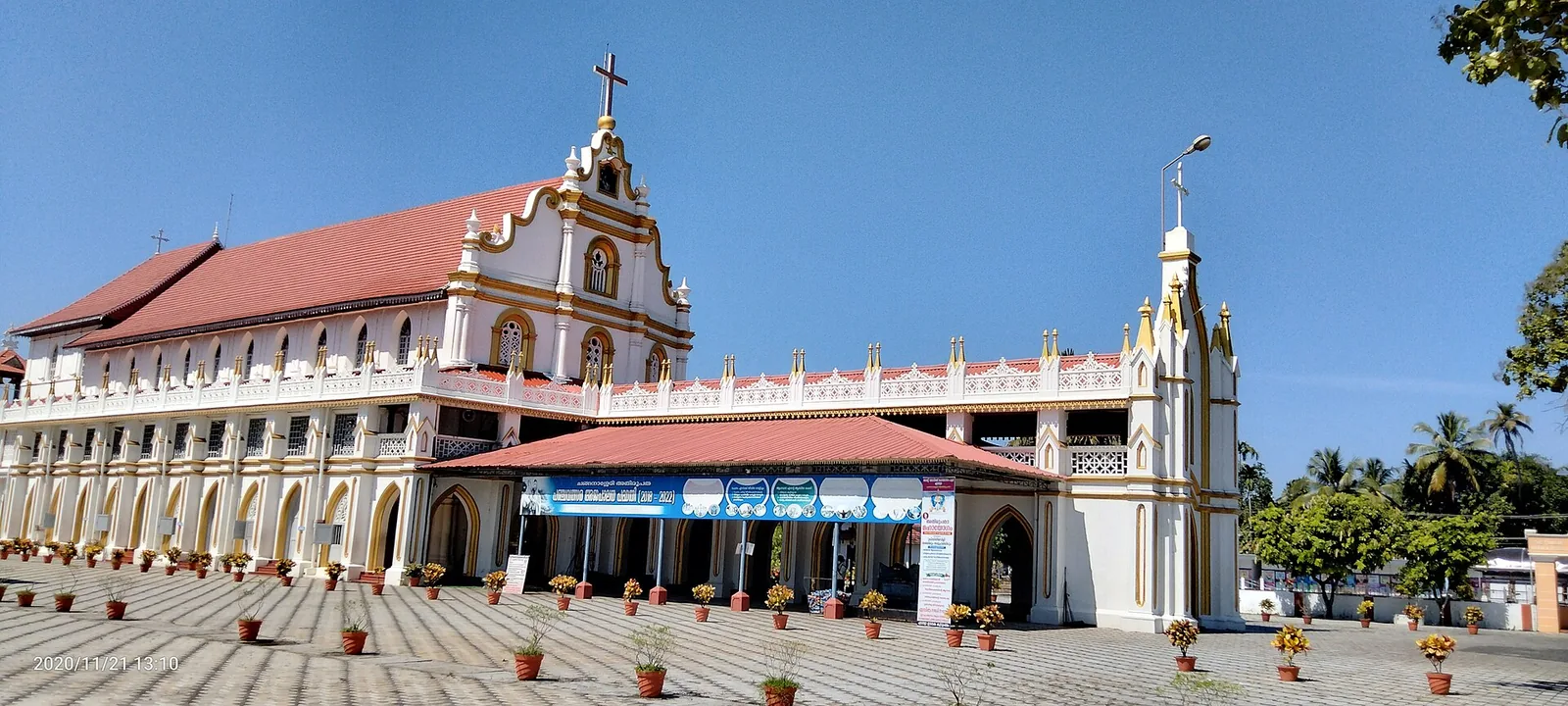
A disagreement between an institution and its own encyclopedia entry is usually resolvable in the institution’s favour, but it is better to have something harder than that. In this case there is something harder. Two photographs were taken at the church in May 2026 by a Wikimedia contributor, and strung across the front porch in both of them is the church’s own official festival banner. It reads, in Malayalam: എടത്വാ പെരുന്നാൾ … ഏപ്രിൽ 27 മുതൽ മെയ് 14 വരെ — Edathua Perunnal, from 27 April to 14 May.
That is not a source repeating a source. That is the parish announcing its own festival on its own porch, photographed. It is the same kind of evidence as a plaque, and it is the kind this site trusts above almost anything else.
What 7 May actually is
The widely printed date is not invented, and this is the useful part of the correction: 7 May is real, it is simply not the end of anything. It is the principal feast day — the peak of the whole observance, when the great procession goes out, traditionally led by pilgrims who have come from Tamil Nadu.
The full shape, as the parish gives it, runs like this. The festival opens on 27 April. On 3 May the sacred statue is installed at the main entrance for public veneration. The 5th to the 7th are the main days, with the 7th the chief feast. And it closes on 14 May with a procession out to a cross erected at the boundary of the town. Mass and novena are offered on every one of those days, in Tamil as well as Malayalam — which is itself a fact about who comes.
So what happened to the internet’s version is a small, ordinary error: somebody recorded the biggest day as the last day, and everybody copied it. A week of the festival simply fell off the record. If you planned a visit from the English sources and arrived on 10 May expecting it to be over, you would walk into a feast still in progress.
While we are correcting things
Two more are worth naming. The first is distance: Edathua is routinely given as about 15 km from Alappuzha town, including by Kerala Tourism’s own page. Measured against our stored coordinate for the church it is about 21 km in a straight line and roughly 23 km by road. That is not a rounding difference; it is the difference between a half-hour hop and a proper drive.
The second is the building. Every description of Edathua — the parish’s, Kerala Tourism’s, both Wikipedias’ — reaches for the same formula: reminiscent of medieval European churches. Not one of them names a European church. It is a genre comparison that gets repeated until it sounds like an attribution, and we have stopped repeating it as one.
What the building actually is
Look at the photograph at the top of this article, which is a better source than the formula. The body of the church is a long two-storeyed hall with open arcaded verandahs on both levels, roofed in red Mangalore tile — a Kerala building. Its west end carries a curvilinear gable, the scrolled baroque-descended shape that Kerala’s Latin churches have used for centuries, with a niche, finials and a cross.
And then, grafted onto the side of it, is an entrance and porch block in a far more literal Gothic: steep gabled fronts, clusters of crocketed pinnacles, tall two-centred arches, the ornament picked out in gold against white. The arcade arches are pointed; the roof is tiled and hipped. Nothing in Europe looks like this, because this is not a copy of anything in Europe. It is a Kerala tiled-roof arcaded hall wearing Gothic decoration, and the seam between the two is visible from the forecourt.
Inside, the parish describes a nave, chancel and sanctuary, with a three-storey altar, four pillars, three statue divisions, a preparation table, table of the Word, baptistry and relic stand. The stand is a church furnishing; published parish material does not say that Edathua holds relics of St George or give them a provenance.
The rest — the snake offerings, the kodimaram, the Nair family who gave the land — is on the Edathua place page and in our companion story on how a Roman soldier became a snake saint.
Frequently asked questions
When does the Edathua Perunnal actually run?
From 27 April to 14 May. The parish’s own site and the Malayalam Wikipedia both give 14 May, and photographs taken at the church show its official festival banner reading ഏപ്രിൽ 27 മുതൽ മെയ് 14 വരെ. The widely printed "27 April to 7 May" mistakes the principal feast day for the closing date.
What happens on 7 May?
It is the chief feast day and the peak of the festival, when the great procession goes out — traditionally led by pilgrims from Tamil Nadu. The statue is installed at the main entrance for public veneration on 3 May, the 5th to 7th are the main days, and the festival closes on 14 May with a procession to a cross at the town boundary.
How far is Edathua from Alappuzha town?
About 21 km in a straight line and roughly 23 km by road, measured against our stored coordinate for the church — not the 15 km commonly printed, including on Kerala Tourism’s own page.
Is Edathua church modelled on a European cathedral?
No source names one. Every description uses the same genre formula — reminiscent of medieval European churches — without identifying a building. What the photographs show is a hybrid: a red-tiled, two-storey Kerala arcaded hall with a curvilinear Latinate gable, and a separate porch block in a much more literal Gothic grafted onto it.