What to expect
Highlights
- Church visit at Edathua Church
- Pilgrimage, architecture or local Christian heritage
- Nearby town food and stays
St George Forane Church at Edathua in Kuttanad, known for its large annual pilgrimage feast.
Check entry arrangements. Ask the church about visiting times around services and any dress or photography rules. During worship, keep voices low and follow staff directions.
Dress respectfully and follow the institution’s admission and photography rules.
Rising white and Gothic above an ocean of paddy that lies below sea level, Edathua Church is Kuttanad’s great pilgrim beacon — where each spring hundreds of thousands come by road, rail and boat to St George.
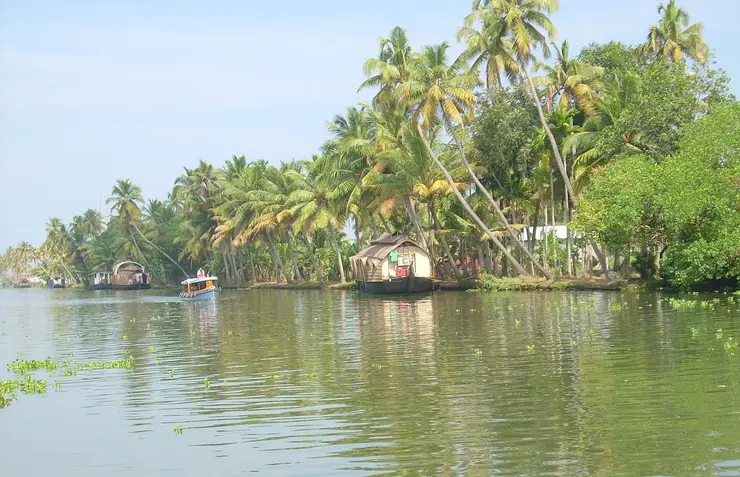
Set on the banks of the River Pamba, deep in the watery heartland of Kuttanad in Alappuzha district, St George Forane Church at Edathua — known locally as Edathua Valiapally — is one of the most visited Christian pilgrim centres in southern India. Its tall, pale façade and steep Gothic arches stand almost startling amid the surrounding green, a landscape of paddy fields, coconut groves and glinting canals that lies famously below sea level. For many travellers the first sight of the church is from the water itself, as the backwater channels of Kuttanad thread right up towards it.
The church is dedicated to St George — venerated here as Marth Gewargis, the soldier-saint and dragon-slayer — and it is his feast that has made Edathua a household name across Kerala and beyond. The annual celebration, the Edathua Perunnal, is one of the largest gatherings of its kind in the region, drawing pilgrims not only from the Syro-Malabar Catholic community but from every faith, all seeking blessing, thanksgiving and relief from their troubles.
At the heart of the devotion is the statue of St George, which during the feast is adorned in gold and jewels and carried out in solemn procession before being returned to its place within the church. Devotees traditionally bring offerings — many in the shape of body parts, moulded in gold or silver — in gratitude for cures they believe they have received. The interior, arranged in the classic nave-and-sanctuary plan with its altars, is the setting for worship during the feast. Ask the parish about any relic display and its provenance rather than assuming that relics of St George are held here.
Edathua carries a long-held popular reputation as a place of healing and deliverance. In the Malayalam accounts the tradition is specific: people have come here seeking release from snakes and snakebite, and from what the tradition calls demonic powers, as well as making the general petitions against illness and calamity that any great shrine attracts. The water of the church well figures in it too — the church’s own history records the statue of the saint being purified in it. Families have for generations come to pray and to keep vigil, and the tradition is held with great seriousness and tenderness by the community. Roampedia records this as a genuine and respected devotional belief — it is not medical advice, and anyone facing illness of any kind should always seek proper professional and medical care alongside their faith.
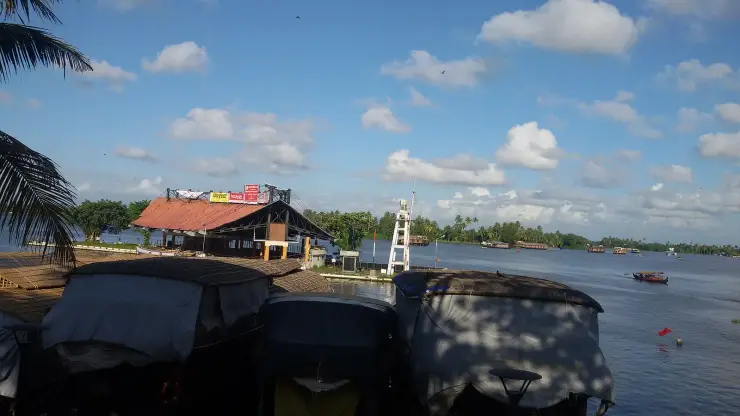
Beyond the great feast, Edathua rewards the quieter visitor too. The church sits amid some of the most photogenic scenery in Kerala — the endless paddy polders of Kuttanad, the slow country boats, the herons wading in the shallows. Many pilgrims combine a visit with a backwater cruise or a stop at nearby Champakulam, home to its own ancient churches and to the famous snake-boat traditions of the region.
To arrive at Edathua is to feel the particular character of Kuttanad: water everywhere, life lived close to the flood line, and a faith that has endured here for more than two centuries. Whether you come in the roar and colour of the Perunnal or on an ordinary morning when only the fans turn and a few candles burn, the church holds a stillness at its centre that pilgrims of every kind have long come seeking.
Ask why a Roman soldier martyred in Palestine around the year 303 should be the patron of a parish in a Kerala paddy polder, and the honest answer is on the offering counter. St George at Edathua is invoked against snakebite, and devotees bring votive figurines in gold and silver — of snakes, of the snake-mound or chithal, and of roosters.
That is not decoration; it is a landscape speaking. Kuttanad is a flooded paddy country lying below sea level, worked by people who spend their days wading bunds and cutting stalks in standing water, and where snakebite is not a folk terror but an occupational hazard of farm labour. A saint whose entire iconography is a man on a horse killing a serpent arrives in that place and is immediately, obviously useful. The dragon becomes the cobra. The Roman soldier becomes a snake saint. Nobody had to decide this; the country decided it.
It is worth naming the neighbour, because the parallel is impossible to miss. The Mannarasala Nagaraja temple — the great serpent shrine of Kerala, where the offerings include metal images of snakes — is about thirty-five kilometres away in this same district. Two shrines, two religions, one anxiety, and votive snakes on both counters. We are not claiming either borrowed from the other, and no source we can find establishes that. We are pointing out that a district which farms water and fears snakes produced snake shrines in both of its religions, and that this is what a genuinely local devotion looks like.
🔑 There is a detail in the founding date that no source we have read appears to have noticed, and it is too neat to pass over. The foundation stone of the first church here was laid on 29 September 1810 — which is Michaelmas, the feast of St Michael the Archangel. Michael is the archangel who casts down the dragon. The church being founded that day was to be dedicated to St George, the saint who kills the dragon. Whether that was deliberate we cannot prove and will not assert. But a community founding a dragon-slayer's church on the dragon-caster's feast day, in a country full of snakes, is at the very least a coincidence worth putting in front of a reader.
The second tradition is historical rather than legendary, and it is recorded in Malayalam rather than English, which is presumably why it is so little known: the ground the church stands on is said to have been donated by the Changanakkari Vellappalli family — a prominent Nair, that is to say Hindu, landholding family. A Syrian Catholic parish in Kuttanad, built on land given by a Hindu house. In a district where the boat-race obligation at Champakulam still requires a Christian family's lamp to be lit before the race can begin, this is a pattern rather than an exception.
The third concerns the image itself. The statue of St George venerated here was formally installed from the church at Edappally, near Kochi — so Edathua's saint is, in the literal devotional sense, a daughter image of Edappally's, which is worth knowing before believing any claim that this is the original or the greatest St George shrine in Kerala. The parish describes the statue as displaying a Persian architectural style, and it stands on the southern altar; Kerala Tourism, describing it independently, sees a bearded, middle-aged man riding a distinctive horse with a long body and upright ears. It is a story about an image that travelled, and about a devotion that grew larger than the place it came from.
And then there is the flagstaff, which is not a story anyone tells but is the most eloquent object on the property. Standing in the churchyard beside a granite open-air cross is a tall, tiered metal kodimaram on a stepped stone base — the dhwajastambham form of a Kerala Hindu temple, ringed tier upon tier, with a lamp-like finial. On top of it is a small gold cross. Nobody wrote that down as a legend. Somebody simply built it, and it says as plainly as anything here what Kerala Christianity actually looks like on the ground.
⚠ One thing this page will not tell you, because no source supports it: that Edathua holds relics of St George. We searched the parish's own site, both Wikipedias, the Catholic hierarchy directory, Kerala Tourism and the district tourism council, in English and in Malayalam. Nothing records any relic here, or when or how one came. The parish's own description of its sanctuary lists a relic stand among the furnishings, which is a fitting, not a provenance. ⚠ And a warning, because the wrong answer is one search away: the relics of St George brought to Kerala from Antioch in 1912 by Mar Dionysius of Vattasseril belong to the Malankara Orthodox Syrian Church and are kept at Kundara, in Kollam district, about seventy kilometres from here. Different church, different tradition, different district. They are not Edathua's.
The origins of the parish are traced to 1810, when a group of believers is said to have separated from the older Champakulam church and established their own place of worship at Edathua; local accounts place the laying of the first foundation stone on 29 September 1810, on the feast of St Michael the Archangel. From these beginnings the community grew steadily along the Pamba.
There is a jurisdictional irony in that founding worth a sentence. Edathua is a Syro-Malabar parish, in the Archeparchy of Changanassery — an Eastern Catholic church. But the canonical permission for the first church in 1810 came from the Latin Metropolitan at Varapuzha, because the Syro-Malabar hierarchy did not yet exist as such and would not for another eight decades. The parish is older than the jurisdiction it now belongs to.
The great church seen today is generally dated to the mid-19th century: the foundation stone of the present structure is recorded as being laid on 15 November 1839, with the main altar completed around 1861. Every source — Kerala Tourism, both Wikipedias, the parish itself — describes it with the same formula, as reminiscent of medieval European churches, and not one of them names a European building. That is a genre comparison, not an attribution, and it should not be hardened into one.
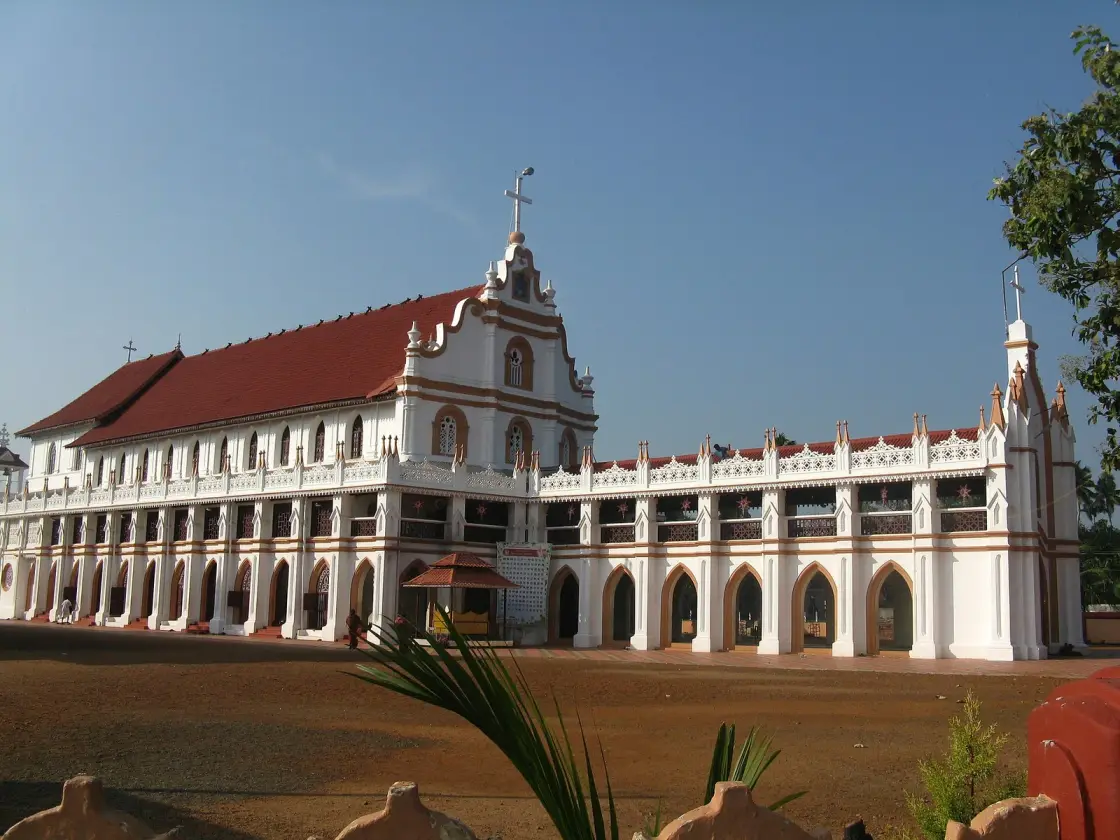
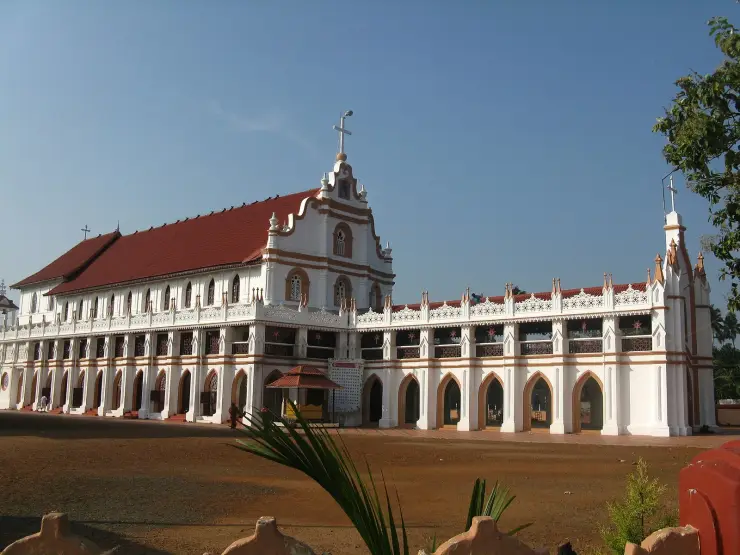
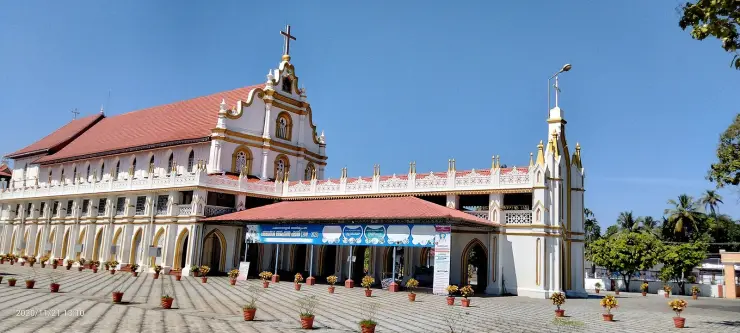
What the photographs actually show is better than the folk claim, and more particular to Kerala. The body of the church is a long two-storeyed hall with open arcaded verandahs on both levels, roofed in red Mangalore tile. Its west end carries a curvilinear Latinate gable — a scrolled, baroque-descended shape common in Kerala churches — with a niche, finials and a cross. Grafted onto that is a separate porch and entrance block in a much more literal Gothic: steep gabled fronts, clusters of crocketed pinnacles, tall two-centred arches, the whole thing picked out in gold against white. The arcade arches are pointed. The roof is Kerala. It is a hybrid building, and the hybrid is the interesting part. Inside is a basilican nave with round-arched arcades to the side aisles, a raised timber pulpit with a canopy, framed Stations of the Cross and a barrel-boarded ceiling; the parish describes its own altar as having three storeys, four pillars and three divisions carrying statues.
As a Forane (or Valiapally, literally ‘big church’) it holds a senior administrative rank, historically serving as the mother church for a cluster of surrounding parishes. It falls under the Syro-Malabar Catholic Archeparchy of Changanassery.
Devotion to St George is what carried Edathua from a local parish to a pan-regional pilgrimage. As reports of answered prayers and cures spread, the church drew ever-larger crowds, and the annual feast grew into the vast gathering it is today — one of the defining religious events of the Kuttanad calendar and among the best-known St George feasts in India.
Over the generations the site has been developed with facilities for the enormous feast-time crowds, while retaining its historic church at the centre. It remains an active parish and a living pilgrimage destination, not a museum — worship continues daily, and the great procession of the gold-adorned saint each spring links today’s pilgrims to more than two hundred years of unbroken devotion.
One of southern India’s most famous St George pilgrimage churches, alive with genuine devotion.
A genuinely hybrid building, rising above below-sea-level paddy: a red-tiled Kerala arcaded hall with a curvilinear Latinate gable at one end and a literal Gothic porch block grafted on, gold on white. Every source calls it European-style; none names a European building, and the mixture is more interesting than the comparison.
The kodimaram in the churchyard — a tiered metal flagstaff of Kerala Hindu temple form, on a stepped stone base, topped with a small gold cross, standing beside a granite open-air cross.
The votive offerings: gold and silver snakes, snake-mounds and roosters, brought to a Roman soldier-saint who became a protector against snakebite in a country that farms in standing water.
The spectacular Edathua Perunnal feast — gold-adorned statue, processions, fireworks and vast crowds of many faiths.
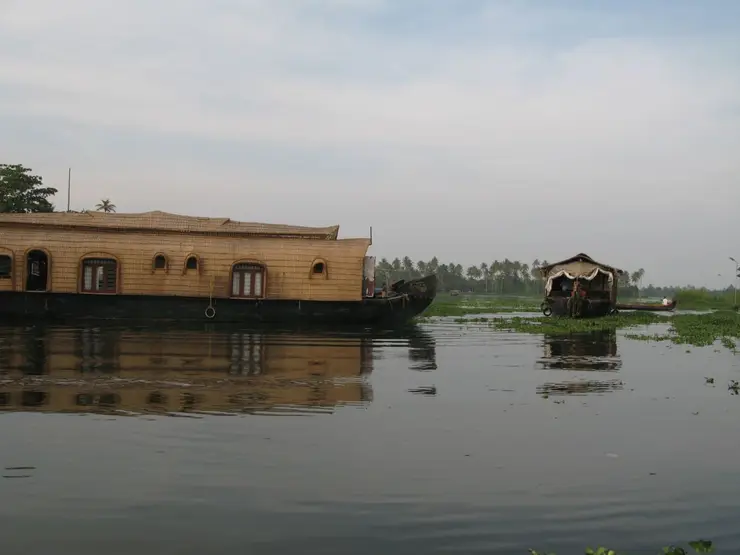
A rare chance to reach a landmark church by backwater boat through classic Kuttanad scenery.
A deeply respected, centuries-old healing tradition and an atmosphere of heartfelt faith.
An easy pairing with Champakulam, Alappuzha backwaters and Kuttanad’s paddy-and-canal landscape.
Road km to Alappuzha; ghat roads and traffic vary — allow extra.
Morning or late afternoon for quieter visits and better light.
Live forecast loads in your browser.
Sun and moon are calculated for this location and shown in IST. Photography windows are the hour around sunrise and sunset; the sunset bearing is degrees clockwise from true north. Moon phase is accurate to about half a day.
Browse listed stays, food, activities, sights, shops and rentals around Edathua Church. Check each listing’s locality and contact the business directly for current arrangements.
Kayaloram Homestay is in Karumady, Ambalappuzha, on the southern Kuttanad side of Alappuzha. Compare this location with a town stay before booking. Ask the host about the road approach, room arrangement and meals; the published record does not establish a private waterfront or included boat trip.
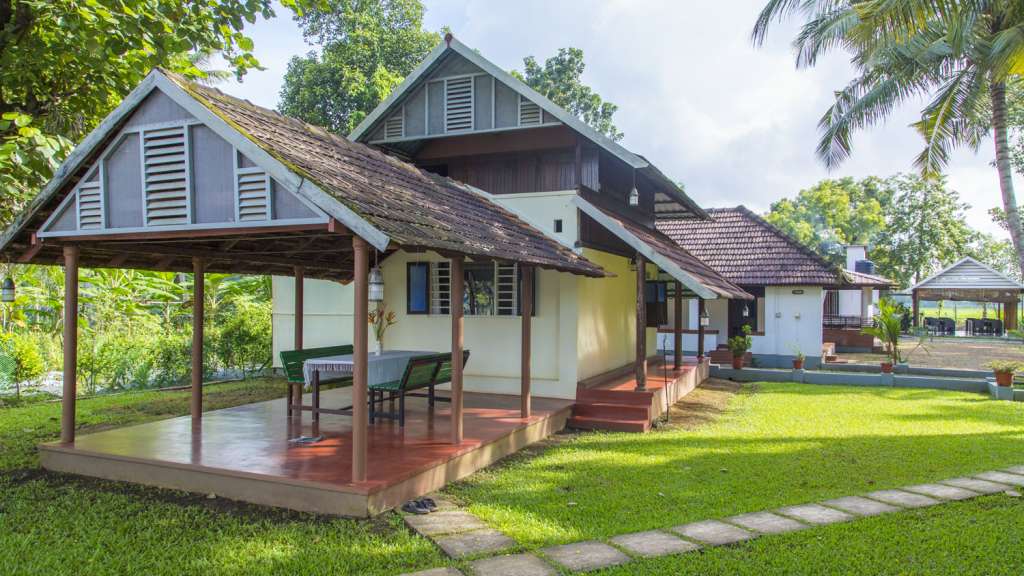
A Manapra homestay near Champakulam whose property description highlights rooms converted from an antique granary and verandas facing the Pamba River. Compare the exact room photographs before booking. Ask about the approach with luggage, steps, meals and whether your assigned room has the described river view.
Kuttanad Kayak Club arranges kayaking, canoeing and river-side outings. Agree the starting point, guidance, safety equipment and route; accommodation packages may differ.
A Punnakunnam homestay facing the Pamba River, with the Pulincunnoo church opposite in its property description. This is a village and river setting for a Kuttanad stay. Ask whether arrival is by road or boat, where luggage is unloaded and which meals are available.
Kuttanad’s canals, bunds and fields create a working backwater landscape. Explore from public roads or an agreed boat route, keeping farm entrances clear.
Memories is a Ramankary restaurant on AC Road with poolside and indoor dining. Confirm the current menu, dining area and table availability directly with the restaurant.
A Kandankary homestay beside the Kuttanad waterways. Kerala Tourism lists boat arrangements on request; ask what is available for your dates.
A Nedumudy homestay for travellers planning time around Kuttanad’s river villages. Confirm the room, route and booking terms directly.
Sunny Days is a Champakulam homestay on the Pampa River side of Kuttanad. Kerala Tourism lists its Chakkalayil address and a Gold House approval valid to 23 April 2027, while the exterior photograph dates to 2018. Ask the host for the exact room, river view, road or boat arrival, meals, available activities, complete rate and cancellation terms.
Green Palace Health Resort is in Kanjippadom, in Alappuzha’s Kuttanad area. An older operator-submitted listing describes a waterside setting with abundant greenery and says televisions were deliberately omitted from the cottages to encourage guests to spend more time outdoors.
Riverbliss Holiday Home is described by the operator as a Pamba River waterfront stay in Thalavady, Kuttanadu. Its listing mentions homemade Kuttanadu-style cuisine and shikkara cruises along the Pamba–Manimala river route towards Vembanadu Lake.
GG Farm House Homestay is a two-room riverside stay at Onnamkara, Mankombu, in the Kuttanad region. The operator describes views of the river and surrounding paddy fields, with rooftop and riverside dining as part of the property's setting.
Book with the place itself. India’s cyber-crime coordination centre warned in April 2025 that convincing copies of hotel and pilgrimage booking sites are being pushed through sponsored search and social ads, taking payment for rooms the property never hears about. Use the contact and source details on each profile to confirm the exact business and booking channel. A directory entry or map pin alone does not establish an operator’s identity or current availability. Roampedia takes no commission and does not collect booking payments. If a booking page reached you through an ad, check the address bar against the property’s own site before you pay. Fraud can be reported on cybercrime.gov.in or on 1930.
Find food, accommodation and activities across Kuttanad. Browse the guides for places to eat, stay and explore along your route.
5 more places around Kuttanad. Open a guide to plan the visit and onward journey.
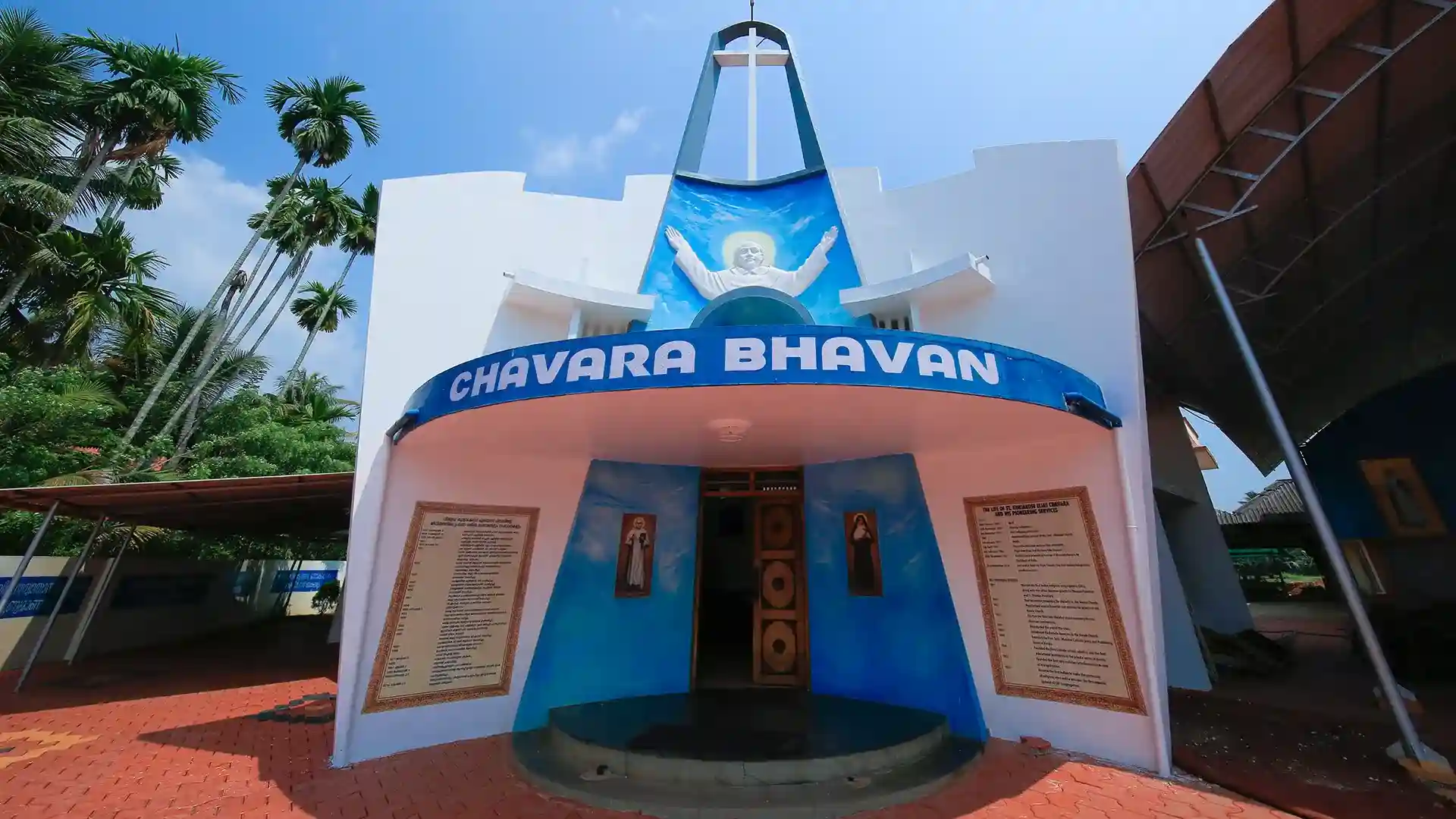
Chavara Bhavan in Kainakary preserves the birthplace and ancestral home of Saint Kuriakose Elias Chavara as a pilgrimage site and museum.
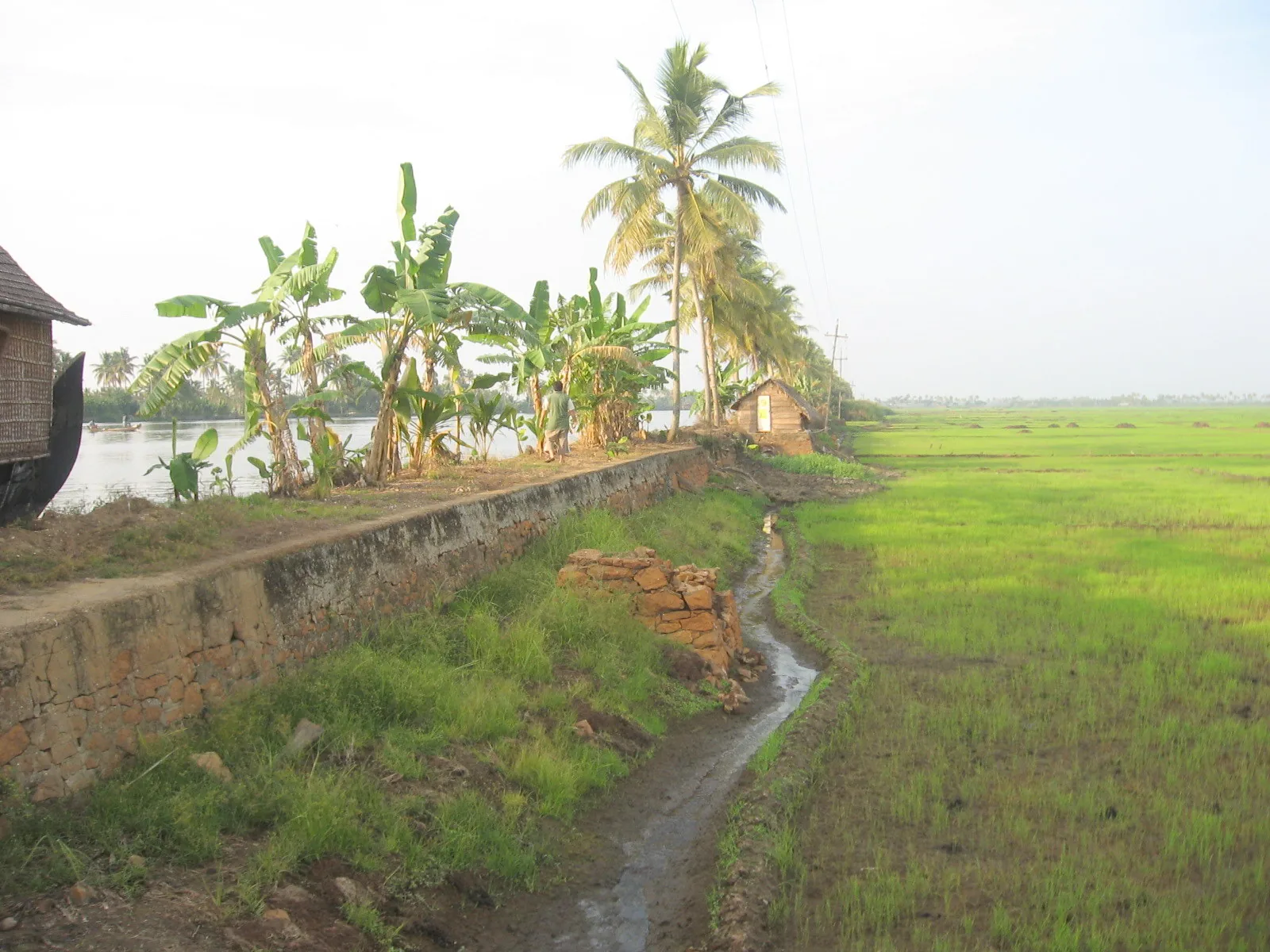
10.5 km · straight line
Low-lying paddy and canal region known as Kerala’s rice bowl.
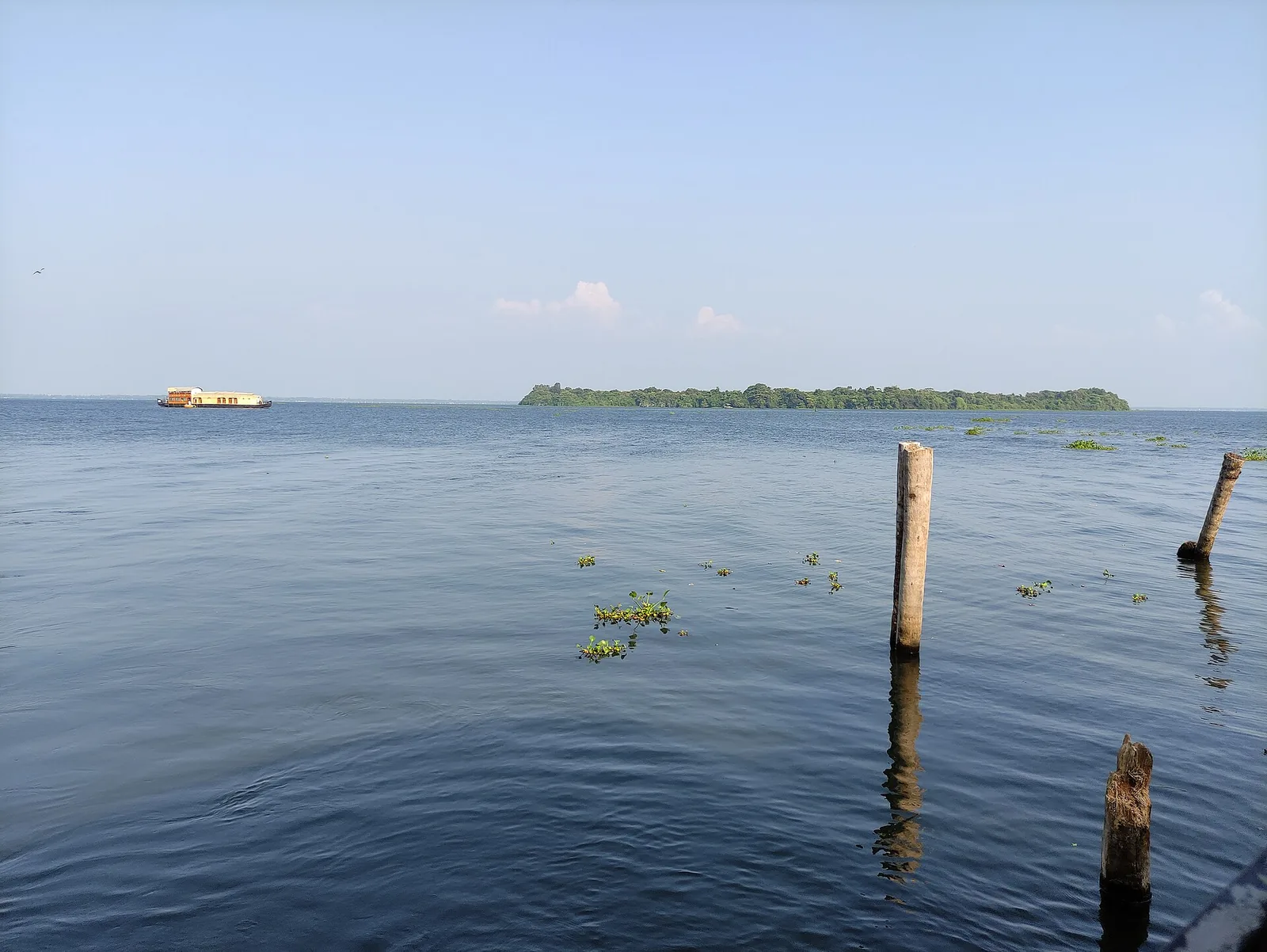
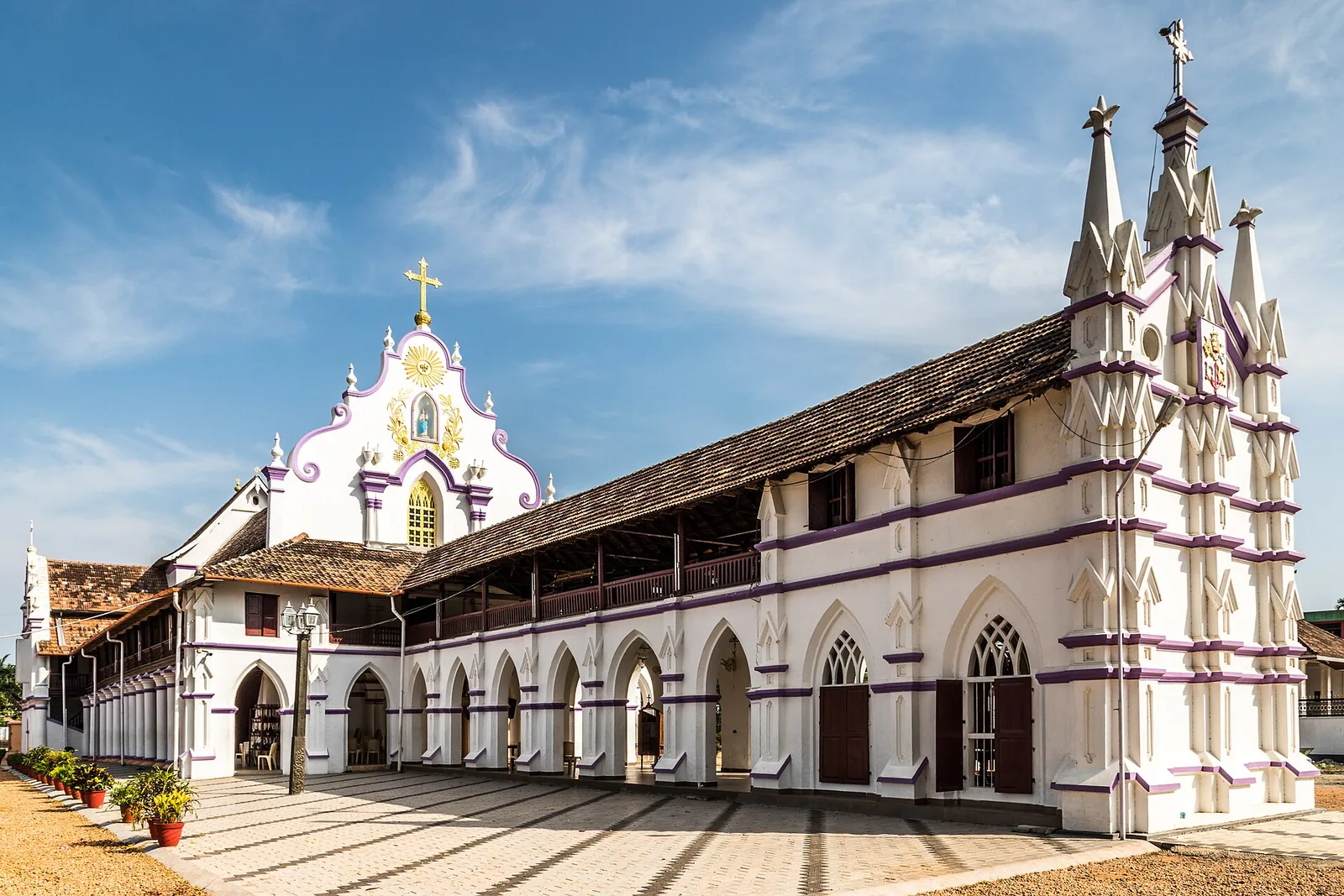
8.3 km · straight line
Kuttanad village on the Pamba known for the Champakulam Moolam snake-boat race and Kalloorkad St Mary’s Basilica.
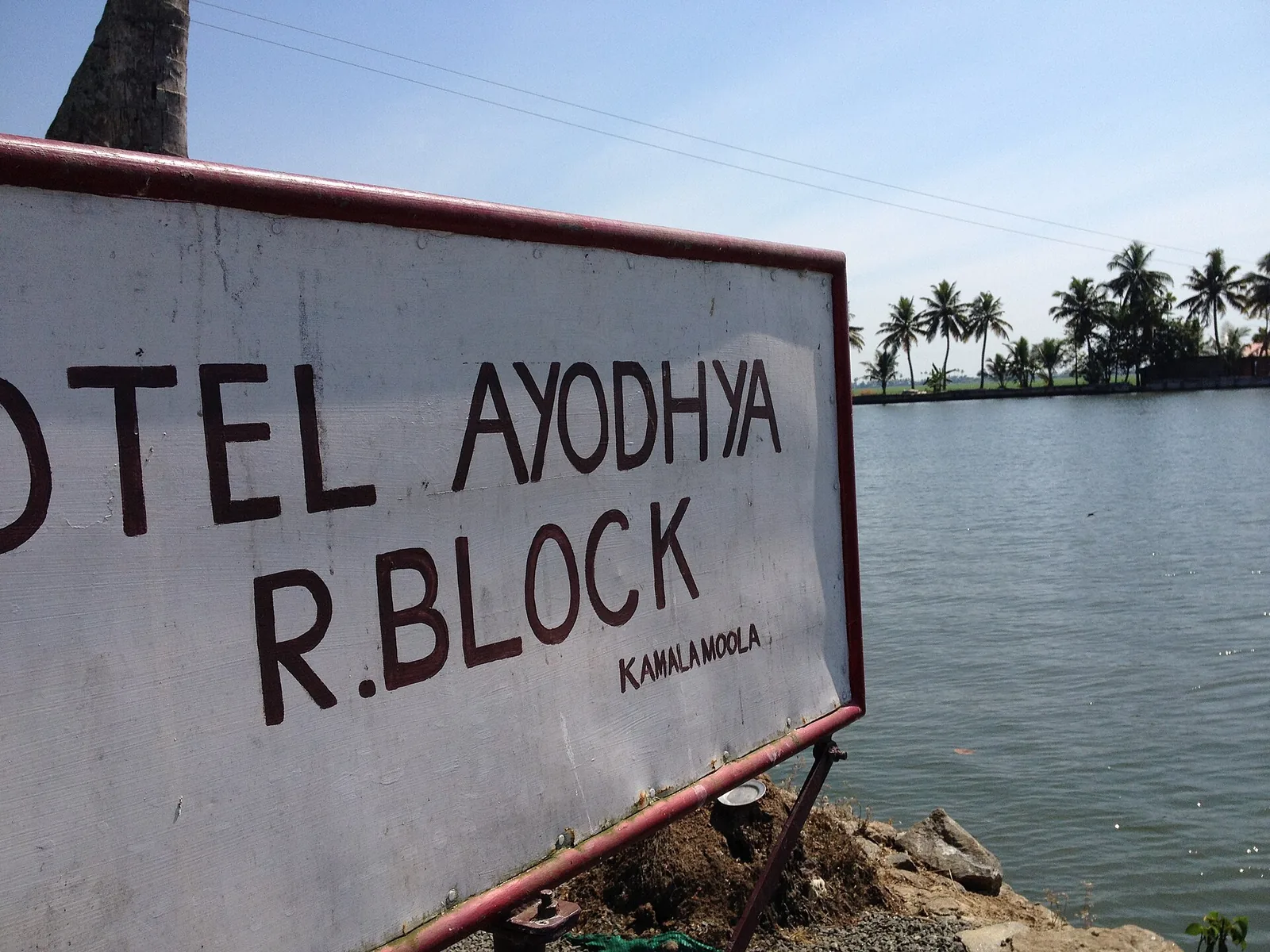
15.0 km · straight line
Iconic below-sea-level reclaimed farmland at Kainakary, ringed by bunds with the canal water sitting higher than the paddy fields.
Roampedia is commission-free — own or know a stay, eatery, guide or shop near Edathua Church? Submit public business details for review.
Add a nearby businessEntry: No entry fee to visit the church. Offerings and donations are voluntary; special feast-time arrangements may apply.
Dress code: Modest, respectful dress is expected as this is an active place of worship — cover shoulders and knees, and dress conservatively; avoid beachwear.
Festivals: The great annual feast is the Edathua Perunnal, the feast of St George, running from 27 April to 14 May. It opens on 27 April; the sacred statue is installed at the main entrance for veneration on 3 May; 5 to 7 May are the main days, with 7 May the principal feast and the great procession of the gold-adorned statue, traditionally led by pilgrims from Tamil Nadu; and it closes on 14 May with a procession to a cross at the town boundary. Mass and novena are offered on every day, in Tamil and Malayalam. ⚠ Most listings, including Kerala Tourism's, print the feast as ending on 7 May — that is its biggest day, not its last. Confirm the current year's dates with the parish. Expect very large crowds, cultural programmes, fireworks and a festival market.
Photography: Photography of the exterior and grounds is generally fine, but be discreet and respectful inside, and avoid photographing during Mass, prayers or the moment of veneration unless clearly permitted. Follow any restrictions posted by the parish, and always ask before photographing worshippers.
If you are travelling by bus or ferry, check the return service with the operator before setting out. Leave time to reach the stop or jetty after your visit.
Ask at the bus stand for the time of the last service back, not the next one. If you miss it, an auto or app cab is the fallback — agree the fare before you get in.
If you need step-free access, contact the site before travelling. Ask about a level entrance, steps along the route, the nearest drop-off point, seating and accessible toilets.
Charge cap and free-transaction limits: Reserve Bank of India, ATM FAQ updated 4 July 2025; checked 4 October 2026.
These services are listed within about 1.2 km of Edathua Church. Walking distances follow mapped routes; access and opening hours can change. Other services may be closer but are not included here.
Published emergency and visitor-assistance contacts. For an immediate emergency, call 112. Shared Kerala contact sources checked 4 October 2026; publication does not establish a tested live response.
Kuttanad village on the Pamba known for the Champakulam Moolam snake-boat race and Kalloorkad St Mary’s Basilica.
8.3 km · straight line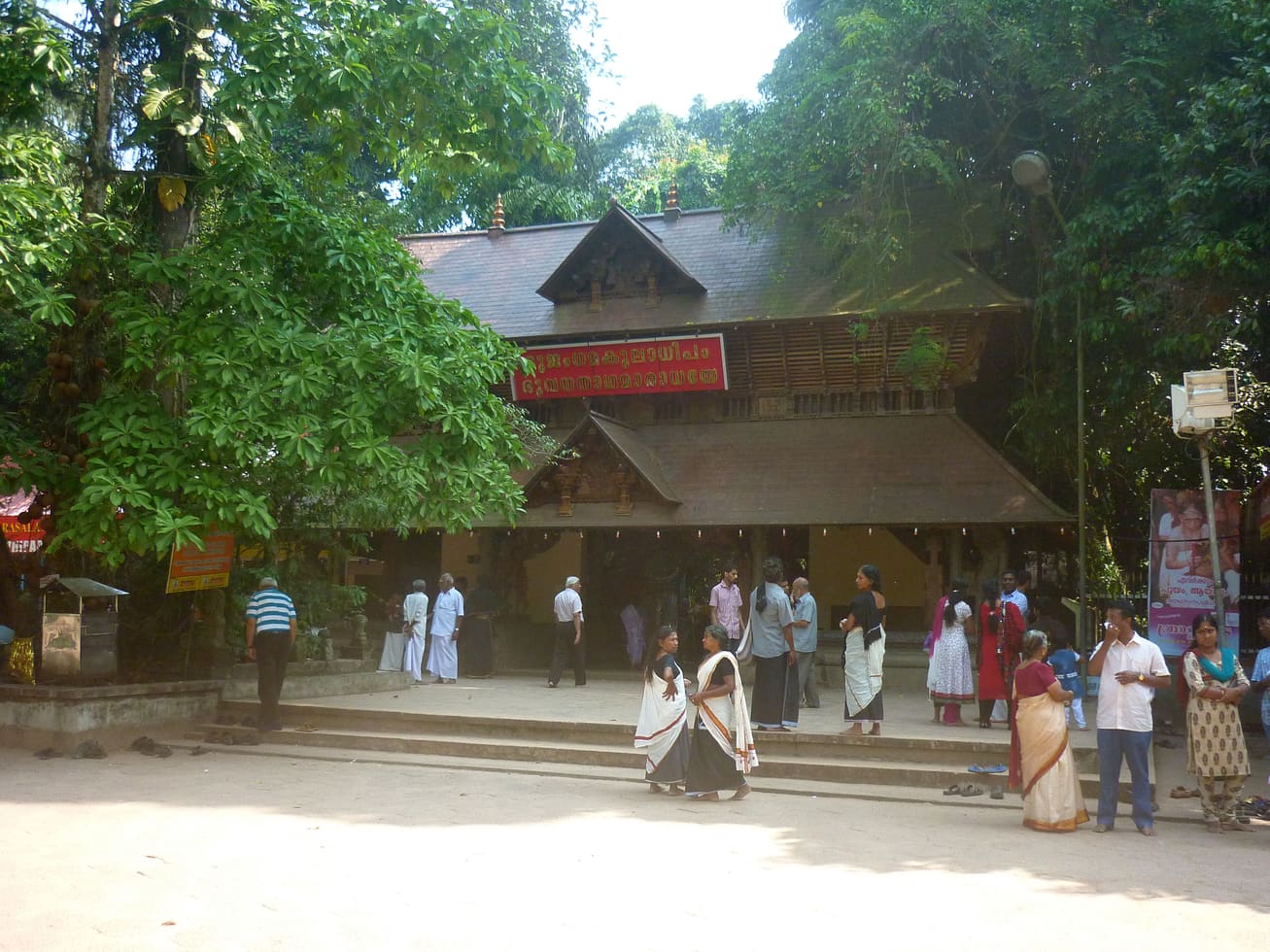
Major serpent shrine set in a sacred grove.
9.1 km · straight line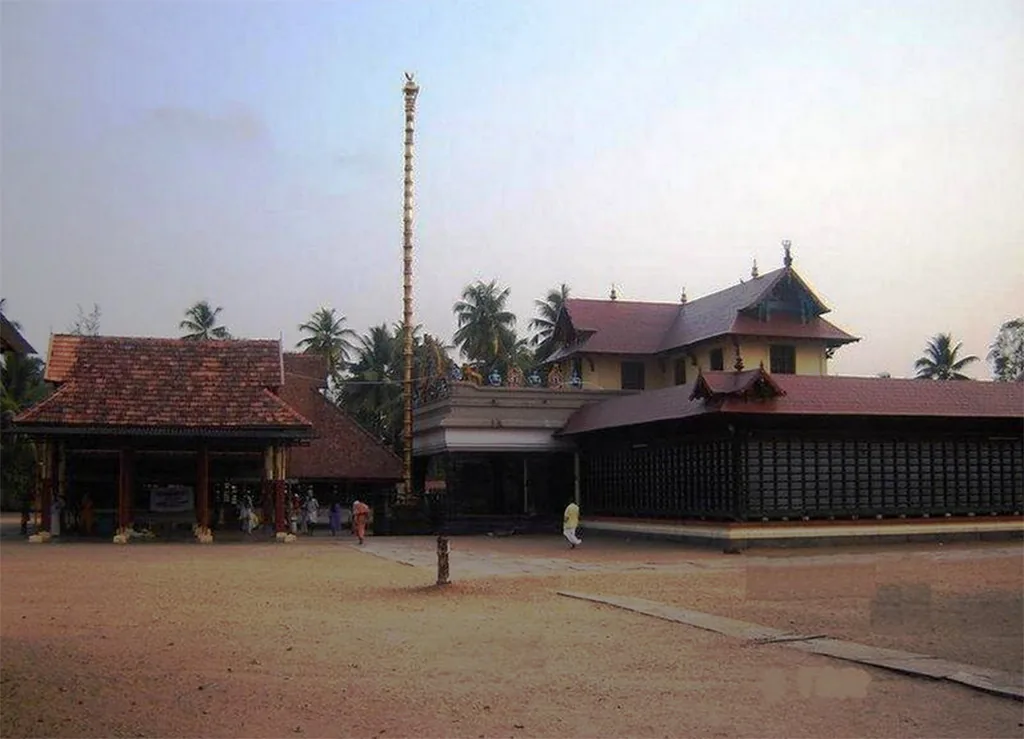
One of Kerala’s oldest Subramanya (Murugan) temples, in the south-Alappuzha town of Haripad.
9.7 km · straight line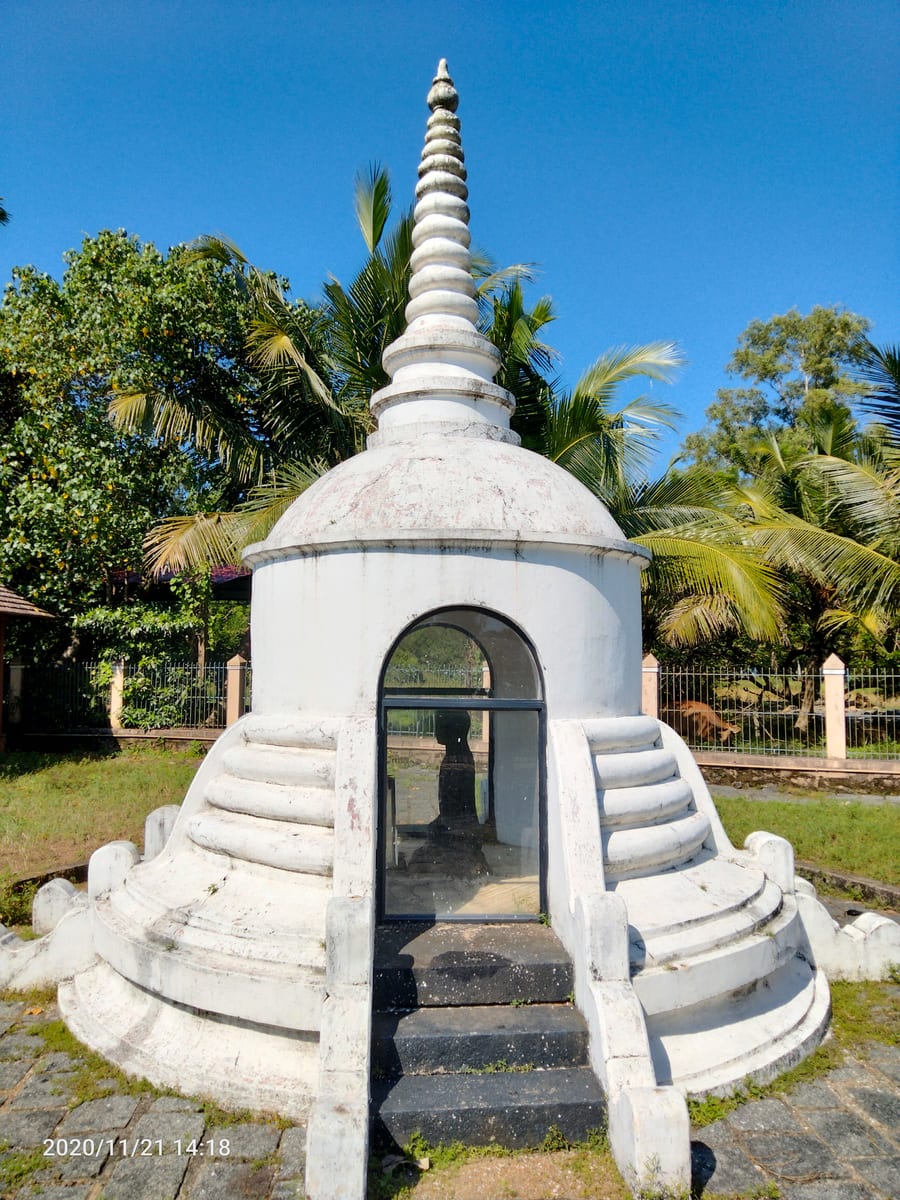
Ancient black-granite Buddha statue at Karumadi near Ambalappuzha, a relic of Kerala’s Buddhist past.
9.8 km · straight lineLow-lying paddy and canal region known as Kerala’s rice bowl.
10.5 km · straight line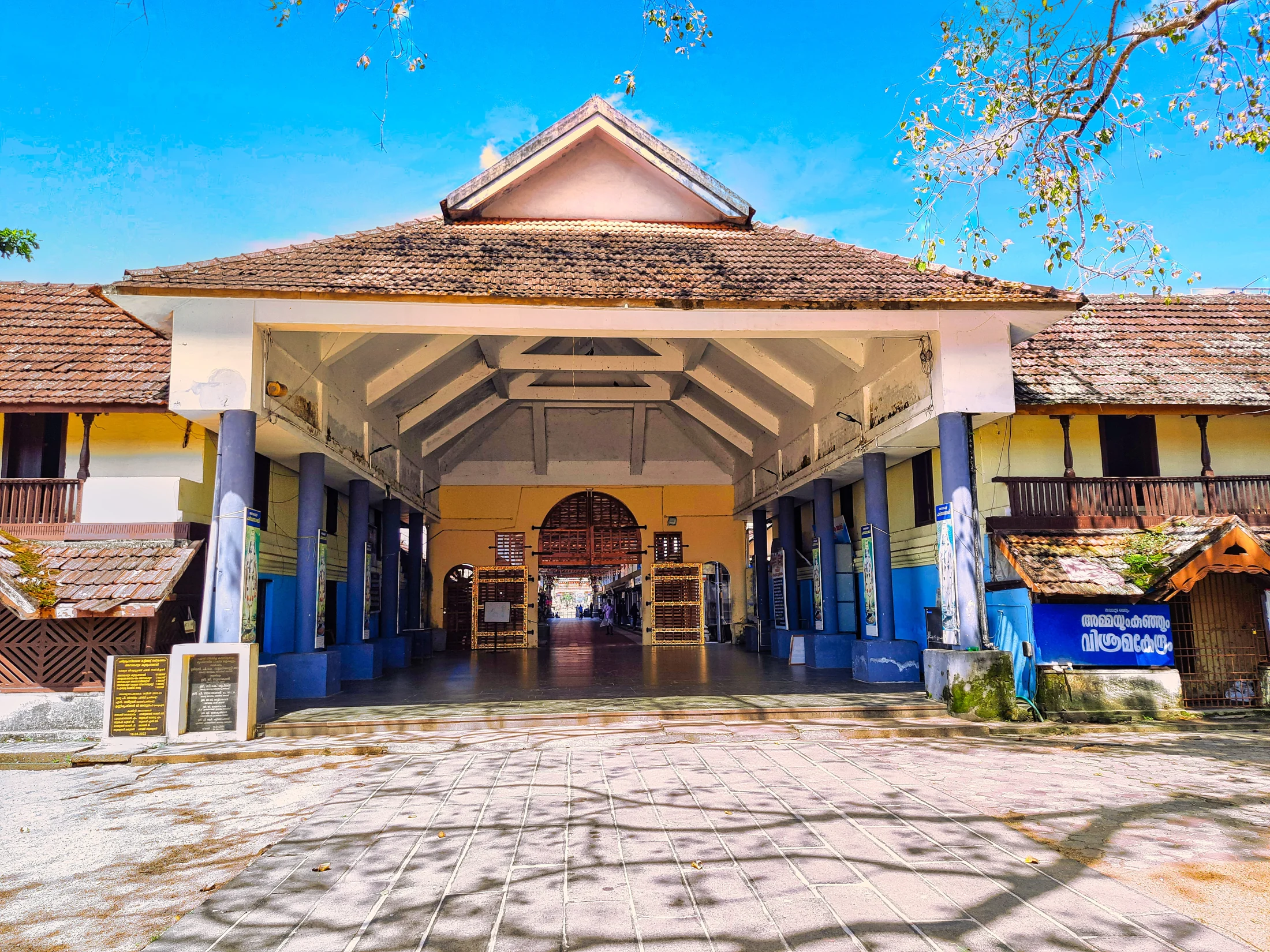
Ambalappuzha Sree Krishna Temple is an active temple in Ambalappuzha town, south of Alappuzha, administered by the Travancore Devaswom Board. Krishna is worshipped here as Parthasarathy, Arjuna’s charioteer. The temple combines a broad tank, tiled courtyards and painted ritual spaces with two enduring cultural associations: Palpayasam offered to the deity, and Kunchan Nambiar’s creation of Thullal. A visit works best when darshan, the permitted exterior spaces and any offering collection are planned around the temple’s morning or evening opening.
11.8 km · straight line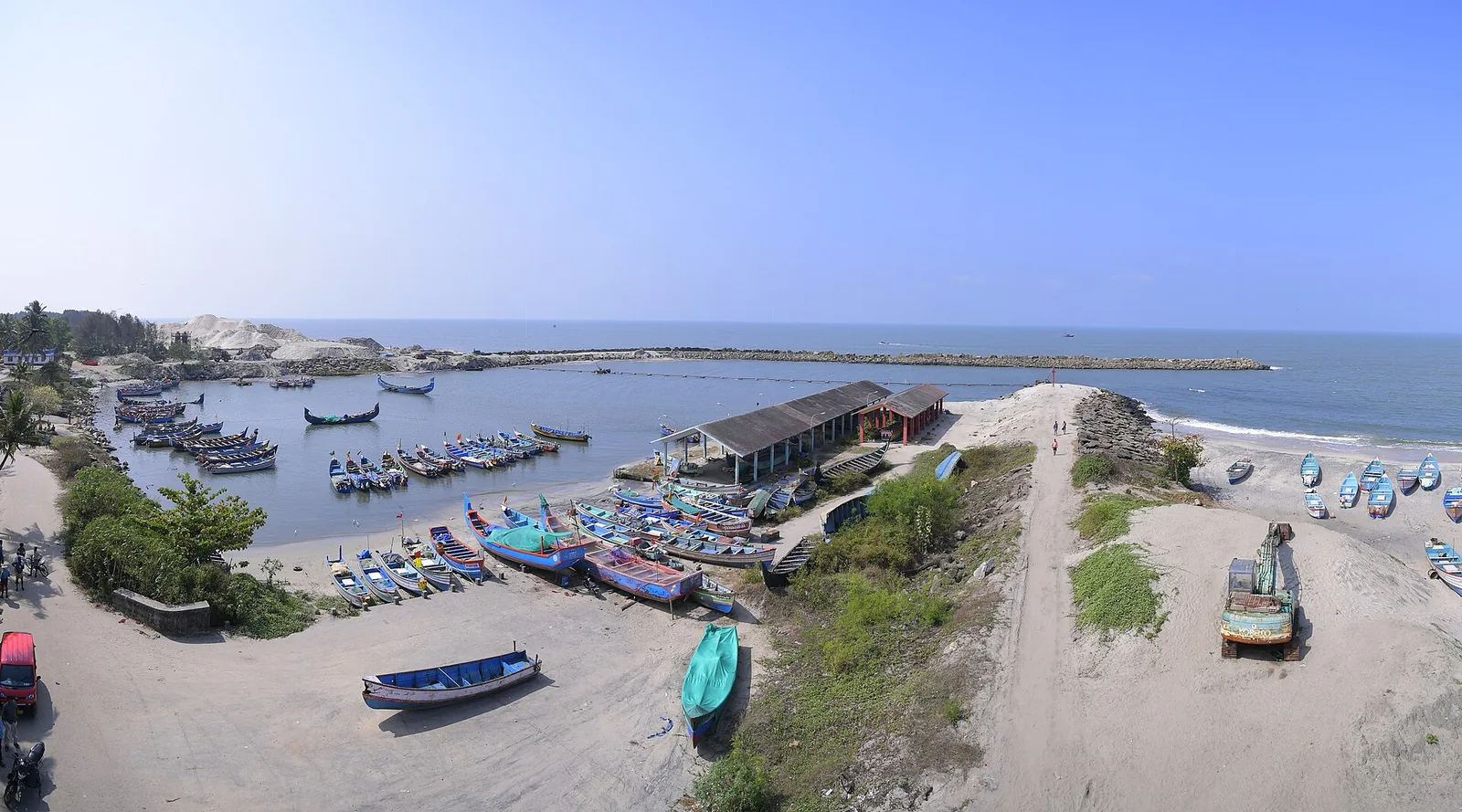
Working fishing harbour and 1955 flood spillway where the Thottappally leading channel meets the sea, south of Ambalappuzha — a painted fleet, two breakwaters and heaps of titanium-bearing black sand, rather than a quiet beach.
11.9 km · straight line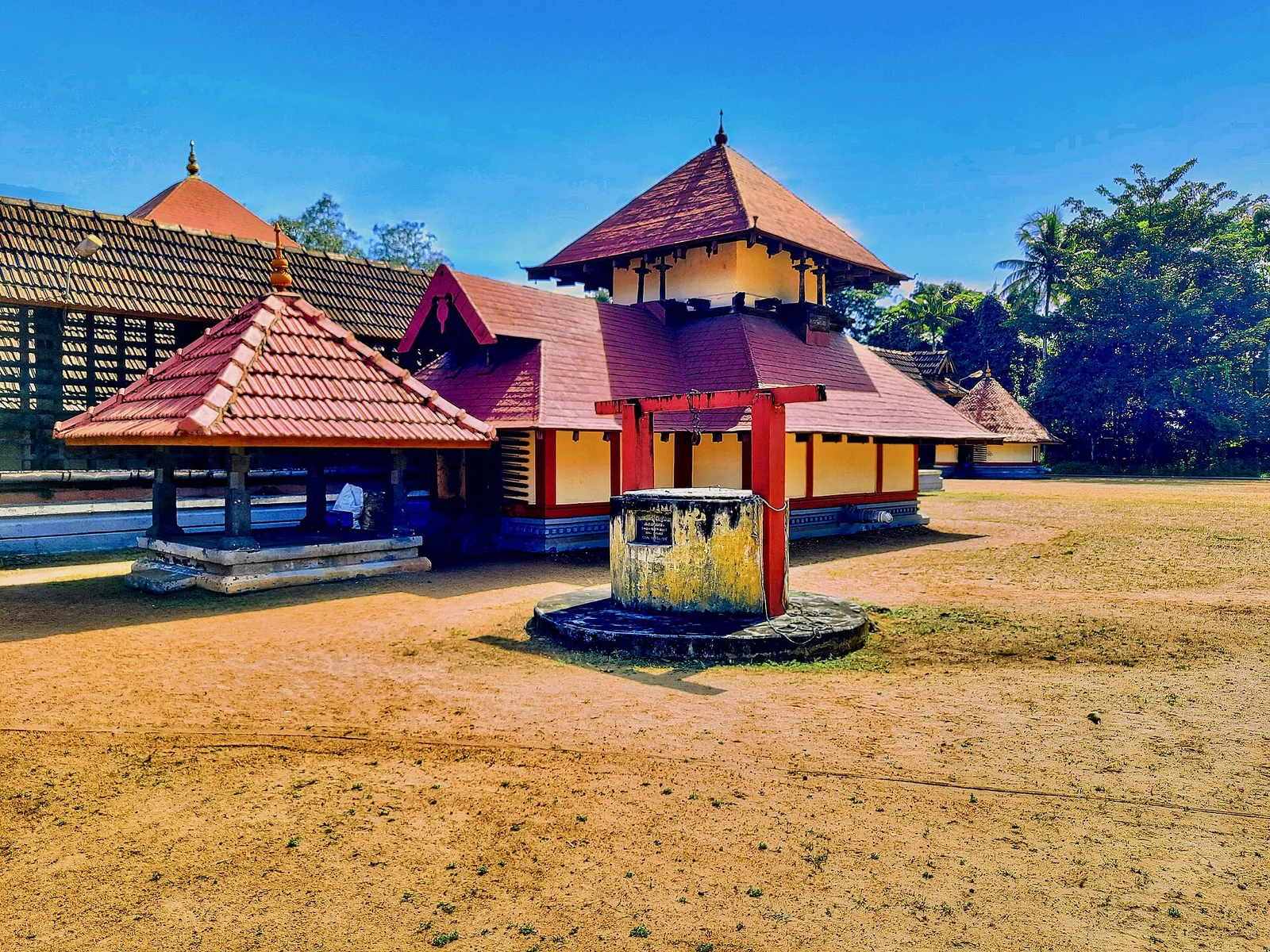
The Shiva temple west of Mavelikkara whose 823 AD epigraph makes it the earliest Kerala temple with a dated inscription about its own origin — Shiva in the kirata hunter form, once the capital shrine of Odanad, and the richest single record of devadasi authority in this region.
14.0 km · straight line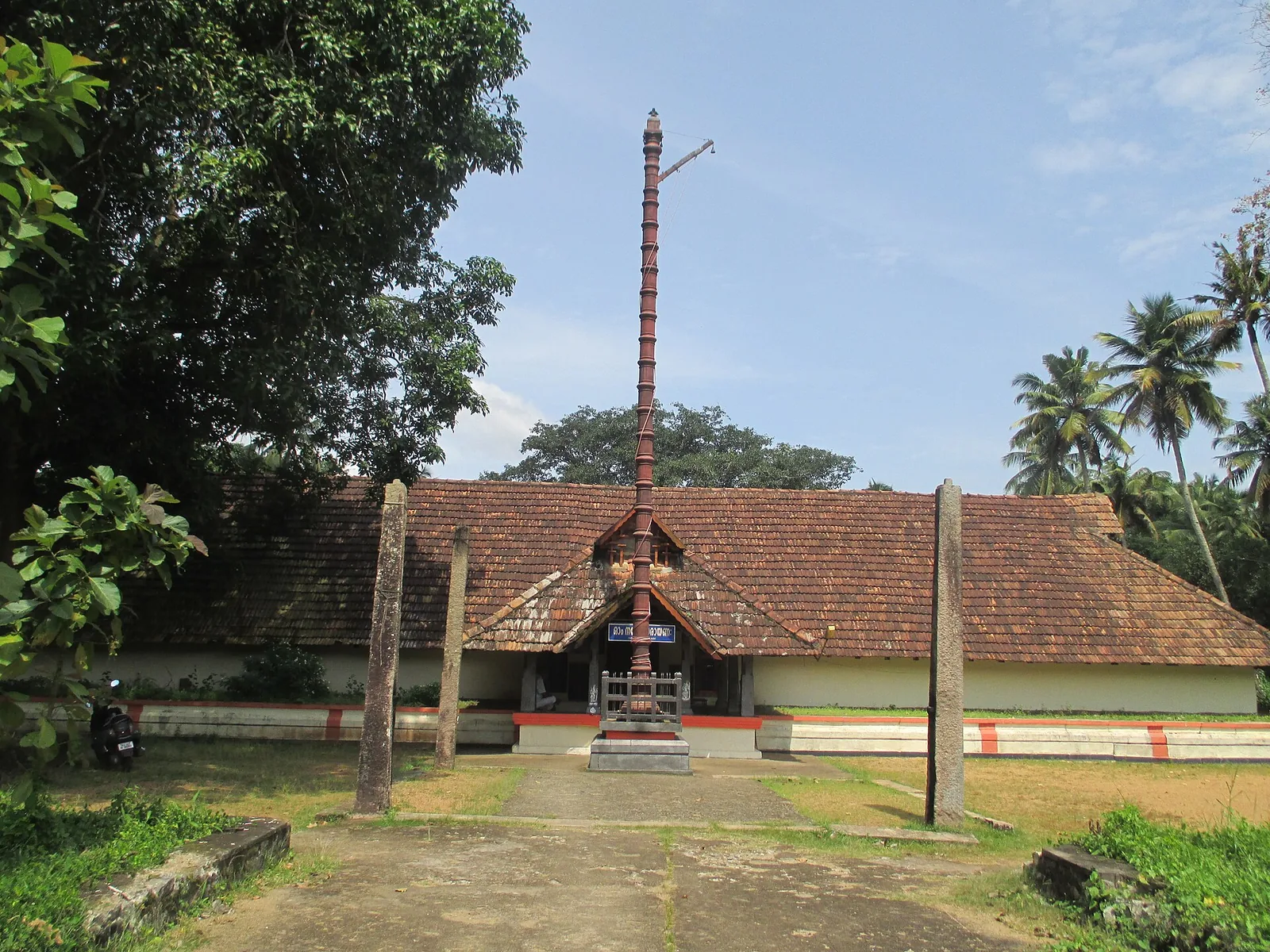
The Yudhishthira temple of the five Pancha Pandava shrines around Chengannur and one of the 108 Divya Desams, at Mundankavu — where the god is Imayavarappan, “lord of those who came before”, and darshan is held incomplete until you have also worshipped at the Shankha Theertham tank.
14.9 km · straight lineIconic below-sea-level reclaimed farmland at Kainakary, ringed by bunds with the canal water sitting higher than the paddy fields.
15.0 km · straight line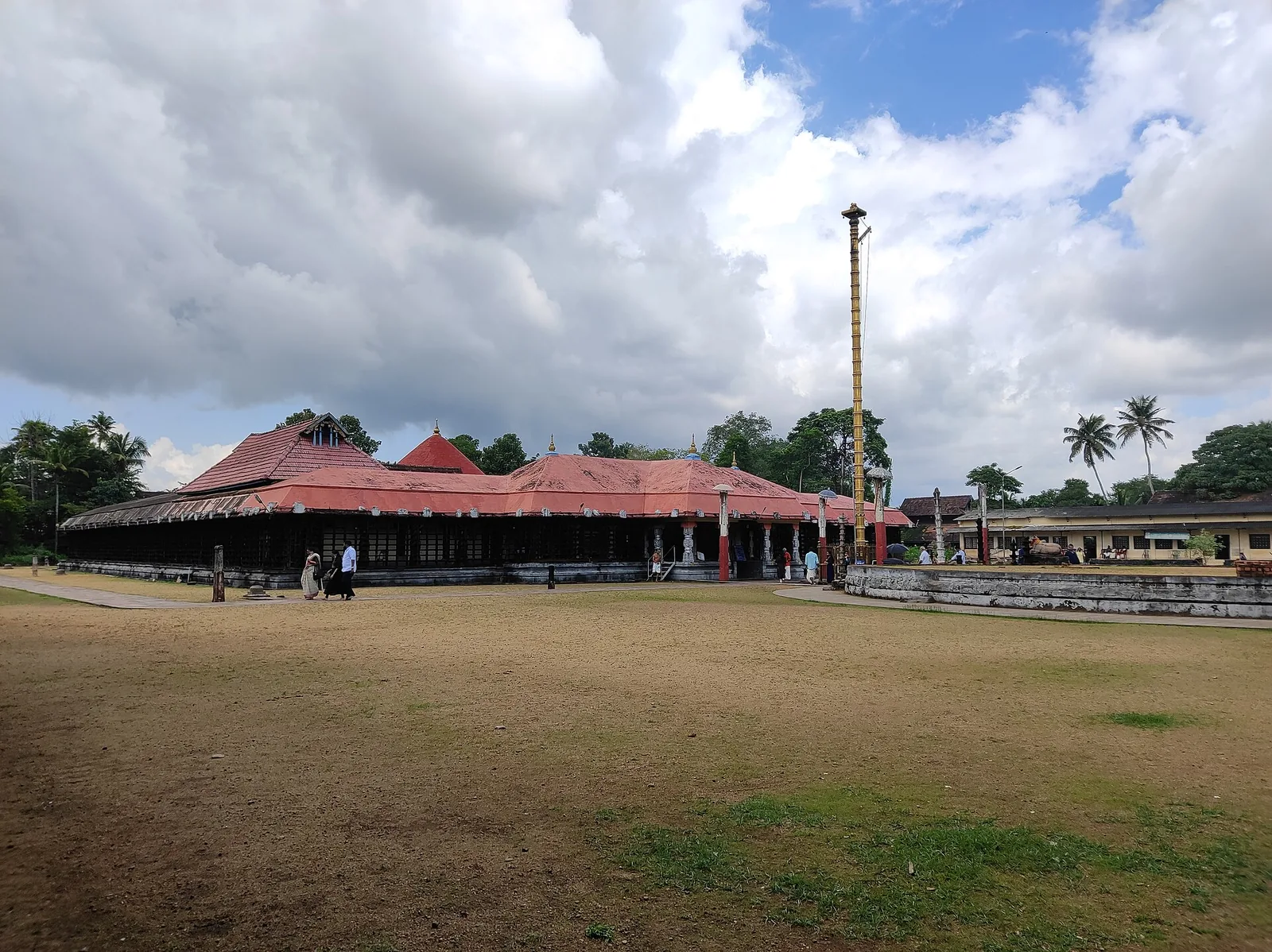
The great Shiva–Parvati temple of Chengannur, where the goddess is held to menstruate and the Thripputhaarattu is observed — one of the 108 Shivalayas, and the temple where the Thazhamon Madom tantris perform their first puja before they may officiate at Sabarimala.
15.7 km · straight line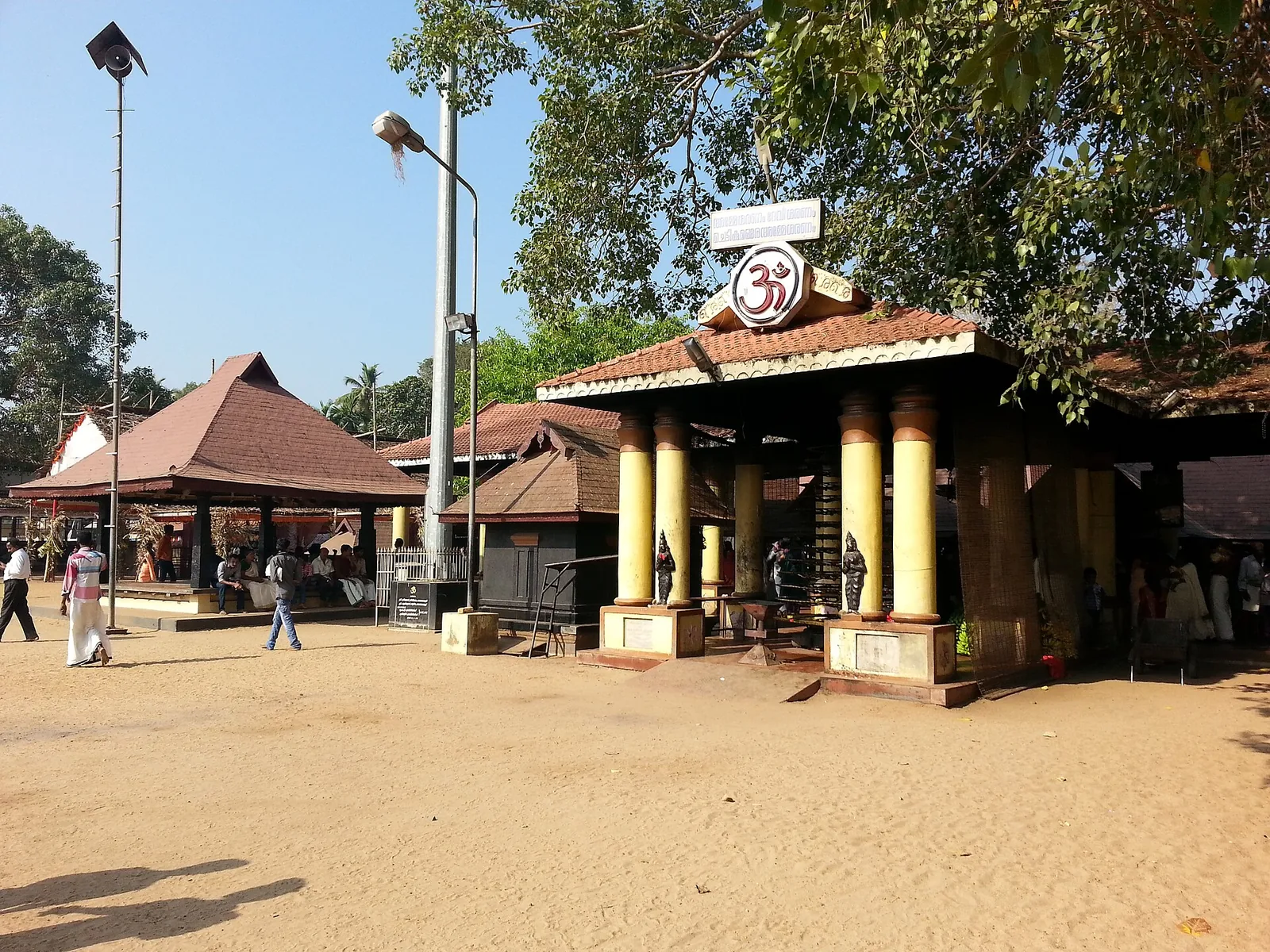
Major Bhagavathy temple near Mavelikkara, famous for its Kettukazhcha and Kumbha Bharani festivals.
16.2 km · straight lineNearby toilets, pharmacies, ATMs, seating and vets are community-mapped and may be incomplete or out of date. Map data © OpenStreetMap contributors | Walking times © openrouteservice.org by HeiGIT
It is famous as a major St George (Marth Gewargis) pilgrimage centre in Kuttanad, especially for its huge annual feast, the Edathua Perunnal, and for a long-held popular tradition of healing that draws pilgrims of every faith.
From 27 April to 14 May — and the dominant figure on the internet is wrong, or rather incomplete. Most sources, including en.wikipedia and Kerala Tourism, give 27 April to 7 May. The parish's own site and the Malayalam Wikipedia give 27 April to 14 May, and that is settled by photographs taken at the church, which show its own festival banner across the front porch reading ഏപ്രിൽ 27 മുതൽ മെയ് 14 വരെ — from 27 April to 14 May. The 7 May date is not the end of the feast; it is its principal day. The shape is: the festival opens on 27 April; the sacred statue is installed at the main entrance for public veneration on 3 May; 5 to 7 May are the main days, with 7 May the chief feast and the great procession, traditionally led by pilgrims from Tamil Nadu; and it closes on 14 May with a procession out to a cross at the town boundary. Mass and novena are offered on every day of it, in both Tamil and Malayalam (confirm the current year's dates with the parish).
Yes — Edathua carries a strong, long-standing devotional reputation for healing and deliverance. English-language accounts usually describe it as a shrine for mental illness, but that is a gloss: the Malayalam sources describe deliverance from snakes and from what the tradition calls demonic powers, alongside general prayers against illness and calamity, and they emphasise the water of the church well. This is a respected popular belief; it is not medical advice, and anyone who is unwell should always also seek proper medical care.
Yes. It is an active parish open to visitors and pilgrims through the year, typically from early morning to evening, and is quietest outside feast days. Services take priority, so read the parish notice on arrival.
It lies in the Kuttanad region on the Pamba, about 21 km east-south-east of Alappuzha town in a straight line and roughly 23 km by road — not the 15 km that Kerala Tourism's own page and many listings print, Measured against our own stored coordinate for the church. You can reach it by road from Alappuzha or Changanassery, by train to Chengannur or Alappuzha plus a road transfer, or memorably by backwater boat through Kuttanad.
No published source says so, and we looked hard — the parish's own website, both Wikipedias, the Catholic hierarchy directory, Kerala Tourism and the district tourism council, in English and Malayalam. The parish lists a relic stand among the furnishings of its sanctuary, which describes a fitting rather than its contents. ⚠ Be careful searching this: the relics of St George brought from Antioch to Kerala in 1912 by Mar Dionysius of Vattasseril belong to the Malankara Orthodox Syrian Church and are kept at Kundara in Kollam district, about 70 km away. They are not Edathua's.
Because St George is invoked here against snakebite, and the offerings are votive figurines in gold and silver — snakes, snake-mounds and roosters. Kuttanad is below-sea-level paddy country where snakebite is an occupational hazard of farm labour, and a saint whose iconography is a rider killing a serpent translates immediately into that landscape: the dragon becomes the cobra. The great serpent temple of Mannarasala, where metal snake images are also offered, is about 35 km away in the same district.
There is generally no entry fee to visit the church. As an active place of worship, modest, respectful dress covering shoulders and knees is expected, and quiet behaviour is appreciated, especially during Mass.
Morning or late afternoon for quieter visits and better light.
Entry: No entry fee to visit the church. Offerings and donations are voluntary; special feast-time arrangements may apply. Timings: As an active parish the church is usually open to visitors from early morning to evening (often cited as roughly 4:00 am to 8:00 pm). Mass and prayer times run on their own daily and Sunday schedule and differ from general visiting hours; check the parish notice board or website for current timings before planning a visit around a service.
30 minutes to 1.5 hours.
Nearby you can pair Champakulam (8.3 km, approximate straight-line separation), Mannarasala Sree Nagaraja Temple (9.1 km, approximate straight-line separation), Haripad Sree Subramanya Swamy Temple (9.7 km, approximate straight-line separation), Karumadikuttan (9.8 km, approximate straight-line separation).
Expect crowds on feast days and Sundays. Use marked parking and official entry points.
Written about Edathua Church itself — its history, its legends and the arguments about them.

These guides explore Kuttanad and the surrounding area. Choose a visit that fits your interests, allowing separately for travel between stops.


Route-level itineraries and practical guides for the rest of Kerala.
Photographs: Johnchacks (CC BY-SA 3.0), Johnchacks at ml.wikipedia (CC BY-SA 3.0), Vijayanrajapuram (CC BY-SA 4.0). Wikimedia Commons.