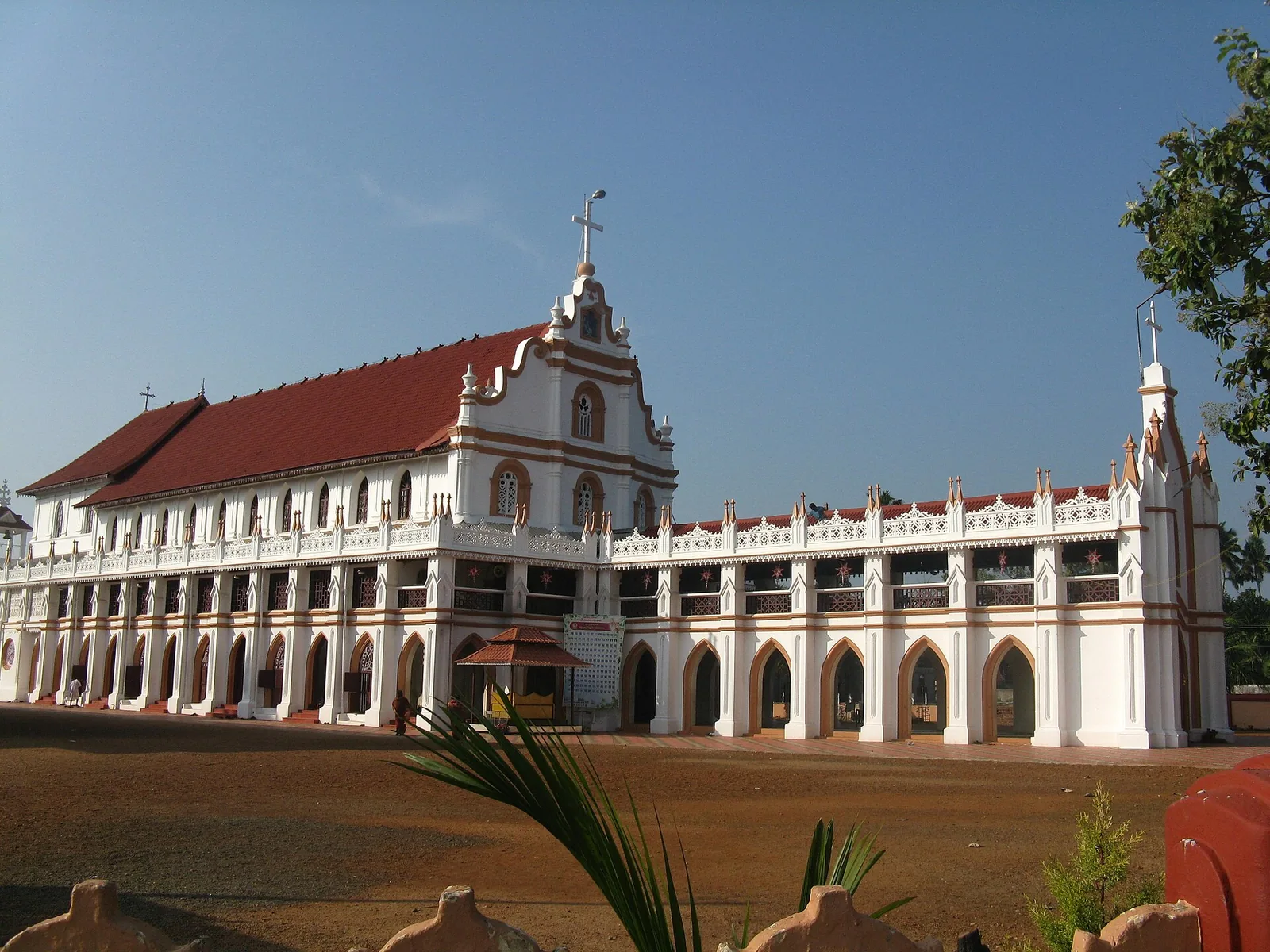
In the green, watery flatland of Kuttanad, where the fields lie below the level of the sea and the roads give way to canals, a great church rises unexpectedly over the paddy: Edathua Church, dedicated to St George, on the banks of the river Pamba. It is beautiful, and old, and famous across Kerala — but not for its architecture.
What people actually come for
Almost every English-language account of Edathua will tell you it is a shrine where the mentally ill are brought to be healed. It is worth setting down what the Malayalam sources actually say, because it is both more specific and less comfortable to summarise.
What they describe is deliverance from two things in particular: izhajanthukkal — crawling creatures, meaning snakes — and paisachika shakthikal, demonic powers. Great numbers, one account says, came to Edathua seeking release from those. Alongside them runs the ordinary and universal petition of any shrine: deliverance from illnesses and from calamities.
That is a snakebite-and-deliverance tradition, in a district where the snake is a real and present danger of the paddy field, and where the temple at Mannarasala a few kilometres south is one of the great serpent shrines of India. "Mental illness" is the standard English gloss for a pisāchabādha — possession — tradition, and it flattens something quite different into a modern clinical category. It also, in practice, tends to produce a certain kind of travel writing about the mysterious cures of the East. We would rather write what the sources say.
None of which is to say nobody in distress comes here. People bring every kind of trouble to St George at Edathua, and always have. But if you want to know what the tradition itself is about, it is snakes, spirits and the church well.
The well
The well is the detail that fixes the rest in place. In the account of how the church got its statue of the saint, the figure is wiped clean and then purified by washing it in the water of the church well — pallikkinar. A holy well attached to a healing shrine is one of the oldest patterns in Christianity and one of the oldest in Kerala, and at Edathua the two traditions are doing the same work in the same yard.
How the church came to be here
The Christians of Edathua and the rest of Kuttanad had for centuries depended on other churches: first Niranam, held by tradition to have been founded by the apostle Thomas, and then Champakulam, said to date from AD 417. As churches rose at Alappuzha, Arthunkal, Thumboly, Purakkad and Pulinkunnu, the people of Edathua began to want one of their own.
They took the request to Bishop Raymond of Varapuzha, whose archdiocese then covered this ground, and with his canonical permission a small church was founded on 29 September 1810 at a spot in Edathua called Koyilmukku. The land was a gift, and the source names the giver: Kocherukkappanicker of Changamkari Vellappally, a prominent Nair tharavadu of Edathua. A Hindu family gave the ground the church stands on, and the record of it survives in the church’s own history.
The parish — farmers and small traders, but determined ones — then decided to build something much larger. The foundation stone of the great church, in the name of St George, was laid in 1839. It is that building, with its façade recalling the churches of medieval Europe, that rises over the paddy today. The two dates are often collapsed into one; they are not the same building.
And the statue that draws the crowds did not arrive new. When the great church was finished the parish wanted an image of the saint, and in the end one of the figures that had been stored in the loft of the church at Edappally was brought down to Edathua and installed with ceremony. Malayalam Wikipedia’s own caption for it calls it the miraculous statue.
The Perunnal
The Edathua Perunnal is one of the largest church feasts in Kerala. The flag goes up on 27 April, the gold-decked statue of the saint is set at the main door of the church from 3 May and stays there for public veneration until 14 May, and the principal feast day is 7 May — when the procession around the church is led by devotees who have come from Tamil Nadu. It closes on 14 May with a procession out to the kurisadi, the wayside cross, in the town. The fireworks at Edathua are famous in their own right.
People come from Tamil Nadu, Andhra Pradesh and Telangana as well as from every part of Kerala, and of every faith. For a district best known for its serene backwaters, it is a startling explosion of colour and sound.
Visiting Edathua
Edathua lies deep in the Kuttanad backwaters, about 21 km south-east of Alappuzha town as the crow flies and roughly 23 km by road, or about 12 km from Thiruvalla on the other side — and the journey there, through paddy, palm and canal, is half the experience. Come for the feast between late April and mid-May for the full spectacle, or on a quiet day for the strange flatness of a church that size standing in a rice field. Details are on the Edathua place page; more of the district is on the Alappuzha hub.
Frequently asked questions
Is Edathua a shrine for mental illness?
That is the usual English description and it is not what the Malayalam sources say. They describe pilgrims seeking deliverance from snakes and from what the tradition calls demonic powers, alongside general intercession against illness and calamity, and they emphasise the church well. "Mental illness" is a modern clinical gloss on a possession-and-deliverance tradition, and we have stopped using it.
When was Edathua church built?
Two dates, often confused. A small church was founded at Koyilmukku in Edathua on 29 September 1810, with permission from Bishop Raymond of Varapuzha. The foundation stone of the great church that stands today, in the name of St George, was laid in 1839.
Who gave the land for the church?
Kocherukkappanicker of Changamkari Vellappally, a prominent Nair family of Edathua, gave the land as a gift — a Hindu household providing the ground for what became one of Kerala’s largest Christian pilgrim centres.
When is the Edathua Perunnal?
The feast of St George runs from 27 April to 14 May. The statue is placed at the church door for veneration from 3 May, the main feast day is 7 May with a procession led by devotees from Tamil Nadu, and the celebration closes on 14 May with a procession to the wayside cross in the town.
Where is Edathua church?
On the banks of the Pamba at Edathua, in the low-lying Kuttanad region of Alappuzha district — about 21 km south-east of Alappuzha town in a straight line (roughly 23 km by road), and about 12 km from Thiruvalla.