The offering counter is the best place to start at Edathua, because it tells you something the architecture does not. What devotees bring to St George here are votive figurines in gold and silver: snakes, snake-mounds — the chithal, the termite mound a cobra lives in — and roosters.
The dragon becomes the cobra
St George was a Roman soldier, martyred in Palestine around the year 303, and the dragon is a later medieval accretion to his legend rather than anything in the early accounts. By the time his cult reached the Malabar coast he was fixed in one image: an armoured rider on a horse, driving a lance into a serpent.
Now put that image down in Kuttanad. This is reclaimed paddy country lying below the level of the sea, worked by people who spend their days on bunds and in flooded fields, cutting stalks in standing water. Snakebite here is not folklore. It is an occupational hazard of agricultural labour, and it has been for as long as the polders have been farmed.
A saint whose entire visual identity is a man killing a serpent arrives in that landscape and becomes, immediately and obviously, useful. This is the part worth being precise about: nobody sat down and decided it. There was no doctrinal move, no missionary strategy, no council. A community with a specific fear met an image that answered it, and the devotion reorganised itself around the answer. The dragon of the European legend, which nobody in Kuttanad had ever seen, quietly became the cobra, which everybody had.
The neighbour thirty-five kilometres away
The parallel is impossible to miss and worth stating carefully. At Mannarasala, about thirty-five kilometres away in this same district, stands the great serpent temple of Kerala, where among the offerings are metal images of snakes.
We are not claiming that either shrine borrowed from the other. No source establishes it and we are not going to invent a transmission. The more interesting and more defensible observation is this: a district that farms water and fears snakes produced snake shrines in both of its religions, with metal snakes on both counters, and it did so because the same anxiety was pressing on everybody regardless of what they believed. Devotion is shaped by geography as much as by theology, and Kuttanad is a very insistent geography.
The date nobody seems to have noticed
Here is a detail we have not seen remarked on anywhere, and we offer it as an observation rather than a claim. The foundation stone of the first church at Edathua was laid on 29 September 1810. The twenty-ninth of September is Michaelmas — the feast of St Michael the Archangel.
Michael is the archangel who casts down the dragon. The church founded on his feast day was to be dedicated to St George, the saint who kills the dragon. Whether the parish chose the date for that reason we cannot prove and will not assert; feast days are chosen for many reasons, and 29 September is a convenient marker in the calendar for its own sake. But a dragon-slayer’s church founded on the dragon-caster’s feast, in a country full of serpents, is at minimum a coincidence a reader deserves to be shown.
The flagstaff
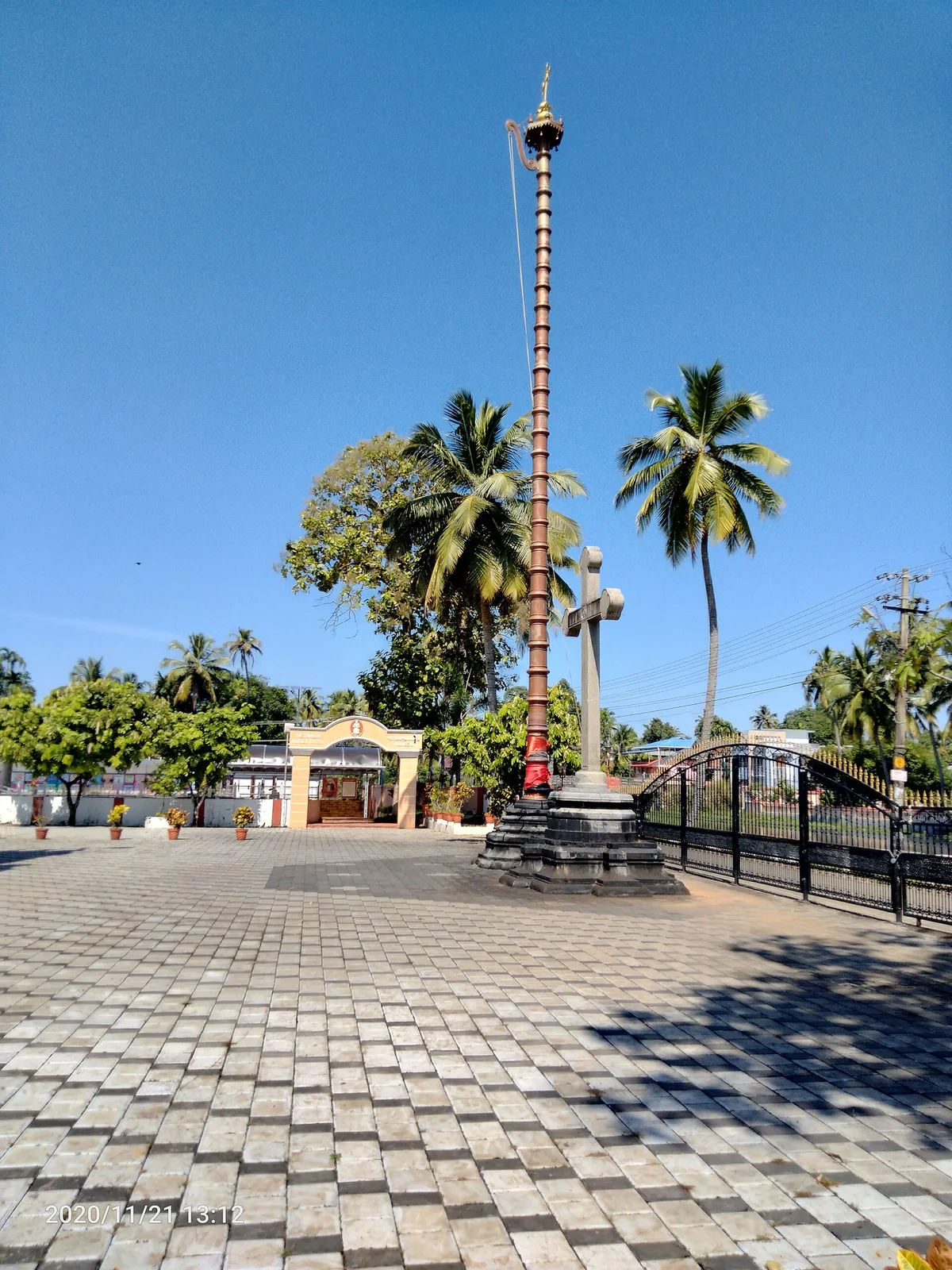
The object at the top of this article is not mentioned in any legend, and it is the most eloquent thing on the property. Standing in the churchyard beside a granite open-air cross is a tall metal flagstaff, ringed tier upon tier up its whole height, rising from a stepped stone base to a lamp-like finial. That is the dhwajastambham — the kodimaram, the flagstaff form of a Kerala Hindu temple, which you will see at Mannarasala and at every temple in this district.
On the top of it is a small gold cross.
Nobody wrote that down as syncretism. Nobody argued about it in a synod. Somebody simply built the flagstaff their region builds and put a cross on it, and it has stood there ever since saying, more plainly than any text, what Christianity in Kerala actually looks like on the ground. The same instinct is visible in the ground the church stands on: the land is recorded in the Malayalam sources as having been donated by the Changanakkari Vellappalli family, a prominent Nair — that is, Hindu — landholding house.
What we are not saying
Edathua is also widely known as a place of healing, and the English-language internet describes it almost universally as a shrine for mental illness. That is not what the Malayalam sources say, and correcting it is a piece of work this site has already done — the tradition they describe is deliverance from snakes and from what is called pisāchabādha, along with illnesses and calamities generally, with the church well figuring in it. The snake, again. It is the thread that runs through everything here.
Practical detail, the feast dates and the architecture are on the Edathua place page; the district is on the Alappuzha hub.
- Kerala Tourism: St George Church, Edathua
- The church’s St George and snake-protection beliefs are religious traditions, not independently verifiable events.
Frequently asked questions
What do people offer at Edathua church?
Votive figurines in gold and silver — of snakes, of the snake-mound or chithal, and of roosters. St George is invoked here as a protector against snakebite.
Why is St George associated with snakes at Edathua?
Because of the landscape. Kuttanad is below-sea-level paddy country where farm labour is done in standing water and snakebite is an occupational hazard. St George’s fixed iconography is a rider killing a serpent, which translates directly into that setting: the dragon of the European legend becomes the cobra of the paddy field.
Is there a connection with the Mannarasala serpent temple?
None that any source establishes, and we do not claim one. What is true is that Mannarasala, where metal snake images are also offered, is about 35 km away in the same district — so the same district produced snake shrines in two religions, which says more about Kuttanad than about either faith.
What is the flagstaff in the churchyard?
A kodimaram — the tiered metal flagstaff form of a Kerala Hindu temple, on a stepped stone base, standing beside a granite open-air cross and topped with a small gold cross. It is unremarked in the written sources and is the clearest single piece of material evidence for how Kerala Christianity absorbed the forms around it.