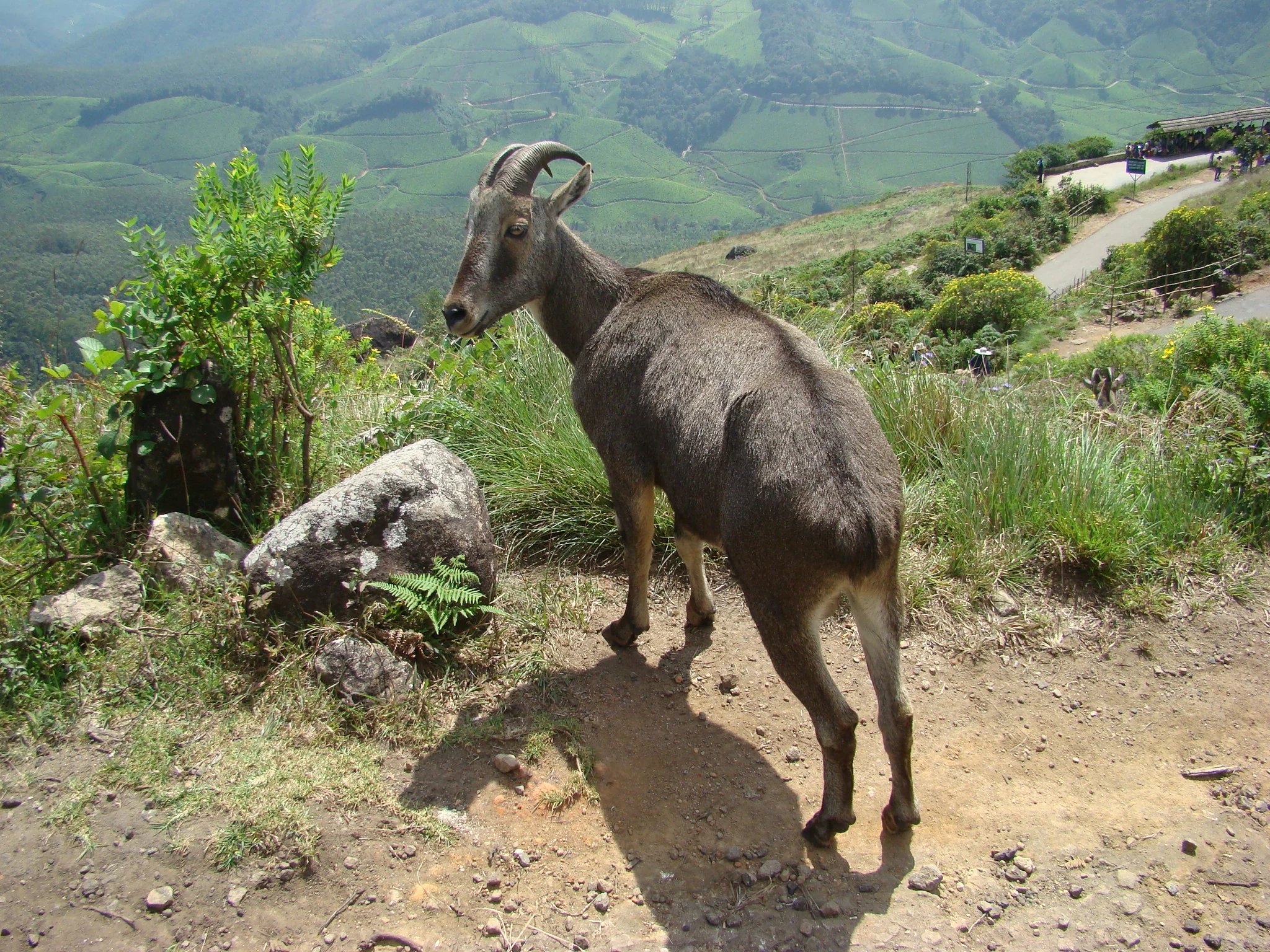
On the open grass slopes of Eravikulam National Park, a sturdy brown goat stands on a rock ledge and watches the visitors walk past. It is a Nilgiri tahr, an endangered mountain goat found nowhere in the world except the southern Western Ghats. Kerala Tourism says around one-third of all the tahr alive live inside this one park, which is why the park and the animal have become one story. That story begins, oddly, with hunting.
In colonial times the land was not a refuge at all. Kerala Tourism records that the High Range Game Preservation Association ran the area as a game preserve for the Kannan Devan Hills Produce Company, the tea company that owned these hills. A preserve kept game for the planters' guns, but it also kept the grassland itself from being cleared for tea, so the tahr's home survived the plantation years almost whole. That is why, when the Kerala Government took the area over in 1971, it inherited a high country still full of the animals it would later protect.
The protection came in steps after that. The state declared Eravikulam a sanctuary in 1975 and raised it to a national park in 1978, over 97 square kilometres in the Kannan Devan Hills. Most of that ground is high-altitude grassland, and the valleys and folds between the hills hold sholas, the stunted evergreen forests of the high ranges. The tahr needs exactly this mix, because it grazes the open grass and escapes onto steep rock. Above it all rises Anamudi, at 2,695 metres the highest point south of the Himalayas, which Kerala Tourism places inside the park.
Because the animal is so rare, the law guards it as closely as the park does. Onmanorama notes that the tahr, called Varayadu in Malayalam, is protected under Schedule I of the Wildlife (Protection) Act of 1972 and listed as endangered by the IUCN. So the Forest Department counts the herd every year, and the counts tell a steady story. Its 2022 census, carried out by 155 staff and volunteers over five days in April, found 785 tahr in Eravikulam, the highest number of any area surveyed. By the time the park reopened in April 2026, officials put the herd at 841, including 144 newborns.
Those newborns explain the strangest thing about visiting the park. The tahr give birth in early spring, and the presence of visitors would disturb the mothers, so the park shuts its gates each year for the calving season. In 2023 Onmanorama reported the closure as 1 February to 31 March, and in 2026 the park again stayed closed through February and March before opening on 1 April. Many of the births happen at Rajamala, which the Forest Department calls the primary habitat of the species. Rajamala is also the only part of the park that visitors may enter, so the calves are born in the very place that tourists walk the rest of the year.
The reason so many people make that walk is that the tahr here are not shy. Kerala Tourism places the park around 13 kilometres from Munnar town. Onmanorama reported in March 2025 that tickets were ₹200 for Indians and ₹500 for foreign nationals, booked online, and that the park opened from 8 am to 4 pm. When it reopened in 2026 it had a new medicinal garden of around 200 plant species, a rainbow bridge and photo points along the visitor route. Early visitors tend to see the herd grazing beside the path before the day warms up and the mist lifts off the grass.
The grass carries one more surprise. Neelakurinji, the shrub that flowers once in twelve years, grows in abundance across these slopes, and when it blooms the hills where the tahr graze turn blue. Our story on Munnar's twelve-year flower tells that side of the high country.
Frequently asked questions
Why is Eravikulam National Park famous?
It holds the largest wild population of the endangered Nilgiri tahr, around one-third of the world's total, according to Kerala Tourism.
When is Eravikulam National Park closed?
It closes each year for the tahr calving season. In 2023 and 2026 the closure ran through February and March, and the park reopened on 1 April.
How many Nilgiri tahr live in Eravikulam?
Officials put the herd at 841, including 144 newborns, when the park reopened in April 2026.
Which part of Eravikulam can visitors enter?
Visitors may enter only the tourism zone at Rajamala, about 13 km from Munnar town.