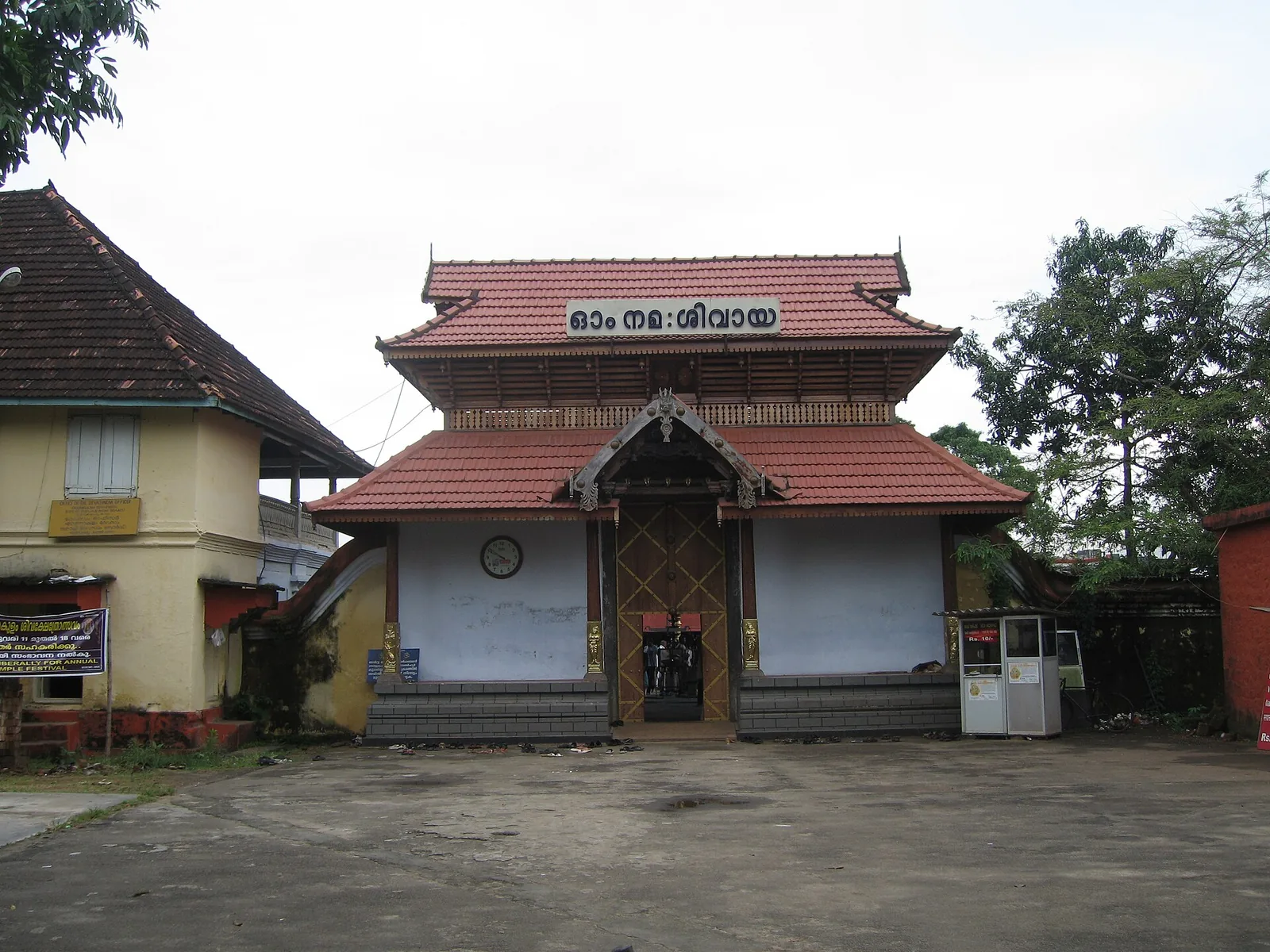
Kerala’s great temple festivals almost all happen in places built around a temple. Guruvayur, Thrissur, Tripunithura — the town exists because the shrine does, and when the festival comes the town rearranges itself around it without much friction.
Ernakulathappan is different, and that is the whole interest of it. This is the city temple of Ernakulam, on the mainland, a few minutes from Marine Drive and the Broadway shopping streets, surrounded by offices and traffic. When its festival runs, a full-scale Kerala utsavam takes place inside a working commercial district.
What that looks like
The Kerala festival form is fixed and it does not compromise for an urban setting. There is a flag-hoisting to open it. There are caparisoned elephants standing in line with the deity’s image, the nettipattam — the gold forehead ornament — catching whatever light there is. There are the percussion ensembles that are the real substance of a Kerala festival: melam and panchavadyam, built to be heard outdoors and to run for hours, tightening in tempo until the crowd is doing nothing but listening.
And there are processions, which is where the collision happens. A procession in a temple town moves through streets scaled for it. A procession here moves through a city centre, past shopfronts and parked scooters and people who came out for something else entirely.
The result is one of the more striking things you can stumble into in Kochi: a ritual sequence a thousand years older than the road it is happening on, moving through it at walking pace.
- This is the city temple of Ernakulam, in the commercial heart of the mainland, minutes from Marine Drive and Broadway.
- The annual utsavam runs over several days on the standard Kerala pattern: flag-hoisting, daily poojas, elephants, percussion and processions.
- Dates follow the Malayalam calendar and shift every year. Confirm locally rather than planning around a fixed date.
- Evening is the time to go. That is when the melam and the processions happen.
- It is an active Hindu temple; entry to the inner areas is generally restricted to Hindus, as across Kerala.
Why the temple is where the city is
It is worth remembering that the causation runs the other way from what you would assume. The city did not acquire a temple. Tradition holds that Ernakulam is named from this shrine — from Rishinagakulam, the pond of the serpent-sage, worn smooth over centuries of speech into the name the district now carries.
So the offices grew up around the temple, not the other way round, and the festival moving awkwardly through the traffic is the older thing asserting itself in a landscape that arrived later. The full legend is on the place page and it is one of the better ones in Ernakulam.
Visiting outside the festival
Most of the year it is a busy, working city temple with the ordinary Kerala rhythm — early morning poojas, a long midday closure, an evening reopening until the night pooja. Dress accordingly: mundu for men, with upper garments generally removed in the inner areas, saree, set-mundu or salwar for women; footwear and leather left outside; no photography in the sanctum.
Twenty minutes, in the evening, with the lamps lit, is the version most visitors will get, and it is a good one.
Frequently asked questions
What is the Ernakulathappan utsavam?
The annual festival of the city temple of Ernakulam, running over several days on the standard Kerala pattern — flag-hoisting, daily poojas, caparisoned elephants, melam and panchavadyam percussion, and processions. What makes it unusual is that it happens in the middle of a working commercial district rather than in a temple town.
When does the festival take place?
Dates follow the Malayalam calendar and shift every year, so confirm locally rather than planning around a fixed date. Evening is when the percussion and the processions happen.
What is melam and panchavadyam?
The percussion ensembles at the heart of a Kerala temple festival, built to be played outdoors and to run for hours, tightening in tempo through the performance. They are the substance of the festival rather than an accompaniment to it.
Is the city named after the temple?
Tradition says so. Ernakulam is held to descend from Rishinagakulam — the pond of the serpent-sage — the name attached to this shrine, worn down over centuries of speech. On that account the city grew up around the temple rather than the other way round.
Can non-Hindus enter?
As at most active Hindu temples in Kerala, entry to the inner areas is generally restricted to Hindus. Follow what staff tell you on the day, and expect a dress code at the gate regardless.
What should I wear?
Kerala temple dress: a mundu for men, with upper garments generally removed in the inner areas, and a saree, set-mundu or salwar for women. Footwear and leather items are left outside, and photography is not permitted in the sanctum.