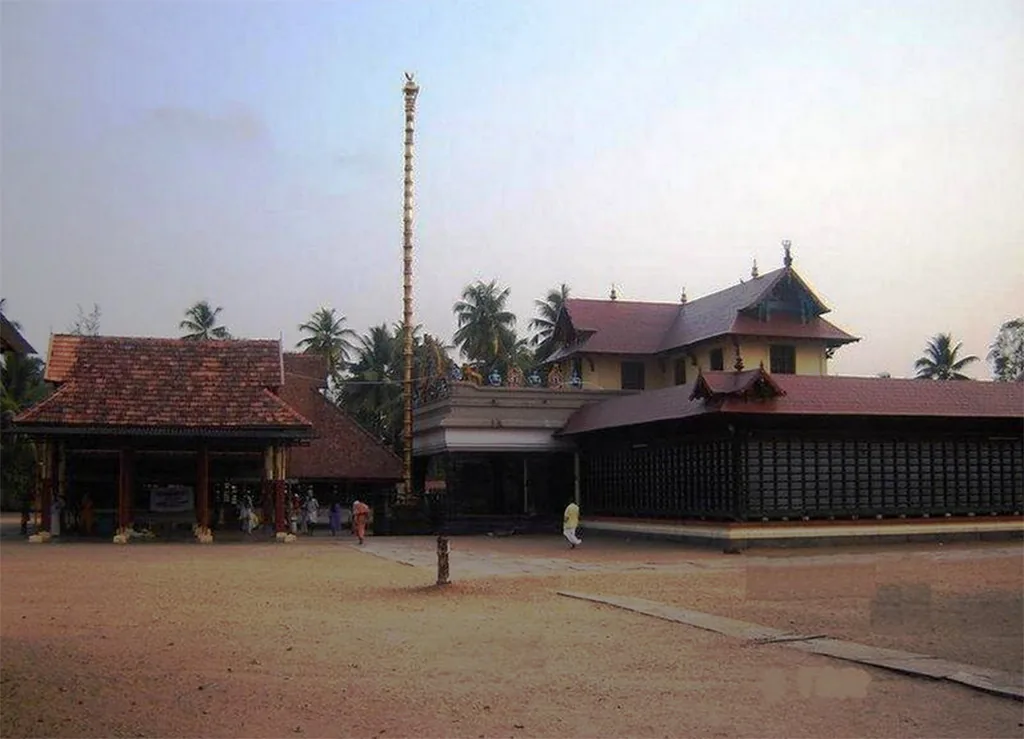
They call it the Dakshina Palani — the Palani of the South — after the great Murugan hill-shrine in Tamil Nadu. But Haripad Sree Subrahmanya Swamy Temple, in the heart of Alappuzha district, has an origin story all its own, and it begins not on a hill but in the water.
The town that dreamed the same dream
Legend holds that one night the leading families of the old town — then called Ekachakra — all had the same vision in their sleep: a divine idol, waiting to be found, out in the water. In the morning they went down together to the backwaters, and there, where a whirlpool turned in the Kayamkulam lake, they found him: an idol of Subrahmanya, Lord Murugan. The idol, the story says, was no ordinary one — it had been used in worship by Parasurama himself, the sage who made Kerala, before it came to rest in these waters. The townsfolk raised him up and built him a temple, and Ekachakra became Haripad.
The four-armed god
The Murugan of Haripad is unusual to look upon. Where the war-god is most often shown with a single pair of arms, here he stands four-armed: the divine spear, the Vel, in one hand; the thunderbolt, the Vajrayudha, in another; one hand raised in blessing, one resting at his thigh. It is a form that speaks less of the boy-warrior and more of the cosmic deity, and it marks Haripad out among the Subrahmanya temples of the south. Tradition places the shrine among the very oldest in Kerala — old enough, the devout say, to predate the current age of the world.
A temple built on a grand scale
Haripad is not only ancient but vast. It is the largest Subrahmanya temple in Kerala, and it wears a few quiet records: the longest golden flag-mast (dhwajastambha) of any Kerala temple, sheathed in gold and rising over the courtyard, and one of the largest temple tanks in the state — the Perumkulam, spreading across some five acres of still green water where the god was, in a sense, first found. To walk its grounds is to feel the scale of the devotion the whirlpool-god has drawn for centuries.
Visiting Haripad
Haripad sits on the main route through southern Alappuzha, close to the snake-temple of Mannarasala and the backwaters of Kuttanad, so it slots easily into a day of the district’s wonders. Come for a festival, or simply to stand before the four-armed god and picture the morning a whole town waded into the water to bring him home. Details are on the Haripad place page; more of the district is on the Alappuzha hub.
Frequently asked questions
What is the legend of Haripad temple?
Legend holds that the leading families of the old town of Ekachakra all dreamed the same dream of a waiting idol; at dawn they found an idol of Subrahmanya (Murugan) in a whirlpool in the Kayamkulam lake — an idol said to have been worshipped earlier by Parasurama. They enshrined it, and the town became Haripad.
Why is the Haripad Murugan idol unusual?
The deity is shown in a rare four-armed form, holding the Vel (divine spear) and the Vajrayudha (thunderbolt), with one hand in blessing and one at the thigh — distinct from the more common two-armed depictions of Murugan.
What is special about Haripad temple’s size?
It is the largest Subrahmanya temple in Kerala, known as the Dakshina Palani. It has the longest golden flag-mast (dhwajastambha) of any Kerala temple and one of the largest temple tanks, the roughly five-acre Perumkulam.