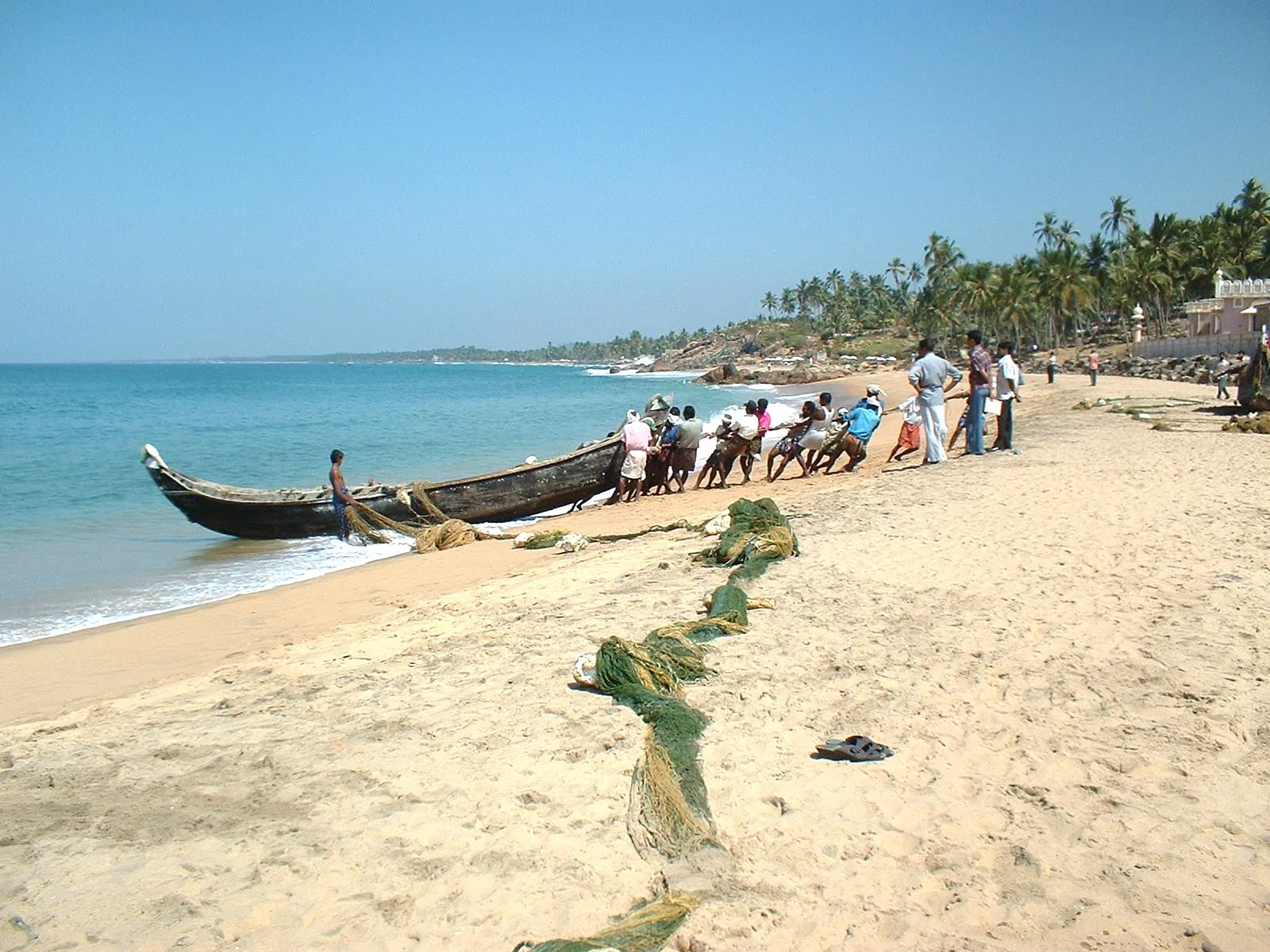
Two ropes lead from the sand into the sea. A boat has taken a net around a shoal; people ashore begin pulling it home. Kerala Tourism documents this work near Kovalam in a photograph of a beach haul. Behind the familiar holiday view is another use for the shore: a place where a fishing crew can turn a stretch of water into a catch.
The boat returns, and the beach becomes part of the gear
In a January–June 2023 report, ICAR’s Central Institute of Fisheries Technology describes the Kerala shore seine called kambavala or karamadi. One group keeps an end of the hauling rope on land. Another takes the net and its other rope out by boat, circles the fish and returns. Both groups then haul from the beach, drawing closer as the bag of the net comes in.
The movement explains why the ropes matter as much as the boat. A wide arc offshore gradually narrows into a landing on the sand. The report gives a broad operating duration of one to five hours. That is a description of fishing work, with its changing conditions, rather than a timetable for visitors.
What a neighbouring fishing centre revealed
Researchers at ICAR-CMFRI’s Vizhinjam centre studied shore seines at Poovar between October 2012 and September 2014. Their 2015 paper describes long net wings, towing ropes and a bag that concentrates the catch. It records shore groups hauling together while several fishers splashed the water to help drive fish toward the gear. This is a documented account from Poovar, a separate fishing centre farther south.
The researchers also looked closely at what came ashore. Sardines, anchovies and silver bellies featured prominently, but the catch included young fish. Juveniles accounted for 76.7% of the total catch in the study’s post-monsoon period. A haul could therefore tell two stories at once: food and income arriving on the beach, and fish removed before reaching a larger size.
The small opening with a large consequence
The 2023 Kovalam report brings the question back to the net. It discusses very small mesh in the bag and sets out ICAR-CIFT guidance to increase it to 22 millimetres, with square mesh helping juveniles escape. The researchers also describe beach seining as a declining, secondary livelihood option at Kovalam. Their concern is how the fishing method can support people while reducing the capture of small fish.
Look beyond the moment of the haul
On a Hawa Beach visit, leave room for boats, ropes and crews whenever work is under way. Ask before photographing people and follow requests to move. The Kovalam boat story follows another piece of this working coast.
If you encounter a shore seine, follow the whole sequence with your eye: the boat’s return, the converging ropes and the narrowing net. The memorable part is the connection between offshore knowledge and work on land. The smallest openings in that net carry the next chapter.