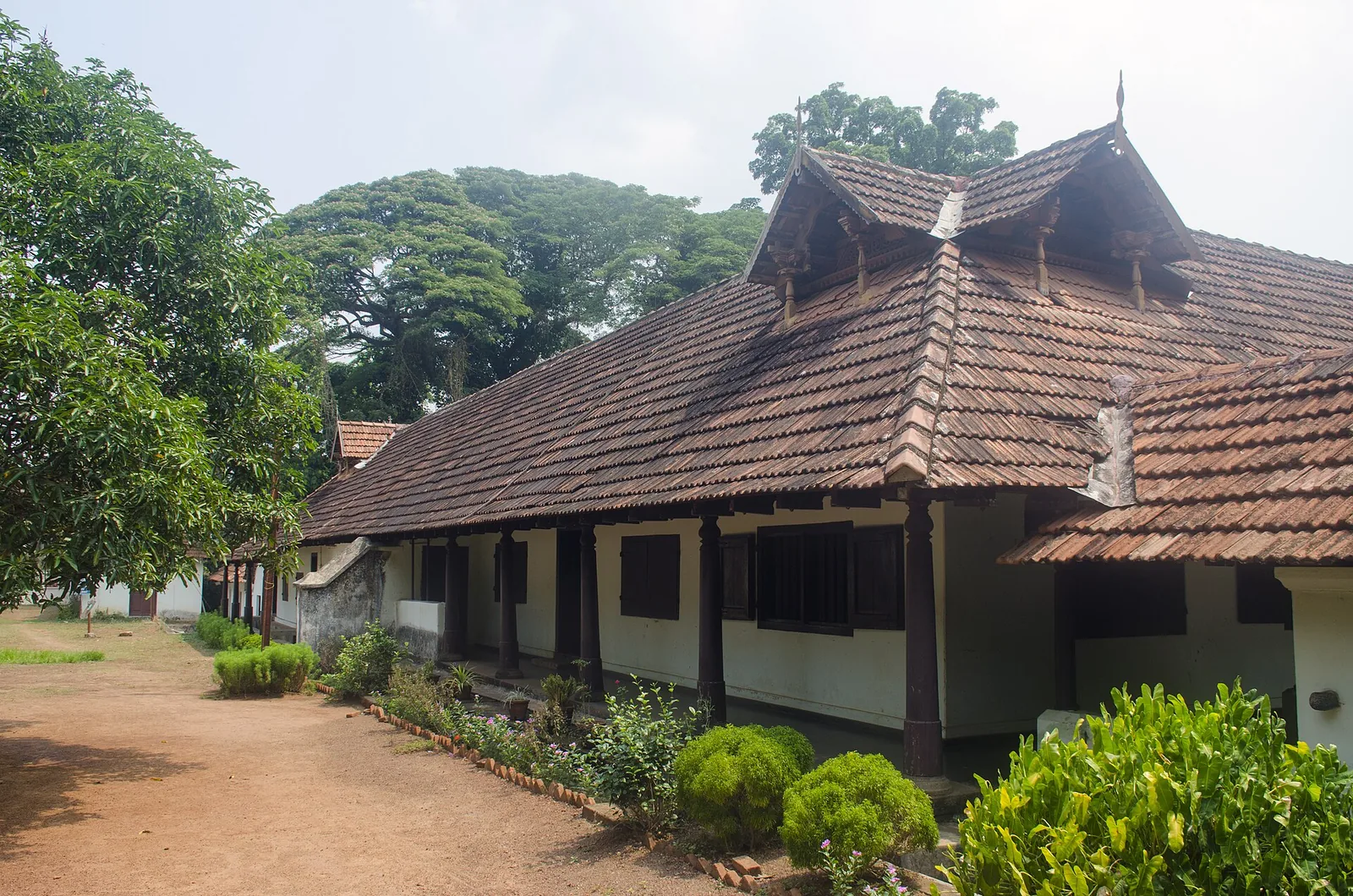
The staff at Hill Palace get asked one question more than any other, and it has nothing to do with the crown, the megaliths or the Cochin royal family. Visitors want to know where the locked room is.
There is no locked room. There never was one. The thekkini in Manichitrathazhu — the sealed chamber the entire film turns on, the image every Malayali carries — was a set, built inside a private house in Chennai.
Four places, one haunting
Fazil’s film, released on 25 December 1993, was shot across several locations, and the popular memory has flattened them into one building. Unpicking them is genuinely worth doing, because the result is stranger than the legend.
- Haripad, Alappuzha district — the real events the story draws on, in the Alummoottil family.
- Hill Palace, Tripunithura — most of the main narrative sequences. The house you think you are seeing.
- Vasan House, Chennai — the thekkini, the locked room, built as a set in S. S. Vasan’s residence.
- Padmanabhapuram Palace, Kanyakumari district — the climax, and the song everybody can hum.
So the most famous haunted house in Malayalam cinema is a composite: a story from Alappuzha, exteriors and corridors from Ernakulam, its central room from a studio owner’s house in Tamil Nadu, and its ending from a palace in a different state altogether. Not one of the four is haunted, and the one that gets the reputation is this one.
What Hill Palace actually gave it
Scale and texture, mostly, and that is not a small contribution. This is not one building but forty-nine, spread over fifty-two acres of terraced hillside — the entire working establishment of a princely court, built from 1865. It has the thing a single grand house cannot give you: depth. Corridors that lead to other corridors, verandas on pillars running the length of a block, wooden staircases, courtyards where somebody could plausibly be standing when they should not be.
A film about a house with something inside it needs a house you can get lost in, and Hill Palace is a campus. That is why it works on screen and why it has kept working — an enormous number of Malayalam films, serials and songs have been shot along these verandas since.
Walk it on a quiet weekday near closing and the effect is not subtle. The galleries are dim by museum standards, the grounds empty out, and the buildings go on rather longer than you expect. You can see the location scout’s decision being made.
The story underneath is real, and it is not from here
The screenplay was written by Madhu Muttam, and it draws on an actual tragedy: a killing in the Alummoottil family, near Haripad in old Travancore. An heir to the property and a domestic worker were murdered; a son-in-law was implicated. Around that, over the following decades, a considerable body of local legend accumulated — which is the raw material the film is really working with.
Muttam was connected to that family through his mother’s side, which is how the material reached him. It matters because it changes the category of the thing. Manichitrathazhu is not an invented ghost story that borrowed a nice old building; it is a piece of real family history from Alappuzha, dramatised, and then filmed a hundred kilometres away.
The association runs one way
This is the part worth being firm about. No tradition attaches Nagavalli, or any haunting, to Hill Palace. There is no folk belief here that predates the production. The film came to the building; the building did not supply the story.
What has happened since is that the film has supplied a story to the building, and it has been so successful at it that a state archaeological museum now has a fictional reputation more famous than its actual collection. That is a real and slightly melancholy cultural fact, and it is more interesting than a ghost would be.
What to look at instead
Having come out here, spend the visit on the things that are genuinely rare. The ceremonial gold crown of the Cochin Rajas and the throne are the headline and deserve the queue. But the gallery almost everyone walks past holds Kudakkallu and Thoppikkallu — the umbrella stones and hat stones of Kerala’s Iron Age — which are the oldest human structures you will encounter anywhere near Kochi, and are rarely displayed anywhere this well.
Then find the heritage museum arranged inside an ettukettu, the eight-block Kerala mansion, which explains how an aristocratic household actually functioned better than any amount of regalia. Our companion piece on the crown and the megaliths goes through the collection properly.
And then go outside. It is a museum with a deer park, terraced lawns and old trees, and treating it as a garden with galleries attached is the correct way round. Closed Mondays; allow two to three hours.
Frequently asked questions
Where was Manichitrathazhu filmed?
Across several locations. Hill Palace, Tripunithura, carried most of the main narrative sequences. The climax and the best-known song sequence were shot at Padmanabhapuram Palace in Kanyakumari district, Tamil Nadu. The thekkini — the locked room — was a set built inside Vasan House in Chennai, the residence of Gemini Studios founder S. S. Vasan.
Can I visit the locked room at Hill Palace?
No, because it does not exist and never did. It was constructed as a set in Chennai. This is the single most common misunderstanding about the site, and it sends a steady stream of visitors down the corridors looking for something that was built four hundred miles away.
Is Hill Palace haunted?
There is no local tradition of a haunting here, and none that predates the 1993 film. The building acquired its spooky reputation from the production, not the other way round. What it does have is a genuinely atmospheric campus of forty-nine buildings, which is why the location was chosen.
Is the Manichitrathazhu story true?
It draws on real events. The screenwriter, Madhu Muttam, based it on a tragedy in the Alummoottil family near Haripad in what is now Alappuzha district — an heir and a domestic worker killed, a son-in-law implicated, and a long afterlife of local legend. Muttam was linked to the family through his mother’s side. The dramatisation is his; the underlying case is not invented.
What else has been filmed at Hill Palace?
A great many Malayalam films, television serials and song sequences. The campus offers verandas, staircases, courtyards and an enormous amount of usable exterior, which makes it one of the most heavily used heritage locations in Kerala. Manichitrathazhu is simply the one everybody remembers.
What is actually worth seeing in the museum?
The gold ceremonial crown and throne of the Cochin Rajas; the megalithic gallery of Kudakkallu and Thoppikkallu, which is the oldest material anywhere near Kochi and is widely skipped; and the heritage museum set inside an ettukettu, which shows how a Kerala aristocratic household was actually laid out. Then the gardens and the deer park.