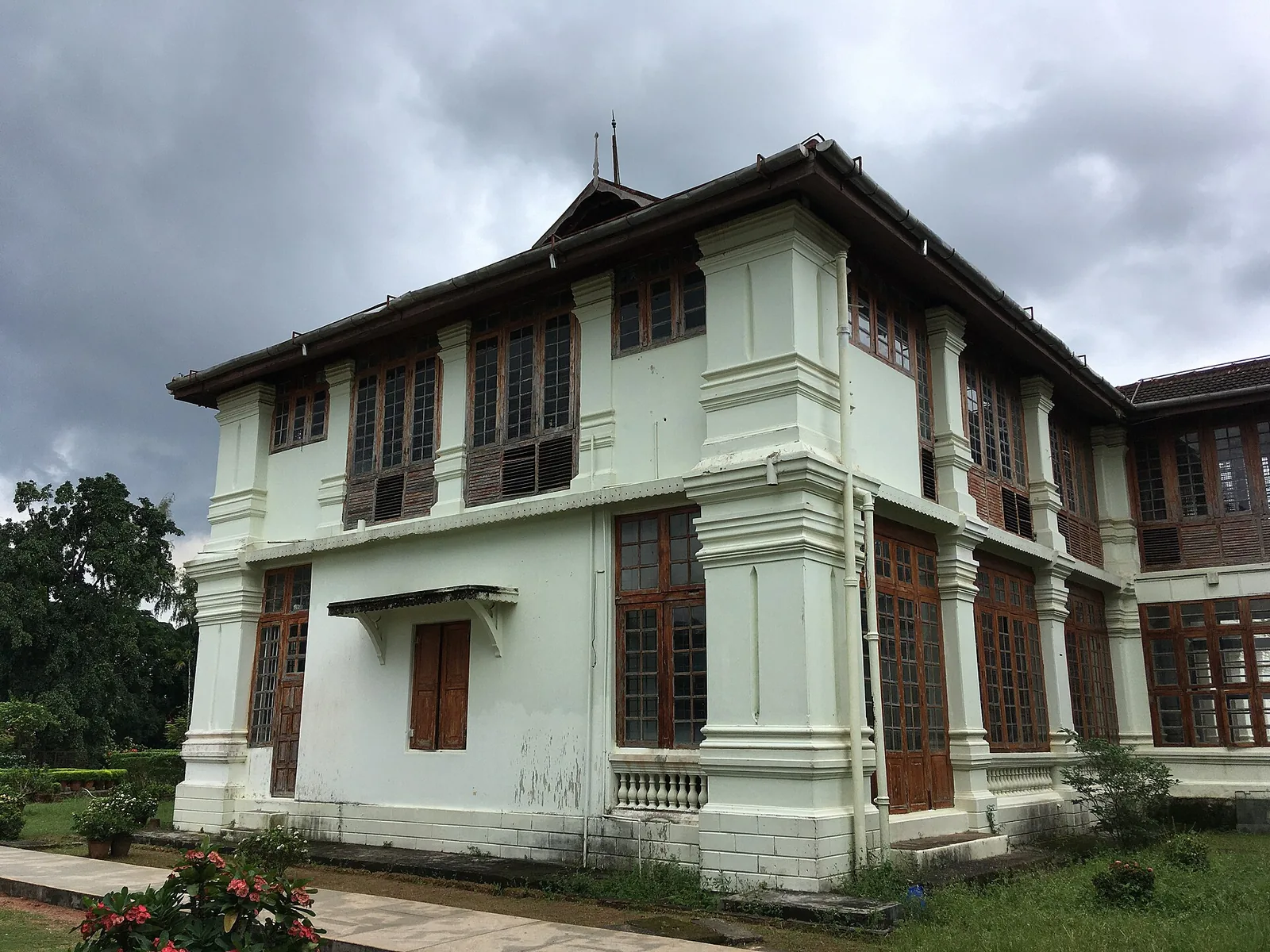
Climb the wooded rise on the eastern edge of Kochi and you arrive at a place that was never quite meant to be a palace at all. Hill Palace, the sprawling heritage complex at Tripunithura, began life as a humble royal office — and grew, building by building, into the official home of the Maharajas of Cochin and, eventually, into the largest archaeological museum in Kerala. Behind its steel-doored strongrooms sits a gold crown weighed in kilograms, and across its lawns wander deer beneath trees that have watched a dynasty come and go. The story of how it all came to be starts, of all things, with a prince who simply did not want to leave home.
A palace built for a homesick prince
The old capital of the Cochin kingdom lay at Thrissur, but by long tradition the royal women kept their household at Tripunithura — the queens and their retinue had lived here since around 1755, following the matrilineal custom by which succession passed through the female line. So it was in Tripunithura that the young prince Rama Varma grew up. When his turn came to be crowned, he found he could not bear to move away from the town of his childhood. Rather than shift the court to Thrissur, the royal establishment built him what he needed close to home: in 1865 a royal office, court and administrative block rose on the hill, and around it the seat of the Cochin Maharaja gradually took shape. A palace, in other words, born less of ambition than of homesickness.
Forty-nine buildings on a hill
What began as a single office never stopped growing. Today the complex counts forty-nine buildings scattered across some fifty-four acres of hilltop, the largest of them the grand two-storeyed palace at the centre. The architecture is essentially traditional Kerala — sloping tiled roofs, timber, cool inner courtyards — but the Cochin royals, long trading partners of the Dutch and the Portuguese, let foreign touches creep in: European tiles, imported fittings and, famously, one of the earliest lifts in the region, brought in from England for a family that liked its comforts. The result is a campus rather than a single showpiece, a small royal town where each building had its purpose and its residents.
The day the royals gave it away
India’s princely states were folded into the republic after independence, and the Cochin royal family’s vast palace slowly became more than a private household could keep. In 1980 the family handed the complex over to the Government of Kerala. The State Department of Archaeology took charge, spent years cataloguing and restoring, and in 1986 opened the doors to the public as an archaeological museum. It remains the biggest of its kind in the state — a whole royal seat, grounds and all, preserved not as a ruin but as a working record of the kingdom that built it.
The crown behind the steel door
The single object visitors most want to see sits in a high-security strongroom: a gold crown weighing around 1.75 kilograms, thick with precious stones. Tradition holds that this crown was a gift from the king of Portugal to the Raja of Cochin, a token of the alliance struck when Portuguese ships first reached the Malabar coast five centuries ago — though how much of the surviving piece is that original gift is a question historians treat with care. Alongside it the museum guards the rest of the royal regalia: ornaments, ceremonial swords and the simhasana, the carved royal throne on which the Maharajas of Cochin once sat. It is the closest most of us will come to the private treasury of a vanished court.
Fourteen galleries of a vanished kingdom
Beyond the crown, the palace is organised into around fourteen categories of exhibits spread through its galleries. There are oil portraits of the Cochin kings, sculptures in stone and marble, temple bronzes, epigraphic inscriptions and a rich collection of old coins that trace the region’s tangled trade with the Dutch, Portuguese, Chinese and Arab worlds. Cases hold ivory carvings, palace furniture, weapons, Chinese porcelain and even megalithic remains far older than the kingdom itself. Taken together the galleries read less like a treasure hoard and more like a biography of Cochin — its faith, its commerce and its everyday royal life set out object by object.
Deer, medicinal trees and open lawns
For many families the real draw is not indoors at all. The grounds hold a deer park where spotted deer graze within sight of the old palace, along with a prehistoric park, a children’s park and stretches of rare medicinal plants and trees maintained across the estate. On a warm afternoon the hill becomes a green lung on the edge of the city, and the walk between buildings — through gardens, under old canopy, past grazing deer — is as much a part of the visit as the exhibits themselves. It is one of the quieter open spaces near Kochi, and a favourite escape for locals.
Kerala’s favourite film set
There is a reason the palace looks familiar even to visitors who have never set foot in Tripunithura: it is one of the most filmed locations in Malayalam cinema. Its corridors and lamp-lit halls stood in for a haunted ancestral mansion in the 1993 psychological thriller Manichitrathazhu, one of the most celebrated Malayalam films ever made, and its buildings have since served as backdrops for many more. Generations of directors have found in Hill Palace exactly what they needed — the grandeur, the shadows and the sense of old secrets — without having to build a single set.
Visiting Hill Palace
Hill Palace sits in Tripunithura on the eastern side of Kochi, an easy drive from the city centre and comfortably combined with the nearby Sree Poornathrayeesa temple. Allow a couple of unhurried hours — the museum galleries reward slow looking, and the grounds, deer park and gardens deserve a wander of their own. The museum is run by the State Department of Archaeology and is closed on Mondays; check current timings and the modest entry fee before you go. For the full details, opening hours and directions, see the Hill Palace place page, and browse more heritage sites across the district on the Ernakulam hub.
Frequently asked questions
Why was Hill Palace built?
It began in 1865 as a royal office and court for the Cochin king Rama Varma, who had grown up at Tripunithura and preferred to stay there rather than move the court to the old capital at Thrissur. Over time the complex grew into the official residence of the Maharajas of Cochin.
What can you see inside the museum?
The star exhibit is a roughly 1.75 kg jewelled gold crown of the Cochin royal house, kept in a secure room. The galleries also hold the royal throne, ornaments, weapons, oil portraits of the kings, stone and marble sculptures, epigraphy, old coins, Chinese porcelain and even megalithic remains.
Is Hill Palace more than a museum?
Yes. The fifty-four-acre hilltop complex has forty-nine buildings, a deer park, a prehistoric park, a children’s park and grounds planted with rare medicinal trees, making it a popular outdoor outing as well as a museum — and one of Malayalam cinema’s most-used shooting locations.