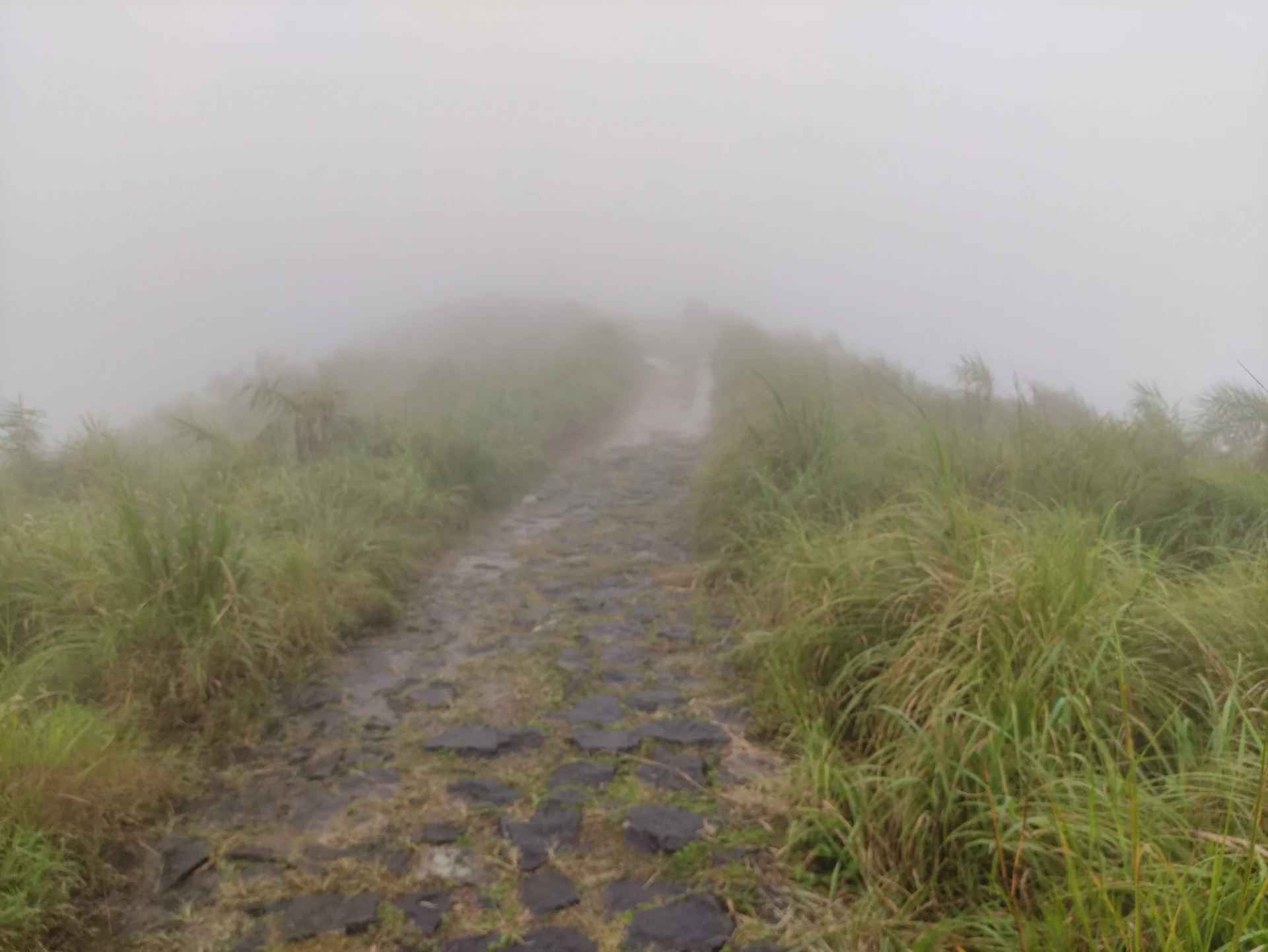
A stone-covered path disappears into white mist between tall grass. There is little distant scenery in the photograph, yet it says something important about Ilaveezhapoonchira. The hill is not always experienced as an uninterrupted panorama. Sometimes the meaningful view is the next stretch of ground and the line by which the group will return.
The foreground becomes the route
In clear conditions, a distant hill or mast may help orient the walker. When cloud closes in, those references can disappear while the ground immediately ahead remains visible. A route that seemed obvious on the ascent may then be harder to recognise at a junction or a broad patch of grass.
Keep track of the accepted walking line as you go, rather than relying on a summit feature to guide the return. Follow the local escort’s directions and shorten the outing if the continuation becomes uncertain. The goal is not to prove that a remembered path can be found through increasingly poor visibility.
The path’s surface also deserves attention. Loose stones, exposed slabs and grass edges demand different footing. A smooth-looking patch can be wet, while a stony section can move under pressure. Look before placing a foot and avoid trying to read the horizon while negotiating awkward ground.
Mist changes the photograph too
Cloud can simplify the scene into grass, rock and a faint line of path. That is a valid record of the visit rather than a failed version of the clear-day view. There is no need to walk farther merely to recover the panorama expected before arrival.
Use a secure stopping position if taking a photograph. The narrow route still needs to serve other walkers, and stepping into apparently level grass can conceal an uneven edge. A modest frame from the permitted line can show the conditions more honestly than an exposed attempt to find a dramatic angle.
Avoid separating from the group to wait for a gap in the cloud. The guide may be making a return decision based on weather developing beyond the immediate view. Staying together allows that decision to work for everyone.
The descent is part of the weather plan
An improving moment at the top does not guarantee the whole descent will remain clear. Keep enough of the daylight visitor window for the return and any agreed jeep collection. The transfer plan should still work if the walk is shortened.
Thunder and rapidly worsening weather are reasons to leave exposed ground, not to wait for a more spectacular cloud photograph. A ridge offers a view precisely because it is open; that exposure also affects the conditions a visitor must accept.
The district visitor guide introduces the scenic hill outing. On a misty day, let the visible path and current local advice determine its extent. The landscape will still be there for a clearer visit.
Plan the visit: Ilaveezhapoonchira trek.